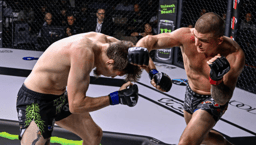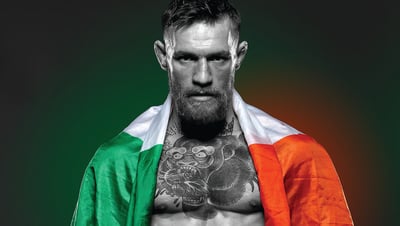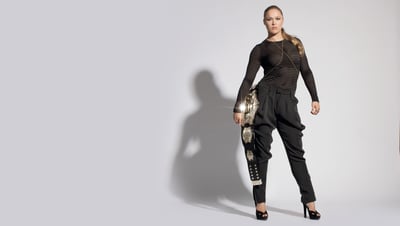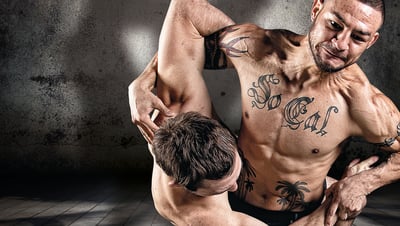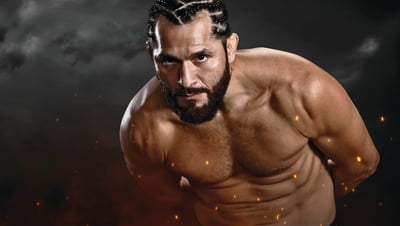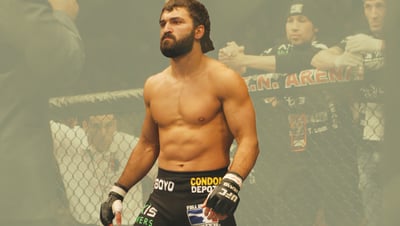

Jon Jones used the basic side kick to keep Vitor Belfort at a distance and finally tapped him out in UFC 152. Anderson Silva and Lyoto Machida have used the front kick to KO their opponents. This sport and the athletes have evolved, and yet simple techniques like the side kick and front kick continue to play a major part in fighting.
This brings me to the simple yet effective tools that I use to give the fighter one more round.
Boxing trainers used to use silver dollars to keep the swelling down on their fighters’ faces. Then someone created the endswell, an ice-cooled piece of metal with a handle, which has been used worldwide by trainers and cutmen. The stainless steel endswell works well, but it never made sense to me why it is flat when areas of the face like the eyebrows and cheeks are curved.
One night I woke at 3:00am with a new idea, I sketched a drawing of the KOswell that I use now. One side is flat like the original endswell and the other side is curved to fit perfectly on the cheeks and eyebrows.
The way to use it is to apply direct pressure on the hematoma, which is an accumulation of blood that has created the swelling. Properly used, it should control the swelling.
Never try to move the clot away, it won’t happen. That will move the clot to tissue that is not damaged and create more swelling.
Another simple idea is the tape that I use when I wrap hands in both boxing and MMA. A couple of years ago I met Ian Dixon, who created a line of athletic tape that has made a sudden impact in the safety of fighters. The half-inch strips are the first in the industry and eliminate having to rip the one-inch tape into strips.
When super middleweight champ, Andre Ward, broke his hand a week before his fight with Carl Froch in December 2011, he had some major concerns. As soon as I arrived in Atlantic City I went to Andre’s room, evaluated his injury, and wrapped his hand to see if he could fight with it. The tape, which I named ‘Stitch Premium Tape,’ did the job.
To see the smile on Andre’s face was priceless. He won the Super Six tournament and is still world champion.
Michael Bisping entered the dressing room for his fight with Brian Stann in UFC 152 and immediately told me he injured his hand in training. “I’ll give you a special wrap,” I said.
I secured his injured hand with extra tape and a tighter wrap. Bisping acknowledged his confidence by giving me a big smile and a hug.
In turn, seeing ‘The Count’ throw and connect right hands on the face of Stann gave me a smile knowing I made a difference.
Finally, there is Qwick-AID, the hemostatic gauze pad that I use in boxing and the UFC and stops bleeding in less than 45 seconds. Plus it’s 100% natural and does not require a prescription, which is perfect for those that cannot get adrenaline 1-1000.
I’ve tried other gauze pads and found they formed a clot when applied to the cut. The only problem was when I removed the pad from the cut it would also remove the clot and start bleeding again. When I was told Qwick-AID wouldn’t remove the clot, I was immediately interested.
You have to be careful trying anything new on a fighter. It can be the difference between a win or a loss. The first time I used Qwick-AID was with Wladamir Klitschko. Wladamir received a cut on the eyebrow from a head butt. I applied it, stopped the bleeding and the cut was never a problem. It worked as advertised.
Then I started using it in the UFC. You don’t have to be a veteran cutman anymore to work on a cut. Every trainer, fighter and gym should make this part of their equipment.
Like Jon Jones, Anderson Silva and Lyoto Machida, these simple tools have given me the edge.
It might sound like an infomercial for these products that I’ll be selling on my website, but my goal is to educate the cutmen, trainers, fighters and even the fans on how we can better take care of these modern-day gladiators
...