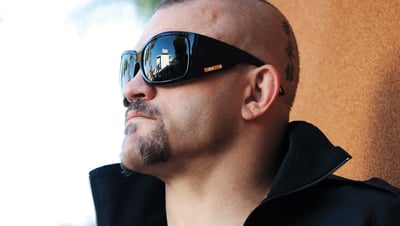

Renowned MMA trainer Martin Rooney extols the virtues of effective leg training, introducing a workout to power up your base.
The predominant style of combat that a fighter performs often molds his body into a certain distinctive shape. His body, therefore, can be seen as the product of the demands of the positions in which he has spent the most time.
When I started physically preparing fighters back in 1999, all of those fighters came from solely a Brazilian jiu-jitsu (BJJ) background. These fighters had spent a lifetime ground fighting from their backs in order to develop world-class technique.
As a result of the demands of this position, these original fighters forged powerful arms, backs and torsos from all of the pulling work required by BJJ. Their legs, however, all had the same deficiencies: small glutes, thin hamstrings and underdeveloped quads.
This lack of development was not only due to the fact there was a lower dependency on the strength of these muscles during pure jiu-jitsu, but also that big legs could actually get in the way of executing certain techniques and submissions.
When the BJJ athletes originally entered MMA, they enjoyed initial success taking other fighters down and finding submissions. But as the world-class wrestlers and strikers started to develop a submission game, takedown defense and became more well rounded in fighting styles, both MMA and leg training were forced to evolve.
Fighters like Fabricio Werdum heralded the next generation of fighters that originally came from a ground-based background. Yes, Fabricio has a world-class jiu-jitsu game, but he also has the strength, speed and stamina to keep things on the feet and slug it out with his opponents. This ability has a lot to do with the development of leg strength.
Before MMA fighters had become well rounded, it was a rarity to see jiu-jitsu fighters content to keep things on the feet and search for the knockout. Today, this is much more the rule than the exception. As the jiu-jitsu fighters like Werdum developed their standup and takedown defense game, they naturally had to realize that adding leg strength would enhance the results from the technical training.
During this discovery process, the legs evolved from a rarely trained area of the body to an essential weapon in a fighter’s arsenal to increase the chances of having his hand raised at the end of a championship fight.
The feet are the only part of the body connected to the ground when you are standing during a fight. This fact proves that the damage caused by the arms during a punch or the hips during a knee strike are a result of the power developed and transmitted from the legs. In short, weak legs will equal weak strikes.
In addition to striking, the legs are also involved in takedown-stopping sprawls and explosive throws. A fighter with tree trunks for legs is more difficult to uproot. In particular, the gluteal, quadriceps and hamstring muscles are essential to develop. All too often, whether due to a lack of interest or motivation, a fighter chooses to leave focused leg training out of his program.
MAKING THE RIGHT CHOICES FOR YOUR LEGS
As human beings, our ultimate freedom is in our ability to choose. When people ask me about how to become more successful in either martial arts or life, I simply instruct them to make better choices. Where you are right now in terms of fitness is a result of the choices you either did or did not make. Once you accept this responsibility, you will learn that your success or lack thereof will only be up to you.
When it comes to your aspirations, you are going to get one of two things: results or excuses. Unfortunately, most people end up with far more excuses for why they didn’t attain the fitness level they think they deserve. I am here to let you know that the difference between having excuses and results is just a matter of choice. In many cases (like leg training), you even know the right choice to make.
I am not going to lie to you. If leg training were easy, 'skinny jeans' wouldn't exist. I know most athletes prefer to work on the upper body instead of the legs. Even though you should now know a strong base is important, the lower body is often easier to skip. If you are skipping leg training because you can’t see them in the mirror, remember that choosing to train the legs more often can lead to increased performance and decreased chance of injury in the ring or the cage.
THE BEST LEG EXERCISES YOU NEVER CHOOSE
This is a leg workout comprised of leg exercises commonly left out of many routines. Since leg training can often be unbalanced and focus on only one of the three major muscles of the legs, this workout makes sure you develop the entire lower extremity.
For the first two exercises, perform four sets of six repetitions each.
For the final three exercises, perform three sets of eight repetitions on each leg.
1: HACK SQUAT
Pro tip: Throughout the lift keep your hips low, shoulders high, arms and back straight. Knees should point same direction as feet throughout movement.
A) Begin standing in a squat position with the barbell held behind the ankles.
B) Stand up by extending at the knee, hips and lower back. Lower the weight back down under control to the original position.
2: GOOD MORNING
A) Begin with the barbell across the shoulders.
B) Keeping the knees slightly bent and the lower back flat, bend at the waist and lower the weight until the torso is parallel with the floor. Bring the weight back up to the original position.
3: DUMBBELL SIDE LUNGE
A) Begin standing with the dumbbell held between the legs.
B) While keeping the toes pointed forward, lower the dumbbell to one foot. Return to the original position and lower toward the other foot.
4: BACK LUNGE
A) Begin standing with the barbell across the shoulders.
B) Step backward with one leg and lower the body so that the back knee almost touches the ground. Press the front leg into the ground and return to the start position.
5: BARBELL SPLIT SQUAT
Pro tip: Most weights gyms have them these days, but stay away from implementing squat pads into your routine as they can hinder your torso strengthening.
A) Begin standing in a split-squat position with the barbell held between the legs.
B) Lower the body and weight under control until the back knee almost touches the ground. Press with both feet, extend at the knees and return to the original position.
...