


issue 220
August 2025
Ray Klerck dives into fresh research that proves today’s MMA athlete isn’t just tougher. Instead, they’re adapting in ways the numbers can finally back up.
The real flex has never been the walkout. It’s how fast you can jump back into training before your gear’s even dry, so you walk away from the fight looking like you’re heading to a dinner reservation at Nobu. Yet scroll the mainstream takes, especially in the early days of the sport, and you’d think every MMA bout ends with a cast, a wheelchair, and a Netflix binge. Turns out, the new science published in Sports Medicine Open in June 2025 has receipts that tell a way better story. A 14-month Australian deep dive into MMA and Muay Thai tracked fighters after competition using the same high-grade monitoring the IOC uses for their Olympians. There was no clickbait KOs. No slow-mo blood sprays. Just cold, lean muscle data on how athletes absorb the grind and come back sharper. What they found says more about real-time evolution than attrition because these athletes act like rebooted Terminators, where the old survival playbook is about to be flipped on its head.
TRACKING THE BOUNCE-BACK
Forget that worn-out trope of fighters limping into obscurity after every bout. This new data paints a very different picture. Across 175 competitors, the research team logged everything that the fighters self-reported in the days and weeks after competition, following up until the athletes said they were training like their next opponent was already signed. The researchers didn’t just measure the big, fight-ending hurts. They locked into the most seemingly inconsequential details and tracked them with forensic detail. The tender left foot. The fading morning headache. The weird shin bruise. And here’s where it gets interesting because patterns started to emerge. Certain battle scars healed faster than expected. Curiously, some injuries barely slowed these athletes down at all. Instead of months on the sidelines, the clock on recovery often ran in weeks, sometimes days. These Darwinian upgrades are proving the modern fighter into reset-and-reload specialists before the fans have even had a chance to argue about the merits of an athlete’s strength of schedule.

BY THE NUMBERS
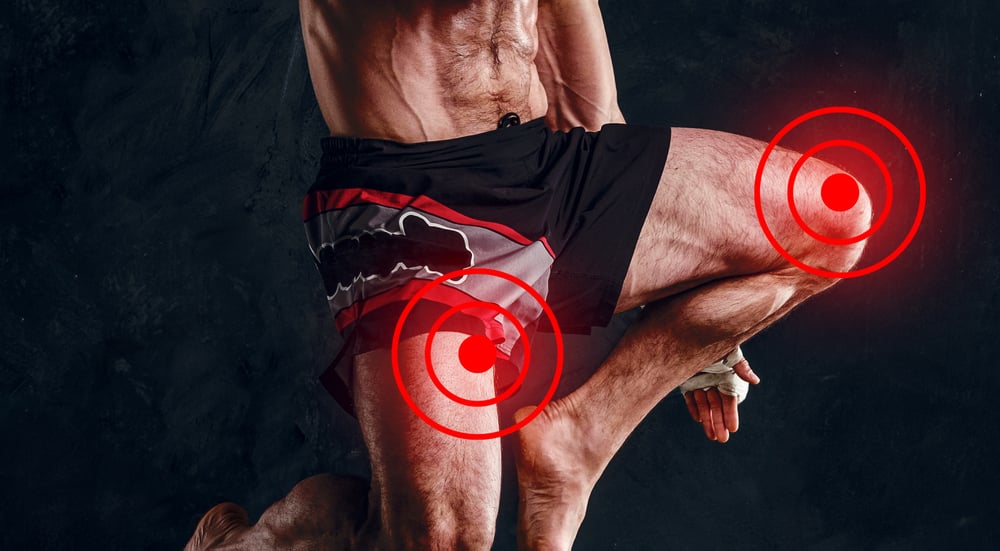
Stuck in the back seat of the strugglebus? Not these fighters. Of the 238 post-fight reports collected, nearly two-thirds of fighters, so that’s 61.3%, walked away with no health problems at all. Scarcely a rogue sniffy nose you’d blame on pollen counts. Even when something did show up, it was rarely the career-pausing kind. The median downtime for the most disruptive issues was 20 days for MMA and just 16 days for Muay Thai. The worst offender? Lower limb complaints topped the charts. They accounted for as much as 41% of all injuries, followed by upper limb (17%) and head/neck (16%). Most were superficial, like contusions (37.5%) and pain without any clear tissue damage (30.5%). Illnesses, which involved everything from upper respiratory bugs to plain fatigue, made up almost a quarter of all reported problems. Understandable considering their overall training load and proximity to other athletes. And despite the perception that the sport is dangerous, only 10% of athletes in the study were sidelined entirely from training because of a health problem. Compare that to the NFL, where injury incidence averages 34.4 per 1000 exposures and 41% of players lose time to lower-body injuries alone, and you’ll note that MMA’s recovery game starts to look like it’s almost running on cheat codes.
NOT JUST AN AUSSIE ANOMALY
These data sets aren’t just statistical pat on the back for the toughness of Australians, a gene pool that’s gifted us the likes of Alexander Volkanovski and Jack Della Maddalena. A July 2025, 43-study systematic review in the Orthopaedic Journal of Sports Medicine looked at injury rates across the entire modern era of MMA under the Unified Rules, and the trend holds. This research wasn’t a count-the-black-eyes bar napkin audit either. It was PRISMA-guided, data-mined, and bias-scored within an inch of its life. Post-2009, MMA competition injury rates still land between 23.6 and 54.5 injuries per 100 athlete-exposures. The overwhelming majority of these were soft tissue cuts, bruises, and the occasional awkward swelling, rather than career-wreckers. To put that in fight-fan math: in most cards, only a handful of fighters walk out with anything more serious than a 1990s ghetto limp that would be enough to keep them from training the following week. Which, if you consider the job is basically paid violence, is like clocking off with nothing worse than a stubbed toe and a good story.

WHY THE NUMBERS LOOK THIS GOOD
The review points to a sport that’s outgrown its smash-and-hope origins. Look at these two studies side by side, and you start to see a pattern where MMA is learning to protect its own. The Australian 14-month deep dive tracked fighters like Olympic lab rats, logging every shin that looked like it had lost an argument with a coffee table. The global 43-study review zoomed out to find a big picture revealing that most damage is surface-level, most recoveries are quick, and the sport’s biggest injuries are happening far less often. Why? More innovative training has put an end to the old “see who can send the other guy home in an Uber made for one” approach. Dialled-in weight-cut science is keeping athletes from hobbling into bouts where they’re already broken and depleted. Medical suspensions are enforced with the kind of rigor that makes a payday less tempting than long-term health. And recovery isn’t a side-hustle anymore. It’s treated as seriously as the training. On top of that, the rulebook itself is constantly being fine-tuned to keep fighters in the game. There have been bans on the nastiest strikes, tightening medical checks, and making sure no one is stepping into a bout unless they’re actually fit to fight. You could call it progress, but it’s really a coordinated shift where the coaches, medics, and fighters themselves are all pulling in the same direction. Together, the data says this isn’t just a few tough humans. This is a sport that’s become the world’s best at learning how to fight, heal, and fight again without leaving half its roster on the shelf. If you consider that back in the early 2000s, fight data reported in the Journal of Sports Science & Medicineshowed injury rates hovering at 28.6 per 100 fight participations, with 40% of bouts leaving at least one fighter injured. The latest numbers make the early 2000s look like the dark ages of duct-tape medicine. Now, instead of half the card heading home looking like they lost a bar fight with a lawnmower, most just need an ice pack, a protein shake, and a humblebrag on socials.
KEEP THE SHOW ROLLING
MMA’s real-time evolution is there to keep the fighters safer, which keeps the sport alive, loud, and in motion.
We’ve reached the age of professionalism where years of hard sparring, precision conditioning, and smarter training have sharpened techniques while turning the modern fighter’s body into something that can take a hit, file it under Tuesday, and jog on. It’s not magic, its real real-time adaptation, that you can call a warrior callus, where bones, muscles, and reflexes get conditioned to absorb the grind without breaking stride. It’s working for the sport because fans don’t buy tickets or tune in to watch highlight reels of people rehabbing in ice baths for six months. They want the rivalries. The rematches. The next grudge match on the calendar. And that only happens when athletes aren’t being chewed up and spat out by a hectic schedule. Because let’s face it, nobody wants to watch a last-minute shuffle between two guys who met in the warm-up room five minutes earlier. The real win is keeping the stars healthy enough to keep the storylines alive, so that MMA never slows thanks to a plaster cast getting in the way, and the only ice pack anyone’s talking about is the one chilling the post-fight beer.
...