


Issue 222
October 2025
Ray Klerck dives into the science of grip strength to reveal why missed chokes, lost scrambles, and slipped holds might be less about technique and more about physics.
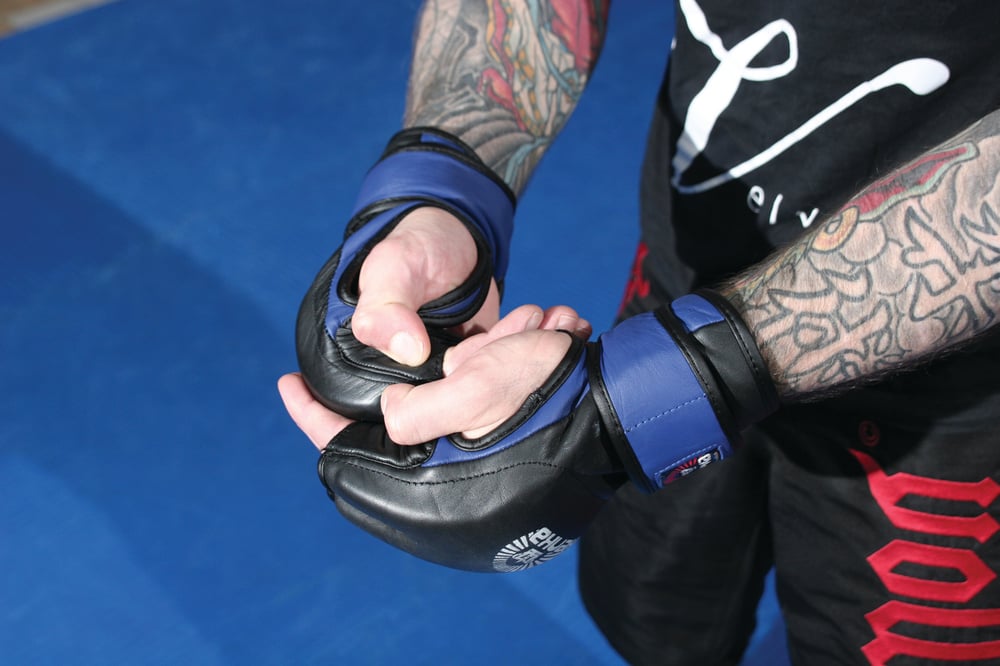
Grip strength is the invisible thread that holds every fight together, and right now it’s fraying fast beneath six ounces of foam. It’s something that dictates how you can hang onto a single leg, grab your own hand to finish a choke, or prevent someone from rag-dolling you. It’s the quiet power behind control, and there’s plenty of research linking grip strength to athletic performance and even longevity. Sure, grip strength is about as dull as watching cardboard exist, but it has a bearing on many MMA situations than the fans realize. Curiously, the same gloves that are built to protect a fighter's hands may also be stealing their hold. An August 2025 study in the Journal of Strength and Conditioning Research found that grip strength dropped by 23% when fighters wore their MMA gloves compared to when they used bare hands. It may be the difference between locking a guillotine and giving someone a polite hug. You could argue that both fighters face the same disadvantage, but here’s how and why you may want to turn it into an adaptive advantage.
PROTECTIVE SABOTAGE
If you’ve tried to pop open a jar after training, you’ll appreciate that grip fatigue is real. To measure this, the study authors had 14 trained MMA fighters grip a dynometer with and without gloves to reveal some cauliflower-eared differences that would make your forearms weep. Barehanded, fighters generated an average of 101 pounds of force. With gloves, that number dropped to 78lb of force. That 23% reduction is due to the padding restricting finger flexion and dulling tactile feedback, which are the micro-sensations that tell grapplers when a grip is slipping or locked in. Nobody should critique MMA gloves. They make the sport what it is today, but the researchers suggest that fighters should regularly drill their grappling techniques while wearing gloves. The more you get used to the loss of sensation in this space, the better you’ll be equipped to prepare for that discrepancy. If you consider the numbers posted by the pros, you’ll get a sense for how percentages matter. Here’s how they fared: Michael Chandler (113lb), Paul Craig (126lb), Bo Nickal (153lb), Stipe Miocic (131lb), Joaquin Buckley (107lb), Khalil Roundtree (166lb), and Alex Pereira (159lb). With fighters higher up the food chain pushing bigger numbers, you can see how a percentage decrease may impact the fight outcomes if they’re not accounted for. While these numbers may seem impressive, they’re pretty low on the pro-athlete pecking order. Research found that MMA fighters averaged about 101 pounds of grip strength, while baseball players topped the list at 126 pounds, football players hit around 121 pounds, and basketball players averaged roughly 110 pounds. Despite boasting the greatest trunk flexibility and aerobic capacity in the research, MMA fighters lag in raw grip strength because their strength is spread across multiple demands, including striking, grappling, and conditioning. The other sports often see it funneled into a single repetitive action, such as throwing, catching, or tackling. Add gloves into that mix, and you’re starting every clinch with a handicap tighter than a sauna suit.
HANDBALLED PERFORMANCE
While this is the most recent research on the topic, it’s not the only time scientists have tried to explain why some fighters hold on like pit bulls and others like politicians to campaign promises. A paper in the International Journal of Environmental Research and Public Health looked at pro and elite MMA athletes and found the biggest difference-makers weren’t in their fingers — they were in the frame. The standouts showed superior upper-body pushing power and lower-back isometric strength. Heavyweight elites benched more weight and braced harder through their lumbar muscles than lighter or lower-tier fighters, and those two metrics rose together. A strong chest means a strong trunk. In elite-level MMA fighters, this marriage creates a pairing that keeps frames solid, grips steady, and chokes from slipping when a fight turns messy. It’s safe to say that handgrip strength alone can’t separate the winners from the losers. However, it can illustrate how grip strength runs like an electrical current through the forearms, shoulders, and spine.
THICKENING THE FIX
If gloves dull a fighter's grip, using a wider grip during training may sharpen it. A study in the Journal of Strength and Conditioning Research tested lifters using Fat Gripz – a thick rubber sleeve that transforms a standard barbell into something resembling a forearm-wide pipe. Using a fatter grip, which in many ways resembles the effects of an MMA glove, lifters' strength declined across all major lifts, such as deadlifts, rows, and pull-ups, but their forearm activation increased. Training with a fatter grip made things harder, like swimming through peanut butter. But that’s the point. The thicker handle forces more neuromuscular engagement from the smaller stabilizer muscles that gloves might mute. And the payoff doesn’t take very long to kick in if you train for it. Other research found that 8 weeks of thick bar resistance training created gains in both handgrip strength and even bench press performance compared to normal thin bars. The fat-bar lifters pushed heavier and squeezed harder. You don’t want to be pushing weights in your gloves, but using a fatter grip for barbell pulls, towel pull-ups, or farmer’s carries can help rebuild the tactile strength that the gloves might take away. Okay, you’re going to lift a little less, but that’s in the short term, and long term, your hands and forearms will learn to talk to one another. And while their love language is often pain, it’s the kind of conversation that ends with your opponent tapping, not slipping. And if you want to take it to the next level, then try to hit 2-3 minutes on a dead hangfrom a pull-up bar. It’ll power up your grip strength and also lengthen all the muscles in your spine.
WEAPONISED WRISTS
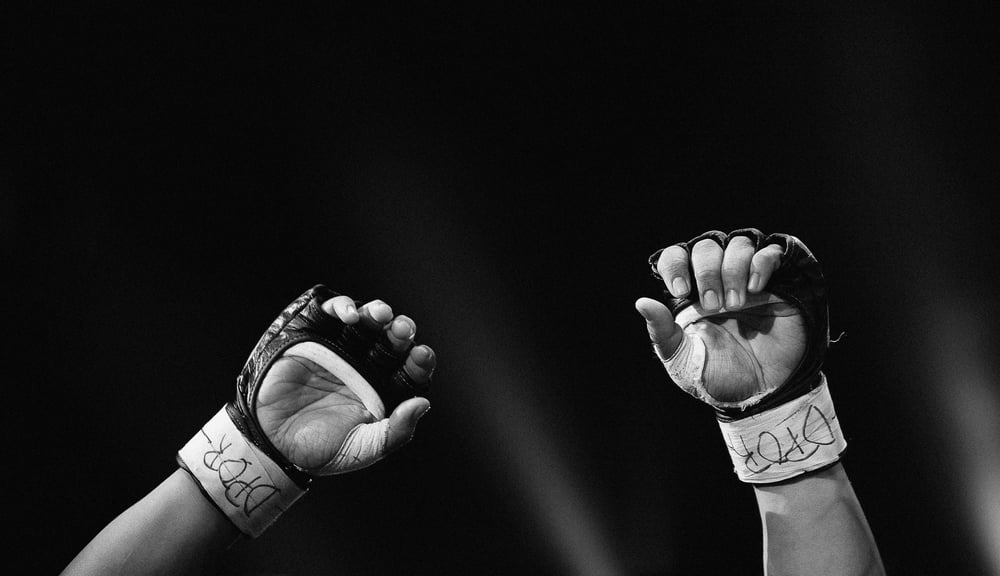
As a fighter, your hands are your weapons, and your wrists are the dodge holsters that hold the arsenal together. It’s worth shoring them up because ignoring this hinge is like bringing a wet noodle to a gunfight. A study in Medicina examined the addition of wrist stability exercises to simple grip training, which resulted in a reduction of wrist pain, improved function, and a 30% increase in grip strength over four weeks. It did this far better than those who visited a physio and a massage therapist. The program was simple. They performed light dumbbell holds, banded wrist flexion and extensions, and grip-ball squeezes twice a week, completing two sets of 10 reps each - basically, toddler toys for violent adults. For a fighter, that’s the kind of low-effort, high upside fix you can slip in between your sets without gassing out. You can even do it while you’re watching TV and just relaxing. A few squeezes, a couple of light band reps, maybe a 30-second dumbbell hold with a neutral wrist, and you’re away. It fires up your stabilizers that protect those joints, steady your punch, and lock in your submissions a little tighter. Think of it as a tune-up for the hinges that hold your weapons together.
GRIP HAPPENS
Grip strength matters in a sport where it’s incredibly difficult to get hold of your opponent, thanks to skintight gear, sweaty palms, and an opponent who will act like an eel covered in olive oil. Losing 23% of this attribute might be the inch that keeps the choke from holding. Grip strength isn’t about crushing power, it’s a type of endurance, stability, and sixth-sense awareness that may get dulled by the protective equipment you need. If you want to be a better fighter, then you can go beyond your fists. You can train your fingers, forearms, and wrists because these are the components that contribute to the power of your punches. Do it between sets, on off days, or while you’re catching your breath. The fix isn’t complicated, and the payoff is control. While strength might win moments, grip can win minutes, and minutes can win legacies
...