

issue 223
November 2025
Ray Klerck dissects the new science around the biomechanics of why elite fighters KO harder and how their legs start the fight that their fists finish.
Knockout punches have an underappreciated backstage crew of underpaid stagehands pulling the strings that do all the legwork. Novice fighters are the masters of this theatrical catastrophe as they try to make their fists do all the work, while their feet miss their cues. However, a new Ukrainian study has just brought the truth about KO punches into the spotlight, finding that the arms are almost decorative and real power starts on the floor, climbs through the hips, and unloads into an opponent’s face, in what the scientists call a “wave of effort.” On a side note, this is curiously one of many recent MMA-specific studies emerging from war-torn Ukraine that seems to make time for MMA research. Back to the knockout blow. The defining element of this research is that in MMA, the power to end a fight with a definitive blow is not in the hands of the fighters. It’s how well their toes walk up the torso.
FROM STAGECRAFT TO SCIENCE
The science tells a story about KOs that may change the way you look at replays. New understandings about striking biomechanics began to emerge thanks to a seminal 1985 paper, which revealed that elite combat athletes generate 6-80% of their power from their legs and trunk, rather than their arms. The Ukrainian study, built on an established scientific consensus, found that when it comes to elite pro MMA fighters, around 42% of a punch’s firepower loads up from the legs, while 39% comes from the torso, and just 24% comes from the arms. It’s a physics lesson that chuckles at the mirror muscles that uninformed people might think make a fighter dangerous. For beginner MMA fighters, a different story is told about the KO punch. Their legs contribute as little as 16%, leaving the rest of their muscles, such as those in the torso and arms, to awkwardly scratch around to generate the other 84% of power. Their punches might look busy, but they will probably feel like they’re issuing an apology on arrival. The researchers refer to this as “a break in the wave of effort,” when the chain of movement collapses halfway up a fighter’s body. Once that wave crashes out, the power stops transferring forward and starts to leak sideways. Every weak link in that chain is a thief that steals the punch’s ability to become a KO.
THE COILED SPRING EFFECT
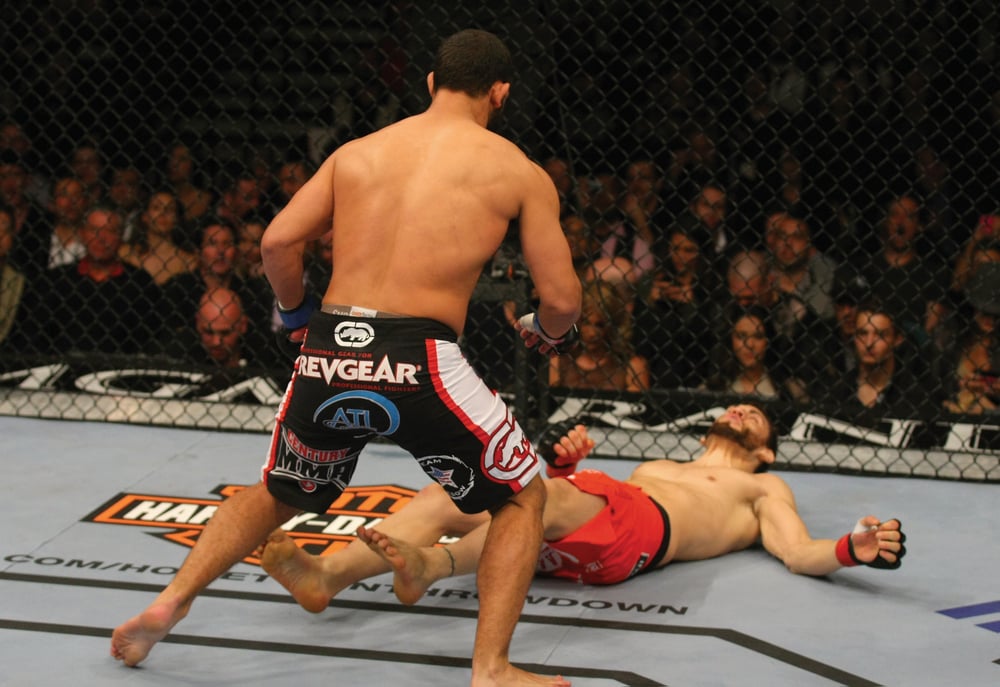
A knockout punch is less straight line and more like a loaded spring. When the body coils up, it stores that energy in the same way a bow holds tension that gets transferred into the arrow. The legs twist, hips rotate, and the torso winds up, turning a fighter into a human corkscrew that’s ready to pop. It’s this spiral motion that allows fighters to turn their bodyweight into speed in this wave of effort, which is really just a mechanical chain reaction. This refers to the percentage of your body weight that you can transfer to the target, which depends on how quickly you can generate force, a factor tied to jumping and squatting power, according to research published in the Journal of Strength and Conditioning Research. The legs plant and twist. The hips drive. The upper body rides the wave to release the power. If there’s a missing link in that rotation, the KO punch turns into more of a friendly shove. All of this is done in milliseconds, which elite fighters learn to time so that the release fires each joint in a sequence that generates torque that electrifies through the body. The result is the skull-cracking punch nobody saw coming. However, it’s one a fighter feels from the ground up. The good news is that you can finesse this coordinated effort through the correct type of training.
THE KO TRAINING CHAIN
Fortunately, KO power is well-researched and is something almost everyone should stockpile to carry in their back pocket, just in case you might need it on a rainy day. The scientific consensus is that compound, multi-jointed exercises are the most effective for this, and you should focus on high-quality, quick reps rather than doing bodybuilder-style volume. These moves that tick all the boxes are the deadlift, jump squat, and rotational shot put. They cover every segment of your punching power chain and are the kinds of things that translate directly into better athleticism in almost every sport.
HEAVY HEX BAR DEADLIFTS
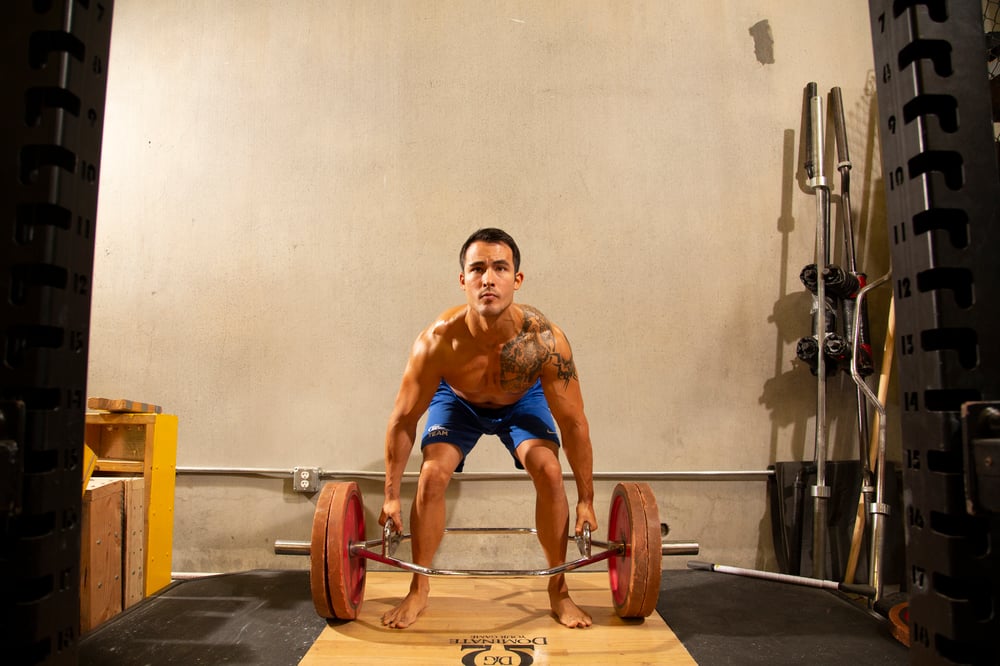
The KO punch had a spirit animal; it would be this move. It’s all hips, legs, and unapologetic grunt, which is why it’s considered the world’s best exercise at helping athletes sprint faster, says a paper in the Journal of Strength and Conditioning Research. So, whether you plan to run to or from the fight, this is what you should do, as it helps you stay upright, load heavy, and push through the floor. Scientific reviews on punch biomechanics consistently recommend emphasizing maximal strength development of the legs as the base that will improve overall punch impact force. Completing three to four sets of 3–5 reps at around 80–90% of your one-rep max (an RPE of 8–9) will do it. Rest long, say three to five minutes. If you’re not slightly reconsidering your life choices halfway through the set, you’re not lifting heavy enough.
How to do it. Step inside the bar with feet hip-width apart and hinge down with your back flat. Drive your feet through the floor, maintaining a tight core, and powerfully extend your hips and squeeze your glutes at the top of the movement.
LOADED JUMP SQUATS
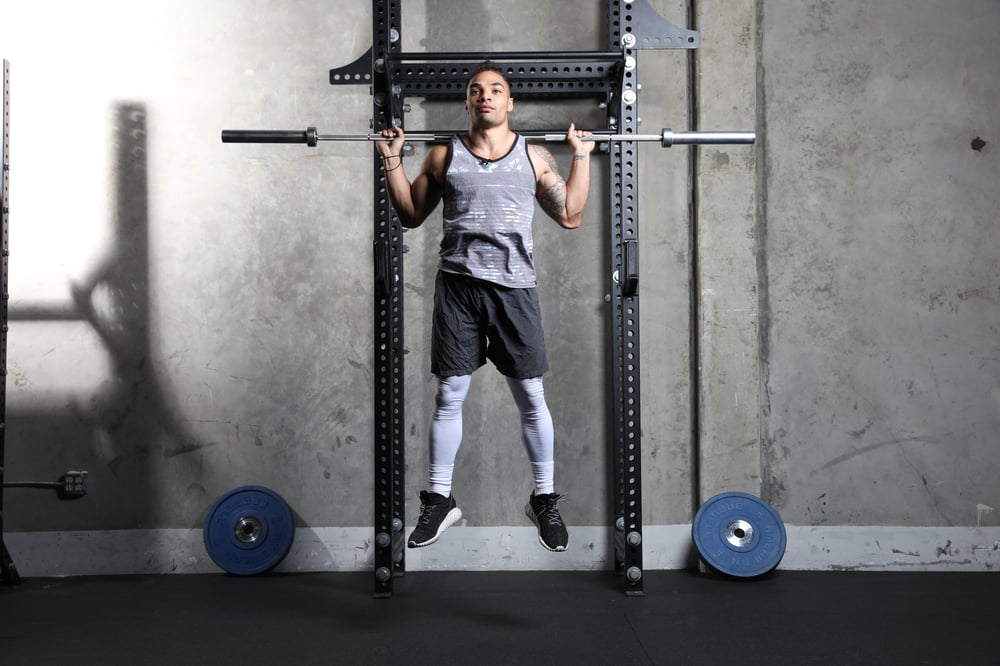
Once your foundation has been poured, the loaded jump squat trains your system to release that force explosively, while targeting all the joints that matter, such as the ankles, knees, and hips. This directly improves the Rate of Force Development (RFD) required for a KO punch's lightning-fast acceleration. Studies on elite boxers confirm this, showing that performance gains in exercises like the jump squat have an "effective transference" to punching impact force, boosting it by approximately 8%. They even tested it against exercises like the bench press, which people would imagine is the big hitter, but it didn’t even come close. The key here is speed. This means you should do 3–5 sets of 3–5 repetitions using a light load (ideally 30–40% of your one-rep max) with a barbell or hex bar, so that you do each rep at max speed. You should rest for 90–120 seconds between sets to let your explosive energy recuperate.
How to do it. Load up a barbell on the back of your shoulders or hold it in your hands if you’re using a hex bar. Dip quickly into a quarter-squat (or slight knee bend), then instantly reverse direction. Explode upward with max force so that your feet leave the ground. When you’re in the air, your ankles, knees, and hips should all be locked out before you land softly.
ROTATIONAL MEDICINE BALL SHOT PUTS
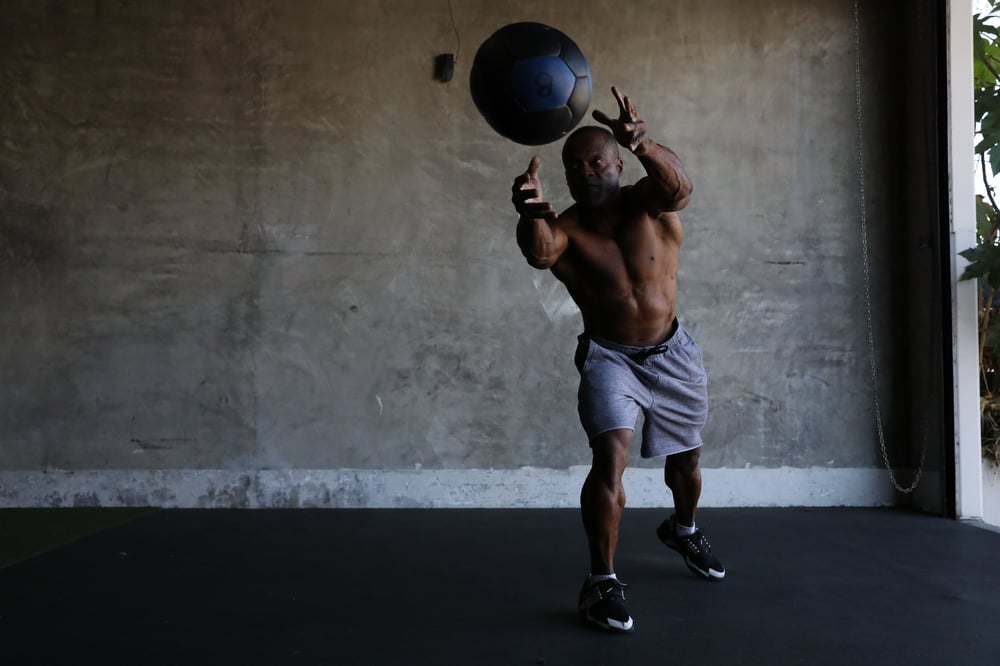
This is the moment your body finally learns to talk to itself. The Rotational Medicine Ball Shot Put is where the floor’s power gets passed up the chain, whipped through the hips, and fired out of the upper body like you’re trying to take out a load-bearing wall in your gym. It’s the closest thing to a KO punch you can train without breaking your knuckles. You should feel a non-decelerated rotation that teaches your glutes, obliques, and trunk to behave like a single coiled spring. These are one of the most widely studied tools that are beloved by sports scientists because they build angular power that transfers to everything rotational: hooks, crosses, golf swings, javelins, and even lifting heavy shopping bags.
How to do it. Grab a light med ball (4–8 kg) and hit 3–4 sets of 4–6 reps per side. Drive off the back foot, snap the hips, and release with bad intentions. Rest 60–90 seconds, switch sides, and repeat until the wall knows your schedule.
PUTTING IT ALL TOGETHER
When you get this chain working in harmony, your punches stop being a noisy arm exercise and start behaving like a proper full-body action. There’s nothing mystical at play. There’s just force traveling in the correct order instead of leaking out of every joint like bad plumbing. Your legs load, the hips turn, the torso follows, and the fist simply arrives last to sign the finishing paperwork. Your coach will tell you all of this, but knowing the research behind it can be influential in your understanding of why. Anyone can build this if they train the sequence instead of worshipping their biceps. Stay patient, keep the reps crisp, and let the floor do its job. With enough practice, your KO punch won’t feel heavier; it’ll feel inevitable.
...