

issue 223
November 2025
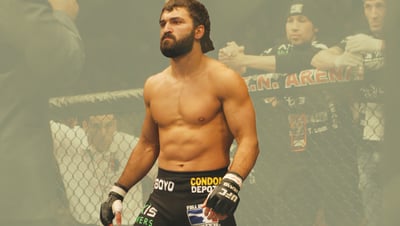
Ray Klerck dives into the science showing that the most formidable opponent in MMA isn’t a fighter, it’s your own stress responses that may be ruining your performance.
Stress is the ever-present threat that slips past your guard without warning. It’s a puller of almost undetectable, yet negative, levers that MMA fighters are utterly unaware of, says fresh research in the American Journal of Medicine and Medical Sciences. It’s something every fighter will unquestionably feel but may not be aware of, because when the gloves are on, deep-rooted biological switches get flipped that no amount of mitt training can prepare anyone for. This research outlines how an MMA fighter's physiology responds to sparring and fights as if they were life-threatening events. Breathing changes. Vision narrows. Clear thoughts get overrun by instincts. Seasoned fighters do react differently to this stimulus because after years of conditioning, they’re able to turn threats into something mundane, and the body responds accordingly. Here’s why in MMA, stress might be relative, but those who control are better poised to become masters of their craft.
THE NUMBERS ON THE INSIDE
When you look at the data on MMA athletes’ cortisol levels, a big chunk of the room is already on the back foot long before the first exchange. In a study of 136 athletes, 1 in 4 was diagnosed with autonomic nervous system tension. This is a fancy way of saying that their stress-regulation mechanisms were already under strain, which reduced their ability to adapt as an MMA fighter. It’s as if they were already struggling before anything fighting even happened, and their body was saying, “This is too much!” Another 10.3% of them were stuck in sympathetic overdrive, meaning their nervous system’s alarm bells were set to DEFCON 1, even when they were just chilling. The research outlines how this state would make it harder for them to remain calm, breathe properly, and recover between intense training efforts. It meant their cardio was going to be sub-par almost all the time because they struggled to find calm. On the flip side, 25.7% were nearly too relaxed. Their bodies found it tricky to switch on when training hit high speeds, so they couldn’t keep up their intensity when it counted. Fortunately, it was the 64% who straddled that precious middle ground who were able to go hard, settle down, and then rev back up without their stress responses falling apart.

WHO CARES?
So, what does the fact that some guys are more stressed than others mean to a fighter? Well, stress isn’t a flaky emotion. It’s a hidden performance variable. Fire up too early, and you gas out. Fire up too late, and you just get punched out. Fire up in balance, and you become a fighter who gets the most out of their skill set. Fighters are battling their own unique constitutions long before they face their opponent. These imbalances can be thanks to overtraining, where their body is pushed past its limits, leading to misfire across their hormones, mood, and immune systems, according to July 2025 MMA-specific research in Scientific Reports. Overtraining is something often seen in endurance athletes, who carry the kind of obscene training load that so many MMA athletes also wear. That’s part of the reason why triathlons are easy meat for the guys like the Diaz brothers. In the research, they found that stress hormones like cortisol spiked after the first week of training and stayed elevated until they gradually decreased in week three. What turns these kinds of things around are the boring basics, like simple lifestyle fixes that include sleep, nutrition, and calmer training blocks.
FIXING IMBALANCES
Fortunately, you don’t have to wait until you’re broken to act. Research shows that you can use heart-rate variability (HRV) to gauge how your autonomic nervous system is coping with your training and resulting stress load. It’s nothing new and has been used by sports scientists to track adaptation or the lack thereof across training cycles. Back in the day, it was a trek to figure out your HRV, but now your Apple Watch handles it all. It’s worth keeping track of because fight-day stress hits MMA competitors especially hard. In a Biology of Sport study, 100% of MMA competitors showed a clear drop in HRV and a rise in cortisol before competition. The body is anticipating the fight and already producing cortisol in response. Fighters are unique athletes because, unlike runners or even contact team sports, they carry more stress than any other athletes, says the research. Training your stress response system can help get it in the right place, because someone with a balanced autonomic nervous system isn’t lucky. They’re conditioned. They’ve trained themselves to adapt. Switch off. Switch on. They don’t rise to the level of their skills. They rise to the upper limits of their stress control mechanisms.
TRAIN THE SYSTEM THAT HOLDS YOU TOGETHER
If your stress can tilt the pivotal moments in a fight, then it’s a hidden system worth training with the tried-and-tested techniques you should add to your schedule to get the best results from your skills. Try adding these science-proven techniques to your training routine to keep your stress hormones in balance.
Own the five minutes before an everyday stressful event. These stressful minutes, which may come before a meeting, a big presentation, or a tough conversation, are the perfect training ground that mimics a fight or sparring session. Researchsuggests that building a pre-stress routine for the anticipation window is valuable rehearsal time that helps your nervous system stay calm on command.
Train to stay steady in unfamiliar territory. A paper in the Sport Psychologist says that fighters found their performance depended on their arousal as much as on their technical skills. To train this, you should add at least one round per session where the goal isn’t output. It’s about staying composed when things go sideways. This will teach you to hold a steady emotional footing when things fall apart so you can recalibrate and come back.
Learn to cope with pain. A paper in the Journal of Physical Education and Sport found that MMA fighters who coped best with pain used distraction combined with staying active. When you feel that familiar training discomfort that causes pain, give your brain a tiny job. Count breaths. Track steps. Focus on a coaching cue while you keep moving. It stops your attention from locking onto the pain and teaches your system that not every sensation needs to be treated as an emergency.
Use real cold for recovery. Ice baths are one thing, but for chill to combat cortisol, you want that cold water to circulate for 10-15 minutes at 50–59°F. A 2025 review consistently dropped muscle soreness but, more importantly, lowered stress markers like cortisol. Stress can be cumulative, so getting the training load monkey off your back can be a big player in settling a stressed-out mind.
Decide on what you can control. An October 2025 study found that people are more likely to resolve a stressor on days when they can take a small action to prevent it. Life will bleed into MMA training, so shrink your problems with one instant action you can do now, like sending a message, booking an appointment, or writing the first line. It’s a small win that might not resolve the problem completely, but it will be the difference between the stressor lingering or disappearing.
BEATING THE STRESS
In the end, every fighter walks into the cage with two opponents: the human in front of them and the nervous system they’re dragging along for the ride. The one you can study on tape. The other, you’ll likely live with each day and know almost nothing about it if you don’t self-reflect. Stress isn’t out to ruin you. It’s life’s biggest test that’s meant to see if you’re paying attention. If you can practise how to steady your breathing, quieten your thoughts, and temper your reactions when you’re under fire, then you can stop being at the mercy of your physiology and start making it work for you. It’s the hidden game that lies beneath the game. Those who have this skill can shape their fight outcomes far more reliably.
...