

Issue 224
December 2025
Emma Bramford caught up with Modestas Bukauskas to find out about the strength of mind it took to rise from a roster cut to being on the crest of a five-fight win streak.
Modestas Bukauskas was born into a disciplined form of violence where fighting was a family tradition. His father was a Soviet Union no-holds-barred heavyweight champion, ranked among the top 10 fighters in Lithuania during an era when rules were merely suggestions.
“They were basically fighting in plastic gloves,” Modestas told Fighters Only. “They wore a Gi, had light headgear. Full power strikes. Takedowns. If it was a draw, they had to break bricks to decide who went through. My dad once kneed a guy in the body, and he was out for 20 minutes.”
And yet, when Modestas was born in 1994, his father walked away.
“My dad did his last tournament around the time I was born,” he told us. “Then he said, ‘That’s it. I’ve got a family now.’”
That decision changed the course of two lives: one fight career was ending, and the other was just beginning.
FROM LITHUANIA TO LONDON
Born in Klaipėda, a coastal city in Lithuania, Modestas moved to the UK at just three years old. The family settled in London, shifting from Kensington to Harrow, then to South Oxhey, and finally landing near Watford.
“My parents came over here with nothing,” says. “They worked non-stop. My mum was a hairdresser and built her own salons. My dad’s been a coach his whole life. That work ethic. It trickled straight down to me.”
With this, he grew up bilingual in identity but not in language.
“A lot of people ask why I don’t speak Lithuanian properly. My parents were speaking English to learn it themselves. But I’m proud of both my Lithuanian and British heritage. I’ve got the best of both worlds.
By the time he was 5, he was training alongside his older sister Anesta.
“She used to whoop my arse before I hit puberty,” he laughs. “She was an English kickboxing champion. I was a four-time British champion. We literally grew up fighting. My dad created his own martial arts gym: Gintas Combat. It’s sambo, karate, boxing, everything mixed. Before MMA even existed in the UK.”
THE QUIET KID WHO DIDN’T FIT
Despite his fighting background, Modestas wasn’t a natural troublemaker at school.
“I was tall, skinny, and quiet,” he says. “I just wanted to chill in the background. But that made me a target.”
He bounced between state, Catholic, and private academies. His parents chased opportunities for him in every form.
“I flopped hard at first. The teachers thought I’d mess up my GCSEs. But I pulled it out of the bag.”
When he reached 16, he moved alone to Louisiana to chase a basketball scholarship.
“The Deep South is different. Proper hospitality. Proper faith. I spent one year just training. I couldn’t even play. But I got stronger than I’d ever been. But I trained. I lifted. I learned how Americans do strength and conditioning.”
He played basketball at a high level. Then, he tried American football.
“I started as a defensive end. Apparently, I was good at it. I even started. That’s unheard of for a British kid.”
But all the while, something inside him was failing.
“I had sports-induced heart palpitations my whole life. I kept telling doctors. They didn’t realise how serious it was. I’d had palpitations my whole athletic life. I’d totally collapse, curl up, and wait for it to pass.”
At 19, after two amateur MMA fights, he finally forced the issue with the medical minders.
“I said to them, I’m not just a normal guy. I want to be a professional athlete.”
The heart surgery the doctors used to cure him nearly ended everything.
“They had to go through my groin, into my heart, and burn an external pathway. I was awake the whole time. I kept saying I needed more anaesthetic. It was the most painful thing I’ve been through.”
Four weeks later, he was running again.
“I played Rocky in my headphones and pushed myself for the first time without a palpitation. I was loving life.”
THE FAST RISE
Modestas turned professional at 21 after being 7–1 as an amateur. He was a double WC MMA champion who went 4–0 as a pro. Then he went to a 10-week camp in Albuquerque.
“I trained with Jon Jones, Andrei Arlovski, Donald Cerrone, Michelle Waterson,” he says. “Even Yoel Romero came through. I was sparring Jon Jones regularly.”
And then, reality hit.
“I got heel hooked early in my next fight. Then I got knocked out after that. Then my knee went.”
Sponsors disappeared. His relationship ended. Momentum erased.
“I felt like the world fell on my shoulders.”
After surgery on his meniscus, lying in pieces physically and emotionally, Cage Warriors stopped returning his calls.
So, he took a kickboxing fight instead, and when we ask how it went, he’s numerical.
“15 seconds,” he says. “Spinning back kick. I smashed his liver.”
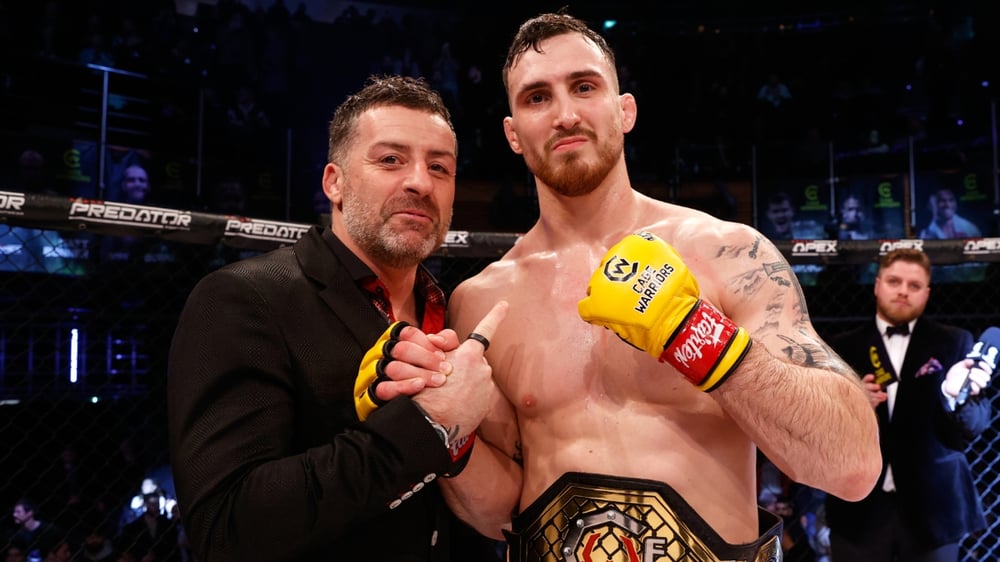
Cage Warriors called the next day. That was the beginning of a legendary run that saw a title run on a partially torn
“I wrote on my vision board that I’d win the 50 grand and give it to my parents, and I did.”
THE NIGHT IT ALL COLLAPSED
Against Khalil Rountree, Modestas entered the cage with 75% torn ACL, two torn meniscuses, and a torn MCL
“They asked if I could fight. I said yes.”
One kick later, the knee exploded.
“They said my ACL looked like half a piece of dental floss hanging on by a thread.”
Surgery followed. Rods. Cameras. Hardware.
“I woke up screaming for painkillers. I was vomiting from the medication. I felt useless. Like a burden to my parents.”
The final blow landed via social media.
“I opened Twitter and saw my name crossed off the roster. My heart sank.”
From 2020 to 2021, the UFC dream was gone, his knee was destroyed, and his identity was erased.
“I was drinking myself to sleep. I didn’t want to be around anyone. I just wanted to disappear.”
Then the mindset shift came.
“Joe Rogan says you must be the hero of your own book. I thought, if my story ends here, it’s a sh*t book.”
After two surgeries, rehab, faith, and visualization, he made it back.
“I imagined what the comeback story would look like. I felt better than ever.”
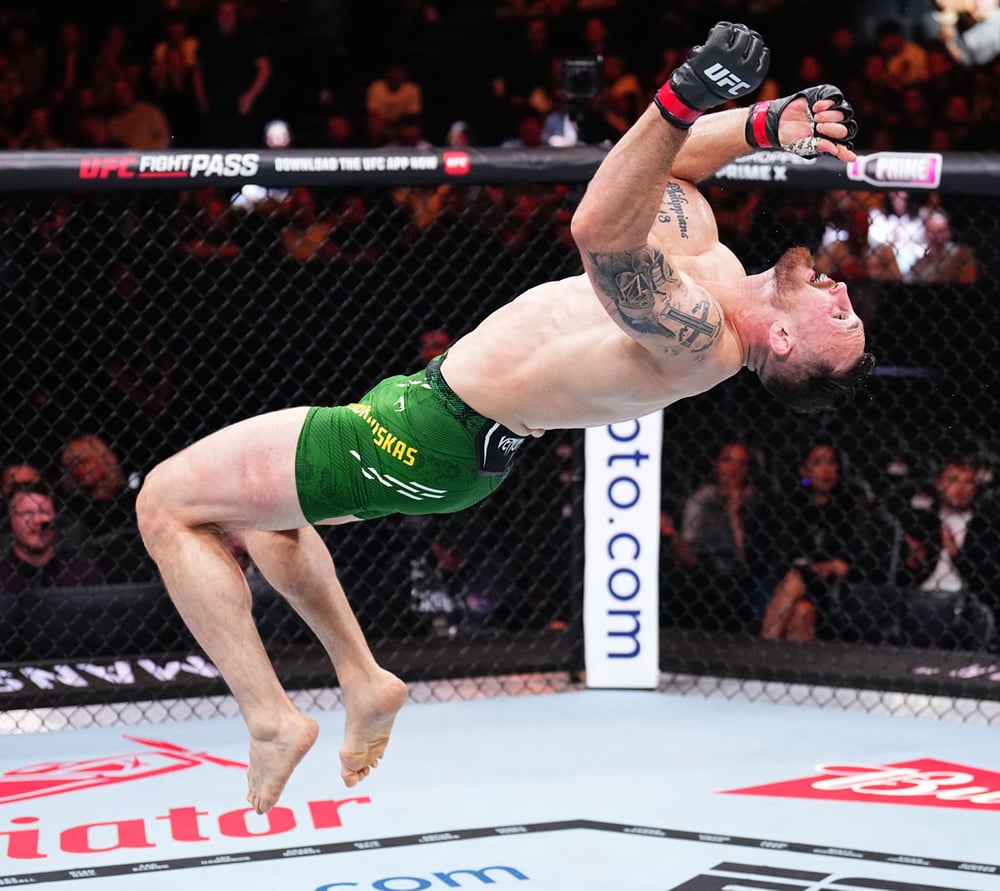
Cage Warriors returned. He won. Then he reclaimed the belt with a fourth-round knockout on New Year’s Eve. Still, no UFC call until one night on a dark road, he got the call.
“My manager video-called me and said, ‘You’re fighting an Australian in two weeks.’ Then he said, ‘You’re back in the UFC.’”
He pulled over and cried.
“I went home, dragged my dad out of bed and shouted, ‘We’re back in the UFC!’”
THE GLADIATOR’S CODE
Following two wins, a loss, and four wins, he’s on a hot streak when he fights in January with clear goals in mind.
“There are two things: the life I can give my family, and proving the people wrong who told me I couldn’t do this.”
“I want to be a UFC champion.”
He’s been an immigrant, national champ, heart surgery patient, cut from the roster, and a man rebuilt from the wreckage.
This is proof that careers don’t die; they evolve, even via a loss or two.
“Every time I lost, it was God telling me to fix something. Now I’ve fixed it.”
And now? The Baltic Gladiator returns home, not to survive, but to rise. As for his story? He’s still writing his book.
...