

Issue 224
December 2025
Ray Klerck examines new science that reveals why modern MMA success depends on heart regulation, recovery, and rhythm, not just toughness under pressure.
MMA will always be all heart. You fight from the heart. You hit from the heart. You have the heart to keep going when your legs are cooked. But having a figurative heart and the literal kind that can keep going when MMA gets tough are two very different things. A recent study in the journal Rehabilitation and Recreation found that even elite athletes from judo, Muay Thai, wrestling, and boxing can enter MMA with championship-level technique and fitness from their sports, but they’ll find their hearts are significantly underprepared for the experience. MMA places unique demands on your system that scramble your ability to find rhythm, steal composure, and demand things from your ticker that almost no other sport can do. Every fighter says they’ve got heart, but MMA is where you find out whether it’s been training or just talking.
HEART OF THE MATTER
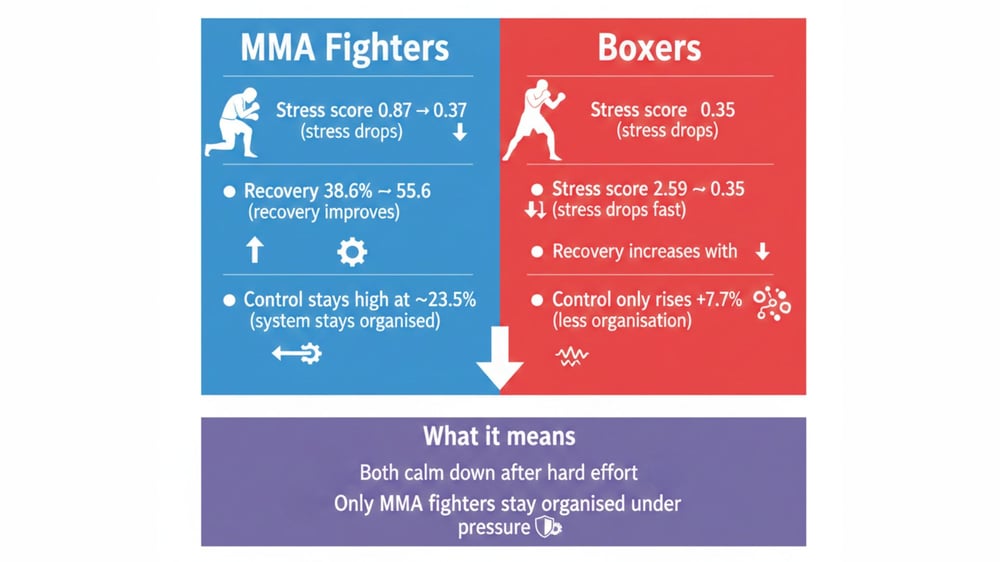
MMA unquestionably is the king of combat sports when you look at what the researchers discovered. When they put fighters from other disciplines through MMA-style training stress, 75% of the athletes from other combat sports didn’t have the physiological endurance to keep pace. Their heart's regulatory system buckled faster than expected. Some of the groups even saw 80-90% swings in their autonomic balance when the pressure spiked, which is the kind of heartbeat sharp rise you’d expect when you’re walking in the dark, expect a step, but your foot finds air and keeps falling. Even athletes like Greco-Roman wrestlers and national-level boxers saw their heart rate control spiral the moment their workloads stopped looking like the tidy, structured home sports they were used to. They’d all been conditioned for predictable tempos, like steady grappling pressure or clean striking exchanges that were repeatable. MMA pops that neatly in the bin and expects you to burst, scramble, clinch, sprawl, explode, stall, panic, breathe. Then repeat. The first muscle to go in this instance is the heart. And it’s why this organ needs special attention if you want to excel.
MMA'S BIOLOGICAL MOOD SWING
It’s not just that your internal engine room works hard in MMA, it’s that the heartbeat swings up and down like the stock market during a banking scandal. A paper in Sports followed MMA athletes and found the heart will tell you a lot about your ability to train, but only if you treat the data appropriately. The researchers measured heart rate variability (HRV), a stress marker that shows how well the heart adapts to pressure. They also looked at direct current (DC) potential, which shows how fresh or fried an athlete’s central nervous system is in response to exercise. HRV is the stress gauge, while DC is the electrical charge that sparks the whole system. Both these measurements could clearly distinguish between mornings after hard MMA training, moderate days, and complete rest, showing that your heart and nervous system keep a running scorecard of everything you put them through. The best time to measure it was early in the morning, before the stimuli of the world start creeping into your system. And while the technical measurement methods are good indicators, you didn’t need heart rate monitoring tech on your Apple watch to track it. Instead, how heavy, flat, or sore a fighter felt was a better indicator of overall fatigue. Double up on this information with the knowledge that MMA fighters’ hearts are always the hardest-working in the room, and it’s easy to see that you should take extra measures to get the best out of this organ.
HEART HEALTHY FOODS
If your heart had a favorite fast food, it wouldn’t be deep-fried in regret. It’d be boring, reliable, and something your great-grandfather ate, minus the lead that was in everything back then. The food staples that reliably support the heart are well known, but if you want those ashes raked over just one more time, then it’s oily fish for omega-3s, colorful veggies and fruit, and whole grains. Add some nuts, olive oil, and legumes, and you have the blueprints for the Mediterranean or DASH diet. But what did 2025 bring to the table in this space? Here are the top three findings.
Eat more potassium. Avocados, bananas, and salmon are high in this mineral that improves the health of your ticker, making you 24% less likely to have a healthy heart.
Polyphenol-rich foods are the ultimate heart helpers. Raw cacao, coffee, berries, and walnuts are the highest sources of these and give you better blood pressure, healthier cholesterol levels, and lower cardiovascular disease risks.
Eat 2-3 eggs a day. People who did this had a 29% lower risk of cardiovascular diseases, so put those omelets back on the menu.
So, nothing super new or out of the norm. Keep off those processed foods and eat the everyday healthy foods that’ll give you more gas in the tank.

PROTECT YOUR HEART IN THE GYM
Training hard isn’t in question if you’re a fighter. You’re going to do that anyway. However, perhaps adapting your workouts can yield serious results if you apply the top heart-healthy findings we learned in 2025.
Track your HRV when you wake up and let it decide your aerobic pace. When your HRV is down, back off and stay low intensity. When it’s in normal range, that’s the green light to push the limits. This strategy can get better results than periodized training programs, especially in MMA fighters.
Use sprint training to boost VO₂max fast. Very short sprints of 3-10 seconds with recovery kept under 60 seconds, performed 3 times a week for just two weeks, were enough to significantly improve aerobic capacity in athletes of all descriptions.
Do 10 minutes of mindful breathing daily. When people did this for 4 weeks, they had less stress, which kept their heart rate elevated and compromised their recovery.
THE HEART IN THE FIGHT
Looking after your heart is more than a romantic notion or personality trait you find in round 3. While your heart is far from view, you can feel it’s there and in a sport that taxes your regulation, recovery, and restraint. The fighters who can outlast their competition are rarely the ones who empty their tank in every session. Instead, they know how to push the limit when their HRV says go and when to back off because their nervous system is cooked. Much of this internal resilience has its foundation in the kitchen, in ways that keep blood pressure steady and arteries clear. So, while having heart in the fight might sound like it’s something you earn through suffering, in reality, it’s closer to a refined skill set you curate over the years. You train it. Keep track of it. Protect it. While many believe the first domino to fall is technique or toughness, it’s really your heart’s ability to keep rhythm when everything around you is trying to knock it out of time.
...