


Issue 224
December 2025
Ray Klerck breaks down why the bench press won’t get you the win, but the new techniques and research may stop you from losing when things start to fall apart in fight.
In the early days, MMA was never showy. It lived in Pankration, Vale Tudo, and smoky gyms that smelled like disinfectant. The sport never asked who was the strongest. That was irrelevant. The burning question was who could win a fight when they’re dog-tired, outmaneuvered, and breathing through a busted beak. A raised hand was the only currency that mattered. Strength only meant something if you could use it strategically while being folded in half by your opponent. The bench press comes from almost the opposite direction. It’s all about the show where you can offer a clean number to a dirty world, which is why gyms love it. Its mythical status is fueled by questions about how much you bench because it’s easy to ego-load and even easier to talk about at dinner parties. Ask any MMA fighter, and they couldn’t care less. You’d probably get a pause, a shrug, and a story about why that answer stops mattering when you can punch someone in the face even if they have a bigger chest than you. So, if you put MMA and the bench in the same room, they won’t argue. They’ll just kind of just ignore one another. One focuses on uncertainty, fatigue, and comfort while in a life-threatening spot. The other trains for optimal conditions, comfort, and a single moment of output. While only one of them would ever survive contact, is there a way these two opposites can make friends? We investigate the science behind this odd pairing.
POWER IS A PULSE
Bench press might look like a lying-down punch, but that’s only to the armchair experts who’ve never felt fatigue outside of typing angrily about judges’ decisions. When Stuart McGill, arguably the world’s most respected mind in biomechanics, looked at the movement patterns of elite fighters, he found they don’t stay tense the way a bench presser does. He wired up elite MMA athletes and tracked their 3D spine motion while they cracked the heavy bag with a variety of strikes. What he found was a double peak in muscle activation during a punch. There was a brief brace at the start of the movement, which made the torso feel solid, then a relaxation as the arm accelerated. Only at impact does the second brace show up, stiffening the body just long enough to turn that speed into force. This is the exact opposite of the way a bench press rewards you for a job well done. It wants you to stay tense, move slowly, and stay rigid all the way through. Striking techniques teach MMA fighters to time things like a switch. It’s why being good at benching doesn’t make you good at punching. Bench pressing just makes you very good at pushing heavy thing while lying down when nobody is trying to hit you back. Case closed. Bench presses are off the menu for fighters, right? Well, not quite.
NOT FOR THE BIN YET
The bench begins its redemption arc when you accept that MMA isn’t all about striking. Sure, max bench press numbers don’t predict who hits the hardest, but they do give a read on your baseline strength. When researchers profiled MMA fighters, their one-rep max bench press was approximately 1.2 times their body weight, which is similar to that of Judokas. It’s not a powerlifter number. It’s not meant to be. It tells you that a 170lb fighter could bench 204lb. So, it’s not freaky, but it’s not fragile either. It can be used in unglamorous places like clinch pressure, defense when you’re pinned to the fence, and posting off the mat when your technique is leaking oil. It won’t ever win a fight, but being weak in this area will most likely put you on the back foot. As an indication of this, when MMA fighters who had never done strength training did a 4-week routine that involved big moves like the bench press, squat, and deadlift, their bench press improvements tracked with faster medicine ball throws (a famous marker for punching power), meaning stronger pressing strength tended to roll with a snappier launch of the strike. It’s not evidence that bench presses equal punching power. It’s more than that because a bigger press may give you the horsepower to convert into speed when the rest of the chain is appropriately coached.
THE NEW FINDINGS
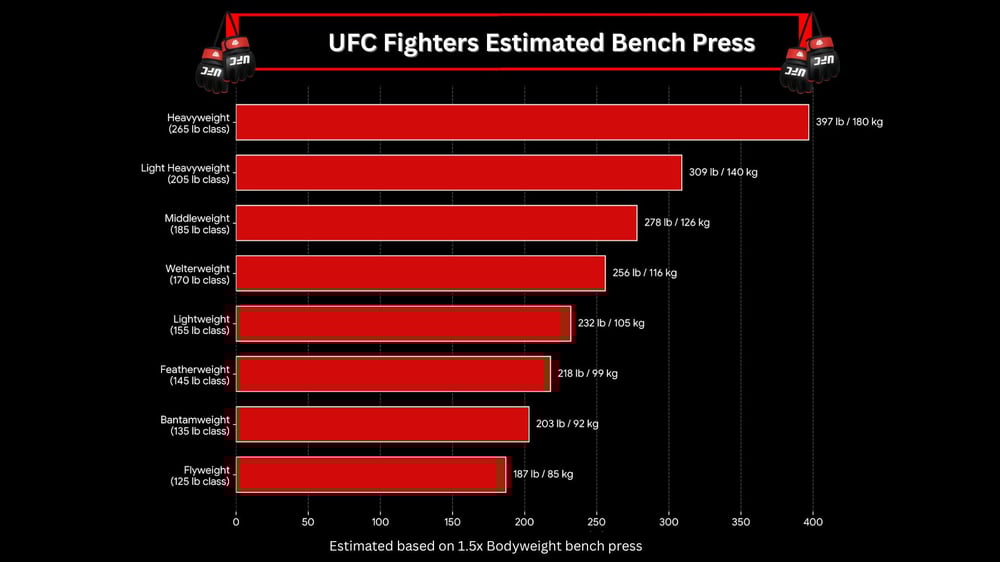
The bench might get a second wind when you realize real fighters use it, perhaps not in the hyperbolic ways listed in the infographic which shows the extreme ends of the scale. McGregor is rumored to bench 265lb, while Jones has been filmed benching 220lb for 10 reps, which is about a 300lb 1-rep max. When a study compared lightweight and heavyweight MMA athletes, split by pros and elite levels, the bench press was one of the few tests that separated the packs. Elite heavyweights pressed roughly 258lb while elite lightweights hit about 180lb. All of that means little until you find what that pec strength was married to: isometric lumbar strength. The bigger the press, the stronger the lower back tended to be. This part of you acts like a middle manager controlling the flow between the upstairs and downstairs work. It matters for force transfer, positional survival, and injury prevention. Unlike bench press muscles, it’s not flashy (possibly the least flashy), but it keeps you in the game, especially when you’re wrestling and grappling. That link becomes clearer when you understand that another long-term study found MMA fighters improved their strength endurance by nearly 27%, alongside gains in max strength and late-fight technical effectiveness after 18 weeks of structured barbell work using moves like the bench press and squats. They lifted more but also ended up being fight functional for longer. The bench itself isn’t flashy, but when it rides shotgun with trunk stiffness and endurance. This means it helps keep fighters dangerous when that Round 3 fatigue becomes a reality.
HOW TO DO IT
There’s no doubt that you’d be a lesser fighter if you weren’t benching, especially if you only do it in ways that enhance your MMA skills in terms of stability and power. Here are the two tactics that research has found are best suited to MMA fighters.
Load unevenly. You get all the glory when you fight, not while you’re on the bench. Research suggests benching at approximately 70% of your 1-rep max, which explains why we see fighters like Jones doing such high reps. Dumbbells should be your first choice because they create a more balanced sense of strength in each limb. That said, the research suggests you should also introduce a slight asymmetry. This is where you’d do a bench press, where one side is loaded with 2-4% less weight than the other. The researchers found it boosted non-dominant pec and shoulder work without wrecking your performance. It’s how strongmen train to handle uneven weights, which fits in perfectly with MMA because when you’re fighting an opponent, one limb will need to push more than the other in a wrestling position. No part of a fight is ever evenly weighted, so you should train for that imbalance, which will also improve the power in your lumbar spine. Do not go above a 6% difference between left and right arm, or your core will start to compensate, and all your performance markers will decline. Use a steady tempo, taking 2 seconds to lower the weight and 1 second to press it back up. Do this at least once a week.
Try a strategic session. While the above builds on the strengths you can use, another approach focuses on building power. It draws on recent research on post-activation performance enhancement. In plain speak, that means you bench not to get tired, but to switch on your nervous system. To do this, get a load that’s about 60-70% of your 1 rep maximum, then do 3-5 clean reps. Take a 3–5-minute rest so you’re fully recovered. Now do 3-4 reps of an explosive chest exercise, such as medicine ball chest passes, plyometric push-ups, or pad work. The research shows that this sequence wakes up your nervous system and improves explosive output. Do one bench press set. One explosive movement. Repeat this 2-3 times, then leave it alone. When the bar speed slows down, pack it in. You’re done for the day. Used in this way, the bench press can stop stealing energy from your training and start to give it back, which is the only reason it belongs in an MMA gym in the first place.
WHAT DO YOU BENCH?
We don’t need MMA and bench pressing to be BFFs. One makes you look tough while the other makes you feel tough. They can live in the same universe, but won’t speak the same language. The judges won’t ask. Your opponent couldn’t care less. Nobody ever tapped because their opponent once pressed a big number in a calm room with safety pins. But when you’re smashed against the fence with your posture collapsing, and lungs begging for mercy, then a quietly trained press might be the difference between getting folded and buying yourself a few more precious seconds. The bench will never win fights. It has its place and helps ensure your weaknesses don’t lose the fight for you.
...