

Issue 225
January 2026
The BMF belt wasn’t designed to revisit old business, but now it’s finally attached to a fight that can actually explain who deserves it the most.
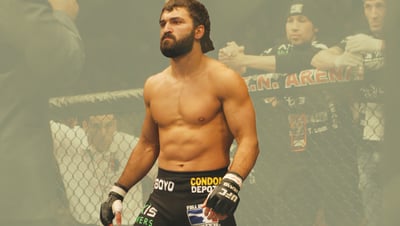
Max Holloway and Charles Oliveira fought once. That was over 10 years ago. A lot can happen in 10 years. Digital art about apes was worth millions, then became worthless. Influencer boxers made more money than professionals. Billionaires began flying their fiancées into space. Over that same stretch, the UFC changed, too. An analysis of more than 6,400 fights shows the advantage once held by favorites, roughly 55 to 60 percent for most of the modern era, has steadily eroded since 2015, pushing the sport closer to genuine parity. That means you never can tell how a fight will play out, and a decade can transform fighters into new people. On paper, this Holloway-Oliveria counts as a rematch. On paper that matters. In reality, it means nothing. The first fight ended early before it could prove anything. Oliveira was injured early, and we’re not sure if that injury was even caused by anything tactical that Holloway laid down. No hierarchy was established, so while their meeting exists in the record books, that’s just biographical white noise, not a reference point. This is not a rematch. It’s the first honest version of the matchup, and everything is different.
FORGED IN DIFFERENT FIRES
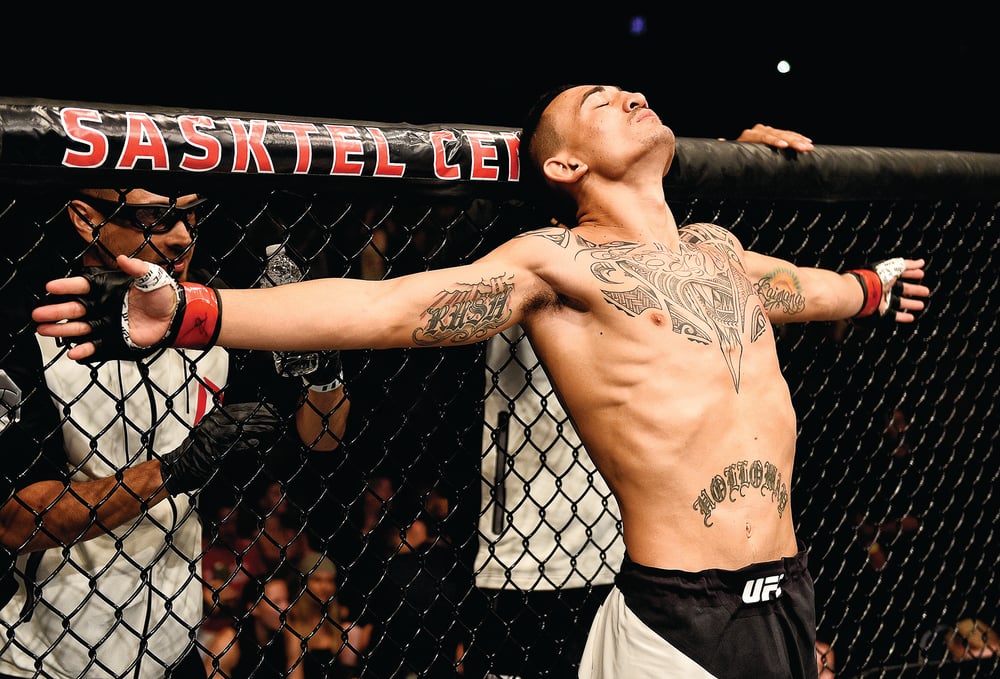
Max Holloway has never hidden how he sees fighting, and he’s made his opinion about it clear to Fighters Only over the years.
“I like to stand toe-to-toe with my opponent,” he said early in his UFC career. “The plan is always to go out there and give the fans what they want to see. I like to go out there and put on crazy kickboxing wars in the Octagon.”
That attitude was never performative. It was about expressing the inner person he truly is, one who sticks around long after the cameras have stopped rolling.
“Fear of failure. Fear of being cut,” Holloway admitted when describing what’s driven his successes. “There was that one point where I came off back-to-back losses, and then I was fighting a UFC novice (Will Chope). Usually, when you're fighting a newcomer, and you're coming off of two losses, you lose, and you get your papers. That feeling haunts me, and I don't ever want to feel that again. So I use it as motivation to keep me grounded and keep me focused. Anything can happen. So I focus on now and take one step at a time and cover all my bases.”
Even as his résumé expanded and the sport around him shifted, his philosophy stayed fixed. “This game is about adapting,” he told us. “You can never feel you’re great anywhere. Things will start going downhill from there.”
A decade after a fight that ended before it could explain anything, those words matter more than the result ever did. Holloway arrives here not as a different man, but as a fully realized version of the person he’s always said he was.
THE MAN WHO LEARNED TO LAST
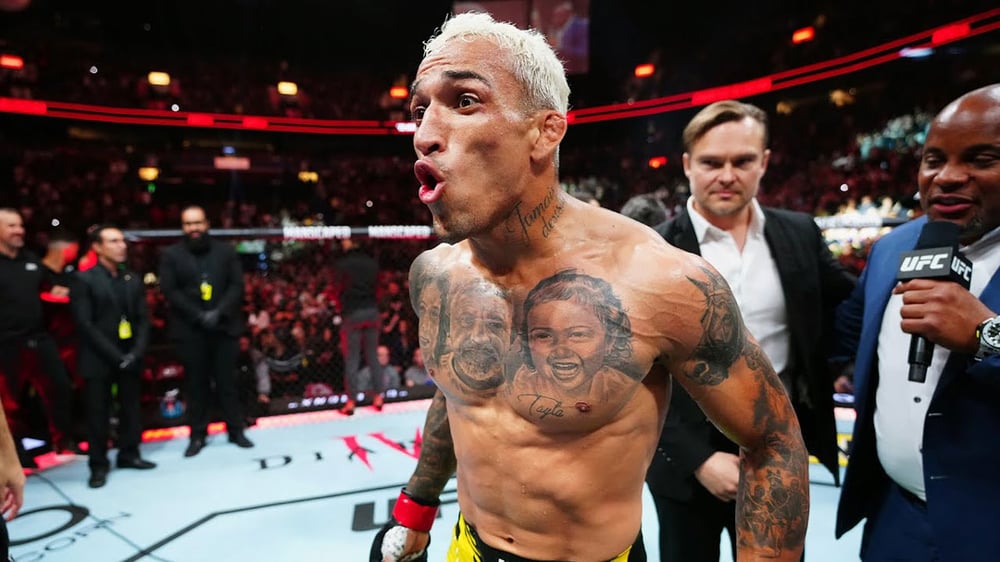
Charles Olivera reached this high point of his career by learning to endure both physically and mentally. Long before the finishes, the crazy records, or even the belt conversations, the language he’s always used sounded more like notes in the margin of a self-help book than the brutish pre-fight trash talk we’re accustomed to. He’s the kind of fighter whose popularity would likely soar if he spoke English, but he probably has his reasons for sticking to his native tongue, and translating these quotes makes for hidden gems.
“The key to success is to never give up, no matter how many times you fail,” Oliveira has said, and his career reads like a working draft of that sentence.
He has framed defeat as instruction rather than interruption.
“Success is not about how many times you win, but how you handle defeat,” he said, and later, more bluntly, “Failure is not a setback, but a steppingstone to greatness.”
It is easy to imagine how globally dominant Oliveira’s popularity might be if he delivered those lines fluently in English at a key moment. However, you can bet that their impact has already hit home in Brazil, where he is understood not just as a people’s unofficial champion but as proof of concept. Even if you can’t understand the words he says, it’s always been clear that his mindset, patience under pressure, and belief after collapse have become his legacy. Oliveira does not speak often, but when he does, he sounds like a man who has already lived the lesson he is passing on.

TOP VS TOP
Measuring greatness against greatness is an impossible task. It’s rarely clean and depends on what you value when the Octagon is stripped back to the bare bones. Is it volume or damage? Endurance or dominance? Max Holloway and Charles Oliveira have answered those questions in opposite and equal ways. Holloway has built a legacy through sheer accumulation, becoming the first fighter in UFC history to land more than 3,000 significant strikes. At the elite level, that’s like Steph Curry or James Harden hitting 3, 000 three pointers. Holloway also owns the record for the most strikes landed in a fight and has spent more minutes at featherweight than anyone before him. Oliverira has taken a much more aggressive path, carving his name into history by ending his opponents’ dreams. He’s set the all-time high scores for finishes, submissions, and performance bonuses, achieving it all across eras of opponents who kept trying to write him off. One fighter overwhelms opponents until their systems fail. The other waits until their resistance collapses. That is why this fight makes more sense than any other fight, especially where the BMF belt is concerned. These are two fighters who became record holders by refusing to disappear, meeting now with a belt that measures not just bravado but long-term endurance at the highest levels.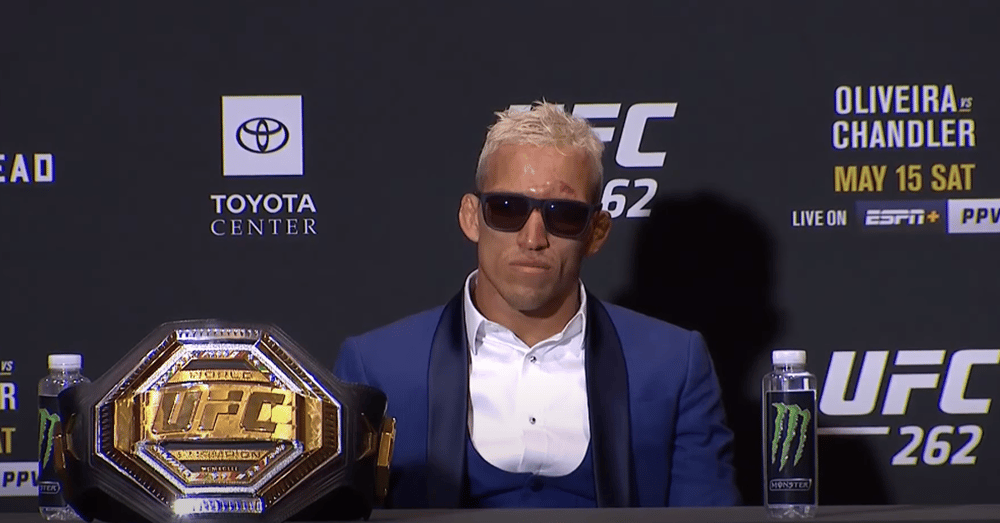
CAN WE PREDICT ANYTHING?
Do we even want to take a wild swing in the dark about who will come out on top? All we can do is look at the science behind these sorts of matchups. Fight outcomes are often decided less by who has more weapons and more by who loses less structure over their time in the Octagon. A 2024 analysis looked at the long-term success across elite combat athletes and found that losses by decision were linked to much higher future winning percentages than losses by knockout or submission. Repeated stoppage losses were the worst thing that could happen to a fighter’s career. For Olivera, he’s had five wins and four losses in the past four years, so the odds are in his favor, although he has only had one loss by way of decision. Holloway has had four wins and two losses over the past four years, and one loss by decision. Both men have lost to Ilia Topuria, though Holloway lost in round three while Oliveria lost in round one, but there’s not much to take away from that stat. In practical terms, surviving matters more than shining, a trend reinforced by a paper that examined how fatigue affects high-level combat athletes. They found that while offensive output declines gradually, defensive performance, including reaction time, guard integrity, and positional decision-making, deteriorates earlier and more sharply, particularly in later rounds. This might help to explain why late-round finishes are disproportionately common among the UFC’s elite fighters. This is not because their aggression spikes, but because their defensive clarity erodes. That said, Holloway might have an advantage here as he can just about outlast anyone. This might be because fighters who experience early-career volatility and injury interruptions tend to adapt by reducing their exposure to catastrophic outcomes, getting better at managing risk, and being more patient. It’s exactly what Holloway mentioned to us early in his career and has clearly shaped him in the long term. All of this serves as evidence that this matchup is unique. It’s not just a battle of styles but of approaches. Holloway can absorb damage without losing defensive structure, forcing his opponents to degrade first. Olivera has learned to avoid losing badly long enough that fatigue and pressure have built in his favor. With this fight’s landscape defined by competitive parity, the BMF belt belongs to the fighter who stays functional the longest, as everything else starts to fail.
WHAT THE BMF BELT ACTUALLY MEASURES
These weird little MMA intricacies are why the BMF label fits. It’s not because one man hits harder or finishes faster. It matters because both have already survived the phases of the sport that quietly end most careers. The BMF belt was never meant to crown a spectacle. It exists to recognize durability under the ultimate consequence. Max Holloway and Charles Oliveira will stand opposite one another as evidence that longevity is not passive. Instead, it is earned through adaptation and an understanding of when not to break. Whatever happens next does not rewrite their pasts or settle unfinished business from a decade ago. It will show us which version of greatness holds its shape the longest when the fight strips away everything else. Same men. Different fighters. And for the first time, the perfect moment to find out.
...