

Issue 226
February 2026
Ray Klerck examines how MMA careers quietly trade dominance for joint damage, and why arthritis might become an unspoken part of the sport.
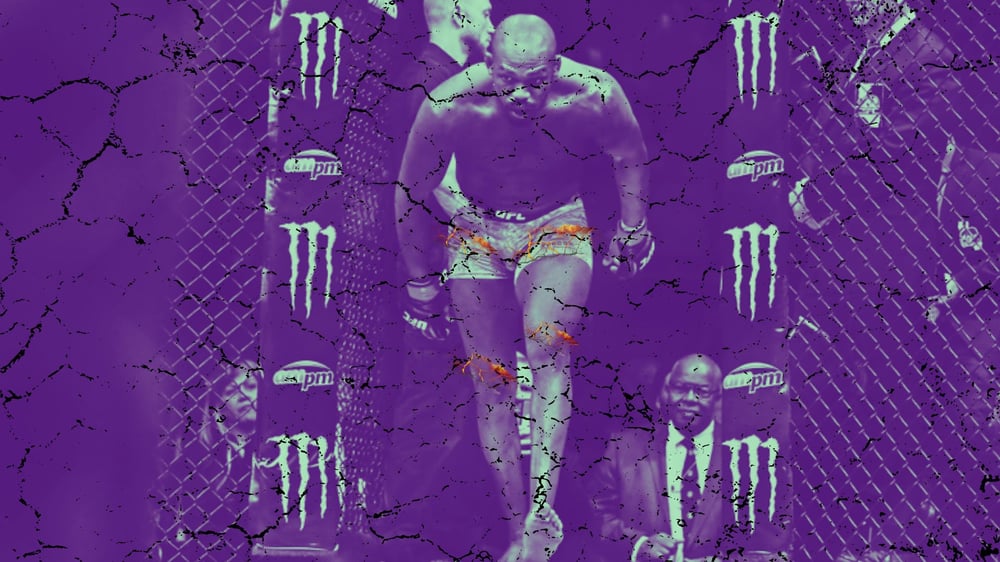
Jon Jones believes he is done. Despite flirting with a return via the White House Card, then teasing a wrestling showdown with Daniel Cormier, he’s said he qualifies for a hip replacement thanks to severe arthritis. He’s not the first. Tyron Woodley. Kamaru Usman. Cain Velasquez. They’ve all complained of joint degeneration without formally mentioning the dreaded arthritis, possibly because it carries the stigma of being an old boy in a rocking chair. Arthritis is a broad medical term that describes inflammation and degeneration of one or more joints, most often linked to the breakdown of cartilage, changes in bones, joint stiffness, reduced range of motion, and chronic pain. In athletes, this is often osteoarthritis, caused by repeated mechanical stress, microtrauma, and long-term joint loading rather than a single injury. Over time, that precious cartilage that allows joints to move freely starts to thin like Colby Covington’s hairline. Thanks to the state of modern MMA, it may be less a sign of ageing and more a receipt issued for all the years spent at the top of the bloodiest food chain.
DAMAGE IS THERE BEFORE THE PAIN
Thanks to MMA’s inhuman training loads, the wear-and-tear factor shows up on scans even in fighters who feel fine. When the knees of MMA fighters were compared to those of normal people, there was cartilage damage in 55.6% of professional martial arts athletes, compared to just 11% in the non-athletic control group. Their ligaments didn’t fare much better. There were ligament abnormalities in nearly two-thirds of the fighters. The areas hit the hardest were the weight-bearing regions of the knee, where the dominant leg showed greater degeneration than the non-dominant one. This reinforces the idea that repetition, stance, and habitual movement patterns matter almost as much, if not more, than the impacts these fighters dish out and receive back. What stands out is that all the fighters felt okay and had no pain despite the structural changes in their joints. This shows that arthritis might show up years before it is felt, diagnosed, or spoken about publicly. It could explain why it’s also something that’s almost a bit hush-hush in MMA.
“Looks like a private conversation I had at DBX 5 in Houston made its way out into the wild,” Jones said.
Perhaps he never intended to go on record about his condition because it may have jeopardized his chances of getting that coveted White House spot.
GREATNESS OUTRUNNING REPAIR
The long game is where the arthritic bill really stings the wallet, which hopefully pro athletes can bankroll. A meta-analysis of former professional athletes found that 30% developed knee osteoarthritis, a rate well above that of the general population of the same age. However, martial artists seem to clock in with 55% rate, which may make them even more susceptible to arthritis. Exercise is never bad for you. However, professional sport might cross a line that comes with a cost. Movement will always be medicine. That is, until volume, intensity, and repetition stack up faster than the cartilage can keep up. MMA inhabits a world that’s far beyond that threshold. Takedowns. Sprawls. Checked kicks. Scrambles. Punches. They all load the joints at speed. When the force arrives quickly, the synovial fluid inside a joint can’t always spread that impact. The stress gets panel-beaten into the cartilage matrix, and once that structure starts to fray, the joint acts less like a shock absorber and more like exposed timber left out to burn in the Australian outback. For someone like Jon Jones, hip arthritis probably started higher up the chain with a labral tear, which is the cartilage ring that keeps the joint sealed. A 2025 analysis of MMA injuries found that this part of a joint was implicated in about 60% of all injuries, and those MMA fighters who injured their shoulder were 22% more likely to reinjure it. They were still able to fight, but their win rates were lower, even though significant strikes were not affected. That said, if you ignore it long enough, the endpoint becomes predictable. When bone meets bone, range disappears, and quietly, it becomes someone who qualifies for a replacement.
WHY ELITE FIGHTERS STILL LOOK SO DEADLY
Arthritis is one of MMA’s hidden parlour tricks. The game is to look invincible right until the wheels come flying off in one dramatically confusing moment. The abs are on show, and the walkout still looks confidently terrifying, but the joints are wearing paper-thin. This is where narrative bends to the showmanship because more than half of fighters with a knee injury don’t even know they have one, so how can anyone else? It’s impossible. If you take this slab of common sense and dust it with an ingrained culture of risk-taking, you get a recipe for how it becomes slow-cooked bravado. Research showsthat athletes are willing to take extreme health risks to succeed in important competitions, so injuries and pain are just an everyday part of the job. Once you have a lack of knowledge about an injury, coupled with a willingness to take a risk, then you deep-fry it in hard-won muscle, you get the crispiest conditions for arthritis to settle in unnoticed. Muscle is a powerful buffer against pain because it helps athletes process it differently than other people do. The effect can be even more powerful in endurance athletes because prolonged, physically intense activity can lead your brain to believe that pain is just normal. While you may not be running marathons as a fighter, your training load and resulting fitness are very comparable. That’s how arthritis sneaks into MMA. It’s not through weakness or neglect, but through repeated success. Fighters are trained to normalise discomfort and reinterpret pain, while their tough-it-out mindset allows damage to accumulate. It’s a slow betrayal that becomes the uncomfortable conversation the body has been trying to start for years.

WHAT EVERY FIGHTER SHOULD DO ABOUT IT
Arthritis is optional in MMA, and you can control how fast it arrives by slowing the clock. Much of this starts with treating joint health like a skill development that’s trained and applied regularly. These are some of the newer ways to stop arthritis before it starts.
Blood flow restriction training (BFRT)
When the hips feel like two bricks arguing, loading up barbells can make things worse. BFRT gets you to use light weights while restricting blood flow to trigger muscle growth and strength, without hammering the joints. Using this technique, you’ll lift 20-30% of your max, but gain equivalent to maximal training, and it’s been shown to help combat arthritis. There are all the same signals to the muscle, but far less punishment to the joints.
Intra-articular PRP injections
Stem cells still live in the maybe pile, but PRP is quickly becoming a viable option. A 2025 Mayo Clinic meta-analysis found that platelet-rich plasma outperformed corticosteroids and hyaluronic acid for longer-term pain relief and functional improvement. It works by calming the inflammatory chaos inside the joint rather than numbing it temporarily. It does not rebuild cartilage, but it can buy time. And in MMA, time is everything.
Neuromuscular prehabilitation
Arthritis often starts because a joint moves incorrectly after an old injury. Prehab retrains a fighter’s nervous system to stabilize joints using secondary muscles before bad mechanics grind cartilage down further. A 2025 systematic review found that targeted neuromuscular training reduced acute joint injury risk by 46%. That does not sound flashy, but fewer reinjuries mean slower progression toward arthritis.
Reducing the walk-around weight
This one is brutally simple. For every kilogram of body weight lost, the load through the knee and hip drops roughly fourfold. Research from Johns Hopkins shows that losing just 5% of body weight can reduce joint pain by up to 30%. For heavyweights, that is not about getting lean for photos, but dropping ten pounds of non-functional mass can make all the difference.
THE REAL COST OF BEING GREAT
Jon Jones might be an outlier with his performance, but his condition may become increasingly common. He didn’t break down because it trained badly or lived soft. He broke down because he trained better, longer, and harder than almost everyone else for nearly two decades. Arthritis is not his flaw. It’s his footprint. The sport celebrates dominance, longevity, and durability, but rarely talks about the invoice that follows them home. MMA rewards those who can ignore pain the longest, reinterpret damage as tightness, and keep winning while the joints quietly unravel. Jones saying it out loud doesn’t diminish his legacy. It may show that greatness in this sport is not free. It is leased, paid off in cartilage and joints that age faster than the rest of the body. The question isn’t whether there’s a tax on greatness. It’s whether fighters are willing to read the bill before the final payment is due.