

Issue 226
February 2026
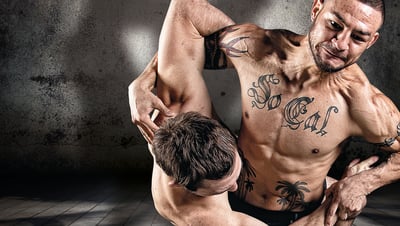
Ray Klerck breaks down why the fighter on bottom isn’t necessarily losing, and how the person on top can be a battery for their opposition to drain.
Score cards have taught us to think in layers. Top good. Bottom bad. Mount equals dominance. Guard equals survival. It’s what brings home the belts. Khamzat Chimaev drowned Du Plessis with 21 minutes of top position control, where he rained down with 529 total strikes. None was enough to create serious damage, but the statisticians were kept busy. Islam Makhachev did the same, where he pinned Jack Della to the ground for 77% of the fight. They’re both masters of the top position, which they’ve used to drown out strikers’ offensive weapons. Does top position mean UFC gold, or are these exceptions that prove the rule? It would seem so to the untrained eye. These guys are the super elite, and almost nobody has been able to solve the puzzles that are presented. But for lesser athletes in the grappling space, competition incident rates are significantly higher than training rates. They looked at 341 grappling athletes skilled in jiu-jitsu, wrestling, judo, and MMA and found that the knee is the most frequent casualty, accounting for 24.5% of all injuries, with ligament sprains making up 24.3% of diagnoses. Even in practice, where 65.8% of their injuries flare up during sparring, the leading injury culprits are the very takedowns and submission attempts required to secure that dominant top position. In this game, taking the lead can mean risking major injury, with nearly 49.5% of recorded cases requiring more than 28 days of recovery. Yet, while the physical and tactical cost of hunting for the top is undeniable, new research suggests we are looking at the ground game through a narrow lens. If the person on top is simply stalling to survive while the person on the bottom is hunting for a limb, who is truly in control? In this case, while it’s hardly revolutionary, the script could be flipped.
BOTTOM UP
A new approach published in the 2026 Bulletin of TulSU argues that our current scoring might be out of sync with the reality of real combat. We use a scoring system that acts like a ladder. Being on top during a grappling exchange is Step 1 toward winning. However, this study points out that the ladder is broken if the person on top is actually the one who is stuck. Think of it this way: if a wrestler takes you down but you wrap your legs around their waist (the closed guard), they might be on top, but you are the one holding them. You’ve locked them into your game plan, neutralized their posture, and restricted their ability to hit you effectively. While sports-applied hand-to-hand combat often resets ground fighting after just 10 to 20 seconds, this research identifies a significant gap where we seldom consider the initiative of the defensive player. This study proposes an integrated classification that moves beyond "top vs. bottom" to look at dominance versus defense. It looks to reclassify positions like the half-guard or closed guard as active defensive control because the bottom fighter is the one shackling and holding the attacker. Traditional rules often score based on the position of the person being attacked. Still, this suggested new model looks at the initiator's body position to determine who is truly dictating the pace. In elite grappling like Brazilian jiu-jitsu, practitioners often spend up to half their training time in these defensive positions, specifically to turn the bottom into a launching pad for sweeps and submissions. This shift suggests that control isn't about being on top. Instead, it's about which fighter has the initiative to decide what happens next. The implication is simple. Control is not about elevation. It is about progression. If the top fighter cannot improve their position, land meaningful strikes, or disengage safely, then dominance is just cosmetic. The athlete underneath is not surviving. They are steering, and the Octagon does offer some quiet counterexamples. Charles Oliveira spent long stretches underneath Dustin Poirier before turning his version of a quiet threat into submission. It’s something with plenty of runs on the board and perhaps this might impact scoring in the future.
THE ATTRITION FACTOR
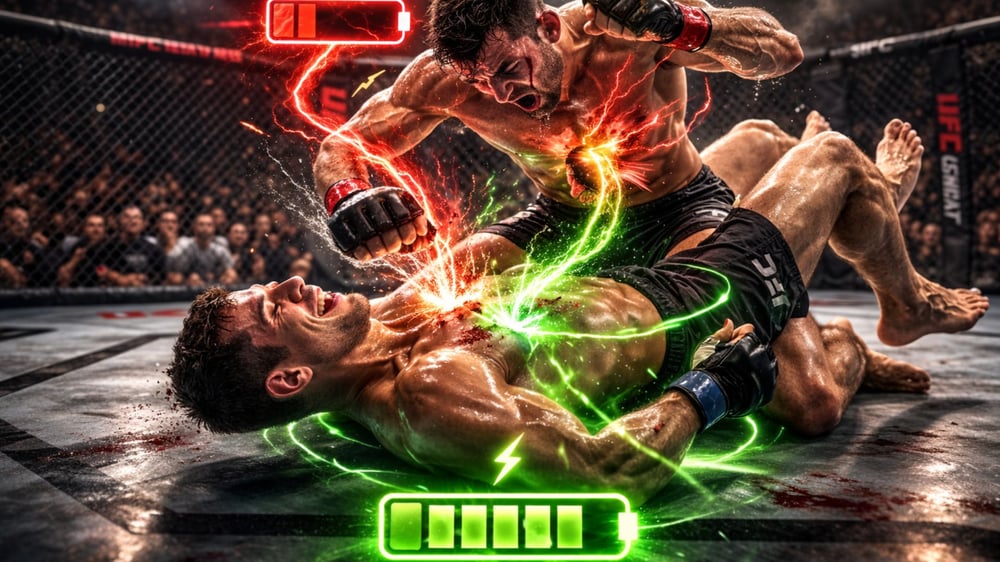
While there’s plenty of evidence that a fighter on top is more likely to get the scoring preference, the knack for maintaining that position is rare and a physically taxing skill in the sport. What matters more than this is accuracy. By focusing on how well a fighter landed their moves (aka accuracy) rather than just how many they threw (volume), researchers could predict the winner 76.3% of the time. If a fighter is stuck in a stalemate, they often pay a higher price for their energy supplies. Some sources suggest that top-position athletes frequently show heart rate elevations 15-20% higher than the person underneath who is successfully shackling them. This means that the effectiveness of that position is more often tied to progression rather than just presence. This physiological tax is almost like the invisible hand of the ground game that fighters like Demian Maia and Charles Oliveira have turned into weapons. In his decision win against Jorge Masvidal, Maia spent significant stretches where he was almost backpacking his opponent. While it looked about as boring as watching cardboard exist, it forced Masvidal to constantly carry Maia’s full weight while defending near-constant submission threats. In a 2025 performance analysis, takedown accuracy showed only a weak relationship with winning, and predicted outcomes just 61% of the time. It means that control on paper does not guarantee victory. This means that a bottom fighter dictates the pace through their defensive initiative. They aren't just waiting for a mistake. They are actively engineering a state of exhaustion in their opponent but with time limits on rounds and Fight Of The Night bonuses on the line this tactic doesn’t always have the limelight. As the 2026 UK grappling study noted, with nearly 50% of injuries being major ligament issues, the safe play is rarely to scramble wildly to the top, but rather to control the initiative from wherever you land when there’s a takedown at play. It means that being underneath isn't a disadvantage. It may, however, be an opportunity to let the top fighter drown in their own exertion.
THE NEW MEASURE OF CONTROL
The Octagon has never cared about optics. It cares about outcomes and entertainment. We have grown comfortable with rewarding elevation because it looks authoritative. Because it dishes out the flashy photographs in the fight reports. Because it fits a narrative of dominance where the bigger, older brother beats the heck out of his little brother. But real control lives in broken posture, trapped hips, stalled advancement, rising heart rates, and choices that disappear one by one. If the fighter on top cannot pass, cannot strike clean, cannot disengage without risk, then they are not dictating. They are reacting and in a state of checkmate while they’re actually losing. The bottom has never been about surrender. It has always been about leverage which forces the other athlete to carry weight, burn oxygen, and make impatient decisions. From Oliveira turning threat into submission, to Maia suffocating opponents who thought they were safe, the lesson is consistent. Elevation wins points. Initiative wins exchanges. And sometimes, the fighter underneath is not losing the round. He is quietly trying to rewrite the rules of the game.
...