

issue 230
June 2026
“I’m doing amazing, man. Another fight week, another opportunity.”
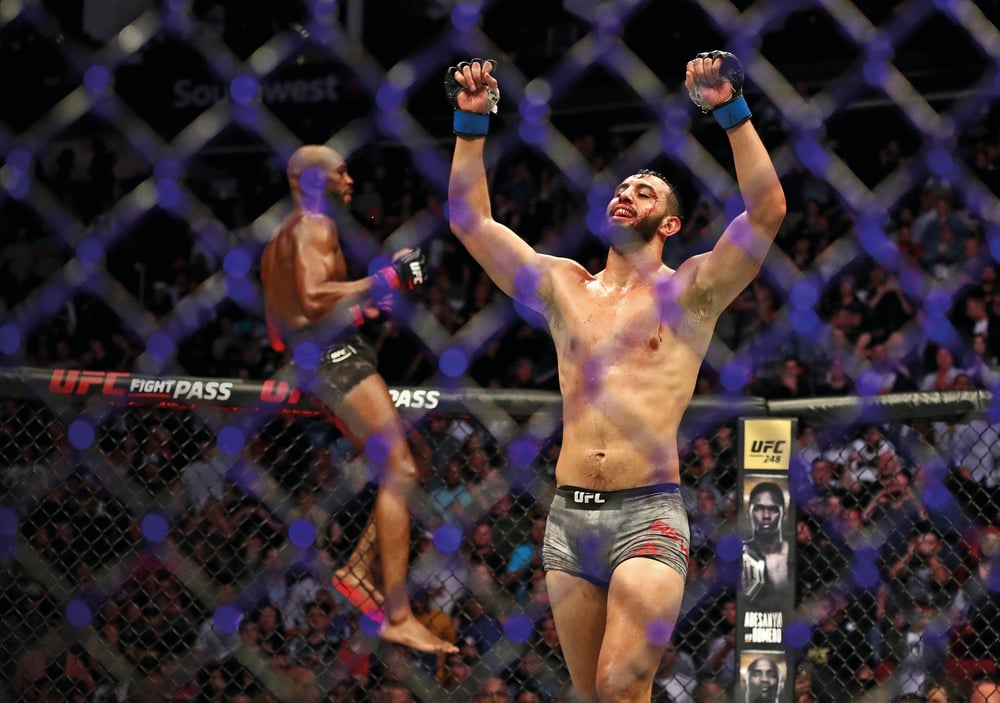
For Dominick Reyes, the words came easily, before his decision win over Johnny Walker, but they mean something different now as he’s won four out of his last five bouts, losing only to the current champ Carlos Ulberg. There was a time when his fight weeks were defined by pressure. Rankings. Consequences. Each performance felt like a referendum on his place in the division. Now, they’re something else entirely: a chance to compete, to grow, and to appreciate a career he once feared was slipping away. That shift in perspective has come hard-earned. After years of turbulence, Reyes has quietly rebuilt himself, culminating in a composed decision win over Johnny Walker at UFC 327. But the result, while important, is only part of the story. He’s a fighter who many argue actually beat the GOAT Jon Jones via the scorecards when they met, and that’s an anomaly that can split a fighter’s confidence in half.
“I think the very best version of me, as we all know, was against Jon Jones,” said Reyes. “But the thing is with that, it was specific for Jon Jones, right? That's what it's hard to explain to people, like you have to fight Jon Jones a specific way to win that fight, you know? So, it's that version of me is different because it's a game plan version of me. I think the version of me against Krylov or Weidman is probably the best version of me.”
With perspectives like this, it’s meant a lot of meaningful change has happened beneath the surface. He’s no longer chasing validation and is operating from a place of gratitude.
“WE GET TO DO THIS”
It’s understandable for an elite MMA fighter to cop a severe case of existential dread when they get hit with a three-fight losing streak after the biggest fight of their life. It turns out that sports psychology actually has a name for what happens when a world-class competitor hits rock bottom, and it isn't just “having a bad day.” In a research chapter published in the Journal of Applied Sport Psychology, Dr. Nicole Gabana explored how positive psychology interventions can completely reshape an athlete's mental framework. Her research shows that higher levels of gratitude in athletes directly correlate with increased resilience, lower psychological distress, and significantly lower levels of athlete burnout. By intentionally noticing the good, an athlete can broaden their perspective, break the tunnel vision of defeat and build the psychological resources needed to bounce back. For Dominick Reyes, the transformation didn’t happen overnight. He traces it back to one of the lowest points of his career, following his loss to Jiri Prochazka in 2021. At the time, he admits he was “overweight, out of shape,” and struggling mentally. The momentum that once carried him to a title shot had stalled, and with it, his sense of direction.
For Reyes, it was a conversation with Cub Swanson that shifted everything.
“He told me, ‘Hey man, we get to do this. This isn’t going to last forever. One day, it’s all going to be over. You don’t want to have regrets. You want to enjoy it. You want to spread positivity. You have this platform for this time, use it for some good.’”
Seemingly simple advice, but it stuck.
“It really helped me get that attitude of gratitude,” smiles Reyes.
That mindset has since become the foundation of his resurgence, one rooted less in outcomes and more in how he approaches the process.

LESSONS, NOT LOSSES
Rebuilds can be a tough ask, especially when the whole world was there to see one of the hardest losses of your career and have thoughts on it. Some may even be writing about it almost 6 years later.
“We did our thing that night, forever in history,” said Reyes after his Jones loss. “It'll go down as what it was. And no matter what he says, or I say, or everything, people are gonna have their opinions on the fight. And that's it. That's really it.”
If that sounds tidy in hindsight, it wasn’t. Even during his rebuild, Reyes faced setbacks, including a knockout loss to Carlos Ulberg last year. For a fighter coming off a difficult stretch, it could have unraveled everything he was trying to put back together.
Instead, it reinforced his new approach.
“You don’t lose, you learn,” Reyes says. “In this sport, the margins are paper-thin.”
He doesn’t ignore the realities of the sport, such as preparation, travel, weight cuts…but he also doesn’t dwell on them.
“He caught me. It was his night. That’s the nature of the beast.”
What matters, in his view, is the response.
“When you lose, you take a deeper dive into what went wrong versus what went right. The lesson is more prevalent. You have to face it.”
That willingness to confront setbacks directly has been central to his evolution, not just as a fighter but as a professional navigating the sport's volatility.
REBUILT FROM THE INSIDE OUT
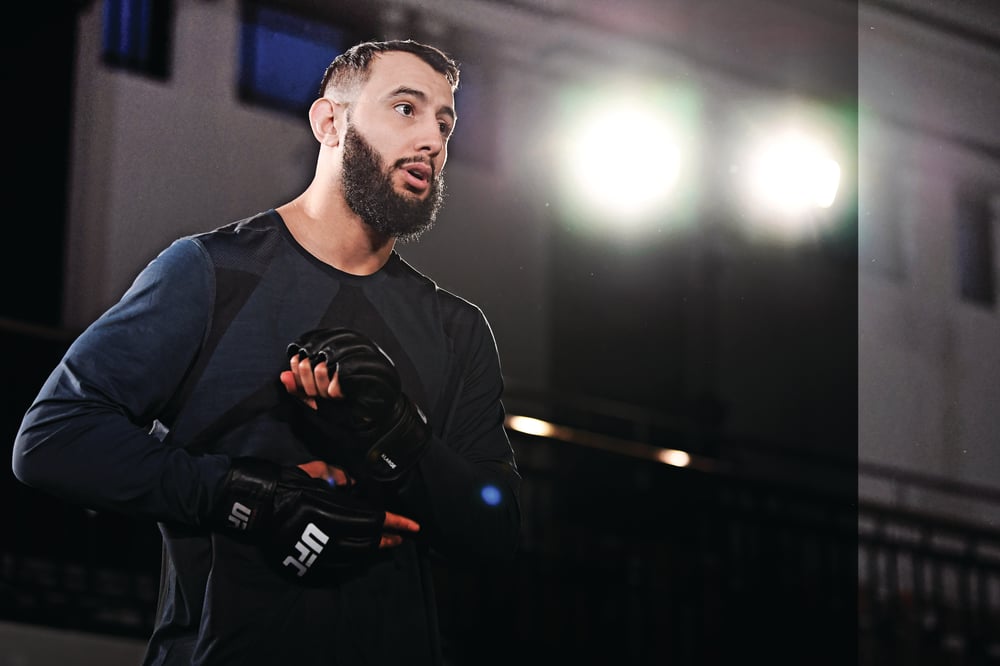
For Reyes, the changes have been tangible as he points to a renewed commitment to preparation, particularly his work with a nutrition team to optimize his conditioning. Physically, he says, he’s in the best shape he’s been in years. But the more profound shift has taken place outside the gym. In December, Reyes became a father.
“I have a whole new motivation, a whole new outlook on life. I feel rejuvenated completely.” The structure of his days hasn’t changed: training, recovery, repetition…but the meaning behind them has.
“It’s easy to do the hard things when you wake up, and your son’s just so happy to see you,” he says. “I’ll sweat and bleed all day, and then I come home, and he’s just as happy. It makes it all worth it.”
This is a new field that’s gathering momentum in scientific circles. A 2024 study in the Journal of Men's Studies exploring fatherhood in elite athletics found that starting a family positively affects male competitors' performance by forcing them out of the isolating “bubble” of their sport. Rather than being a distraction, the qualitative data showed that being an involved dad gives athletes a vital mental escape hatch, replacing competitive tunnel vision with a heightened sense of drive, purpose, and perspective. In short, we hope to see bigger things from Reyes in the future.
A DIFFERENT KIND OF STRENGTH
In a sport obsessed with physicality, Reyes talks about a different kind of edge.
“That’s where the idea of dad strength comes from,” he says. “Not just physical strength, but mental strength.”
It’s less about lifting heavier or hitting harder, and more about stability, about showing up consistently, regardless of results. That’s the real difference in this phase of his career.
The urgency that once came from needing to prove himself has been replaced by something more durable. He still wants to win, and his recent performance against Walker made that very clear, but he’s no longer defined by the outcome.
“I can do all the hard things easily now.”
That doesn’t mean the stakes are gone. It means they’re no longer overwhelming. Reyes is fighting for clarity, for perspective, and for a sense of control that had, at one point, slipped away. Career resurgences in MMA are rarely linear and rarely obvious in the moment. They’re built by very small adjustments, in mindset shifts, in the ability to absorb setbacks without letting them dictate the future. Reyes’ is no different. The results are beginning to follow again, but they’re a byproduct, not the foundation. What’s changed is how he sees the work, the opportunity, and the time he has left in the sport. And that may be the most sustainable version of Dominick Reyes yet, and we’ll be here for every punch he throws.