

Issue 231
July 2026
Marc Goddard reflects on winning his second fan-voted World MMA Award as Referee of the Year and explains why the greatest officials are measured by responsibility, not popularity
Nobody buys a ticket to watch the ref. Fans pay to see knockouts and championship belts raised, not the guy in black gloves quietly circling the action. In the perfect fight, the official barely exists at all. He slips in only when he absolutely has to, then disappears back into the background as though he was never there. It's an odd profession where your finest performances come when you’re almost invisible. Yet in today's MMA landscape, where back-of-the-head strikes risk becoming a social media courtroom, referees have never been under a brighter spotlight. It serves as a timely reminder that officiating isn't about making popular decisions. It's about making the right one, often with less than a second to decide. Marc Goddard has never pretended there is a secret formula.
“I don't do anything at 99% in my life,” he once told Fighters Only. “I put the same attitude and depth of feeling and responsibility on myself from the very first fight to the fights I do now.”
That mindset has carried him from fighting as a heavyweight on the British circuit to becoming one of the most respected officials. It has also earned him a second World MMA Award as Referee of the Year, recognition for a man whose greatest achievement isn't making perfect decisions. It's carrying the gravitas of impossible ones.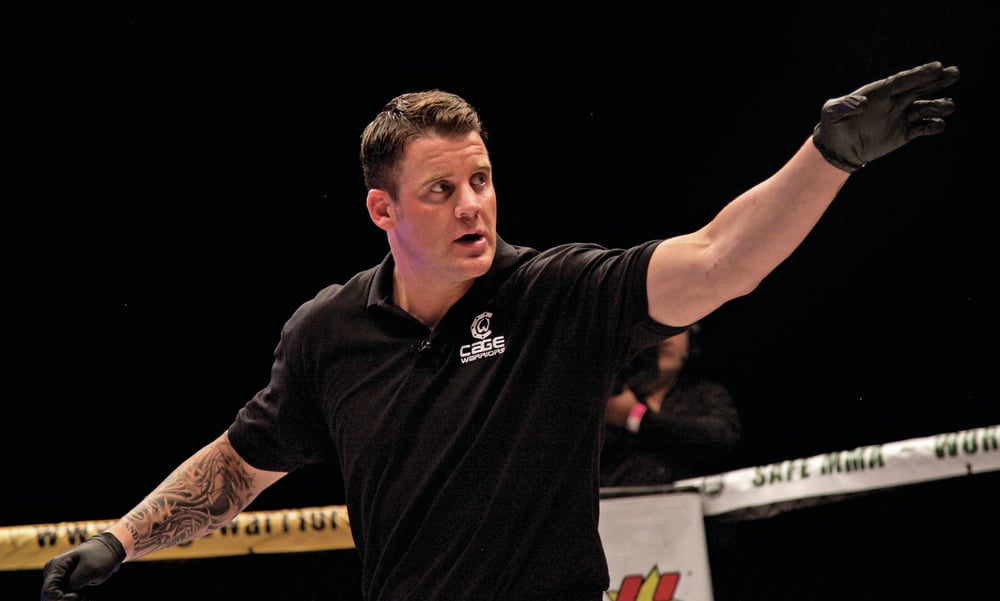
THE FIGHTING REF
Those impossible decisions carry a little more weight when you've been on the receiving end of them yourself. Long before Marc Goddard was one of the world's most respected referees, he was the bloke climbing through the cage door. Standing 6-foot-2, he built a respectable 7-6-1 professional record competing across heavyweight and light heavyweight during the rough-and-ready boom years of British MMA. He shared the cage with feared heavyweights like James ‘The Colossus’ Thompson and never once left a victory to the judges, finishing four opponents by submission and three by knockout. Then, in 2004, fate intervened when an injury forced him out of a scheduled fight, and the event promoter asked if he'd step in as a replacement referee instead.
“Sure,” Goddard later recalled thinking. “How hard could it be? On the night I found myself feeling right at home. I didn’t have time to be nervous or give it any thought, as it was sprung upon me by surprise. I remember taking control in the rules meeting, as if almost on autopilot, this stemming from my years of competing in MMA and grappling and then still actively training in all its facets. I also genuinely felt like I had gained an almost instant unwritten respect from my charges. Many of the fighters had previously shared a dressing room with me, so I was not only a familiar face, but one who understood exactly what they were going through. Immediately after the event, I was congratulated and thanked by many, both personally and publicly, which gave me huge gratification.”
What began as a favor soon became a calling. Within a few short years, he'd hung up the gloves, become the UFC's first UK-based official and quietly started building a reputation that today places him alongside the greatest referees the sport has ever known.
FIGHTER’S FIRST
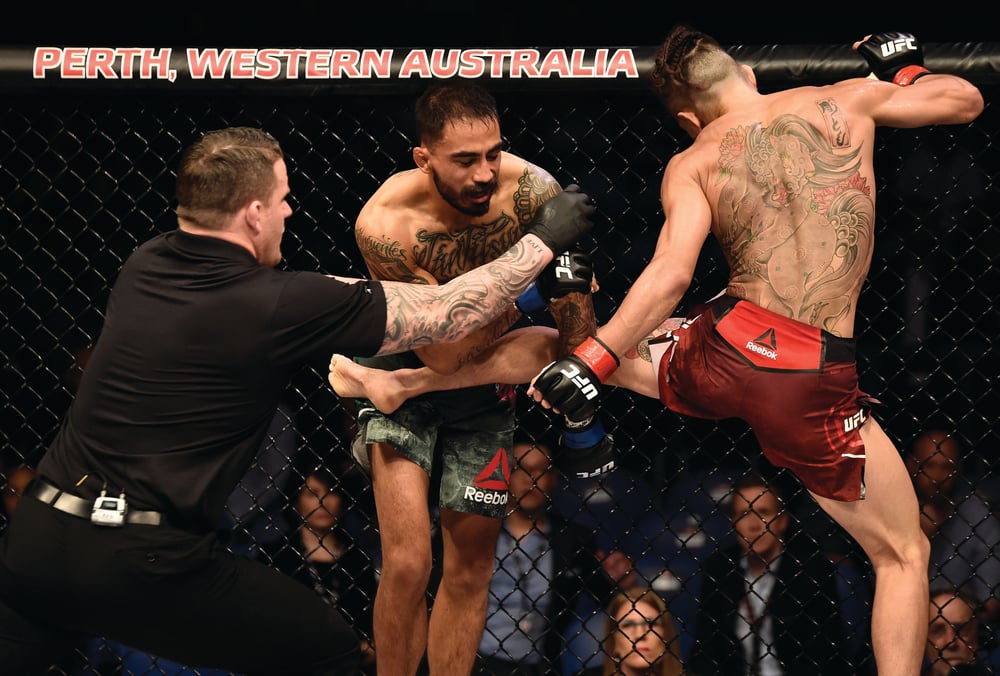
For all the talk of controversial stoppages and impossible split-second decisions, Goddard insists the job itself has always been remarkably simple. The philosophy hasn't changed whether he's overseeing two debutants or veterans in a UFC title fight: the fighters come first. Everything else is just noise.
“Always the most common and unwavering factor in officiating a fight, no matter what the level or consequence of the outcome, is the safety of the fighters,” he wrote in Fighters Only. “As my motto details: ‘Just let the fight play out in front of you, within the confines of the rules, and protect the fighters.’”
It's an approach that sounds wonderfully straightforward until you consider the sport’s subjective nature. A heavyweight can absorb punches that would fold a flyweight. A veteran might still be intelligently defending himself despite wearing five unanswered shots, while a younger fighter might have mentally checked out after two. Every contest brings different rhythms and unique athletes. The rules provide the framework, but they don't make the decision. That's still left to the person standing closest to the action. Perhaps that's why Goddard has never been convinced that knowing the rules alone is enough to become a great official.
“The experience and in-depth knowledge from teaching, training and competing simply cannot be bought,” he explained. “An often-overlooked weapon is the psychological understanding of the fight game: just what a fighter may be feeling and thinking at any given moment of an MMA fight.”
That's where his years as a heavyweight still have value. They weren't just a stepping-stone toward officiating. They have become part of his toolkit. He knows what exhaustion feels like and the difference between a fighter buying a few precious seconds to recover and one whose body has quietly decided the night is over. Those are things that come from having lived the sport. Which is why, despite the endless debates online, Goddard has never chased perfection. He knows it doesn't exist. Every stoppage will probably disappoint someone, but the responsibility isn't to make everyone happy. It's to give two athletes every opportunity to compete while making sure they both leave in a state where they’re able to do it again.

READING THE ROOM
When Marc Goddard's name echoed around the World Mixed Martial Arts Awards theatre, there was no fist pump or wide-eyed look of surprise. He rose from his seat with the quiet confidence of a man who has spent two decades walking into far more intimidating situations than an awards stage. As he made his way to the microphone, the applause wasn't just coming from fans or media. It came from the very people who understand the weight of the job better than anyone else. Fighters whose careers he'd overseen. Fellow referees and judges who knew exactly what it feels like to make a decision that will be debated before you've even left the cage. Coaches, promoters and peers. In a sport where officials are usually remembered only when something goes wrong, this was a room full of people acknowledging everything that had gone right. Accepting his second World MMA Award, Goddard could easily have spoken about the honor of joining the small fraternity of multiple-time Referee of the Year winners. Instead, he didn’t make the moment about himself.
“I'm gonna start by obviously saying thank you and reserve thanks firstly to Rob,” he smiled when speaking about Fighters Only founder and CEO Rob Hewitt. “Big respect to Rob. This is a monumental thing to put on. I think it's important for the sport and it's a difficult thing to do.”
He followed that by thanking the UFC and every promotion that had entrusted him with their biggest fights before paying tribute to one of the men who helped shape modern combat sports regulation.
“I want to speak about Mr. Mark Ratner, one of the most respected persons I've ever met in combat sports.”
Only then did he turn the conversation towards the profession itself.
“The realities of what we do as officials. It's not easy. I’m telling you, it’s not easy sometimes. But coming with that responsibility of difficulty is an awareness of great privilege, and it is for me, you know? I get to see greatness six feet in front of me, like, week after week, month after month, and I mean that from the heart. And lastly, I guess I'm going to say something I share in common with all my colleagues. We understand the responsibility that we carry with this sport.
By definition, as an official, you don't always please everyone in the room, but I can tell you as a human being, you know, we're not perfect. You'll never hear me claim to be perfect, but I promise you, I'll always try to be, and hopefully that's what keeps me afloat.”
Perhaps that's the real measure of a great referee. Not popularity, because that disappears with the next controversial stoppage. Just the willingness to keep making impossible decisions, carrying impossible responsibility and walking back into the fire the following weekend. Standing six feet from greatness has never been about stealing the spotlight. It's about knowing exactly when to step into it. And he has that.
...