

Issue 232
August 2026
Ray Klerck discovers why the fastest way to win a fight might start on a running track.
Nick Diaz sparked the madness almost 19 years ago when he laced up his Nikes and plugged into triathlons. While everyone else was fly-kicking bags and flipping tires, Diaz was swimming, riding, and running for hours on end. Each step took him to an almost unrivaled gas tank that refused to empty. Maybe the weird bloke in the wetsuit had been onto something all along. It marked a moment when running in all its forms found its way into fight camps. Both Georges St-Pierre and Khabib Nurmagomedov relied on explosive hill sprints as pillars of their endurance game. Over the years, sprint work continues to show up where you least expect it. Tom Aspinall uses beep tests and track-and-field sprints as part of his heavyweight game, which is focused on speed. As you’d expect, sports science is catching up, with new research suggesting that short, all-out sprint training may be one of the most overlooked ways to improve the fight-specific speed and agility that wins fights.
WHY SPRINTERS MAKE BETTER FIGHTERS
You’ve probably only sprinted one time in the past year. Don’t feel bad. The internet flings around stats like 95% of people won’t sprint ever again after age 30. True or not, most adults spend their lives avoiding the sort of all-out running they wheezed through as kids. Fighters aren't much different, and that understandable reluctance might be costing them. In a paper published in July 2026, researchers took 12 active MMA athletes and replaced some of the usual conditioning with a six-week high-intensity interval training (HIIT) program built around sprint drills, agility drills and MMA-specific movements. Training three times a week for 60-75 minutes at 85–95% of maximum heart rate, the athletes improved their 30-meter sprint times by 6.05% and their agility by 8.48%. The important thing was that these weren't tiny laboratory gains. Both improvements produced large effect sizes, suggesting the changes were big enough to translate into real fight-specific athletic performance rather than simply looking impressive in a research paper. You see, sprinting has a rather inconvenient habit of exposing your lies. You might think you're explosive until you have to run flat chat for 30 yards with nowhere to hide. There's no technique to lean on, no clever game plan, and no opponent to blame. You're either fast, or you're slow.
FIGHTS ARE WON IN BURSTS
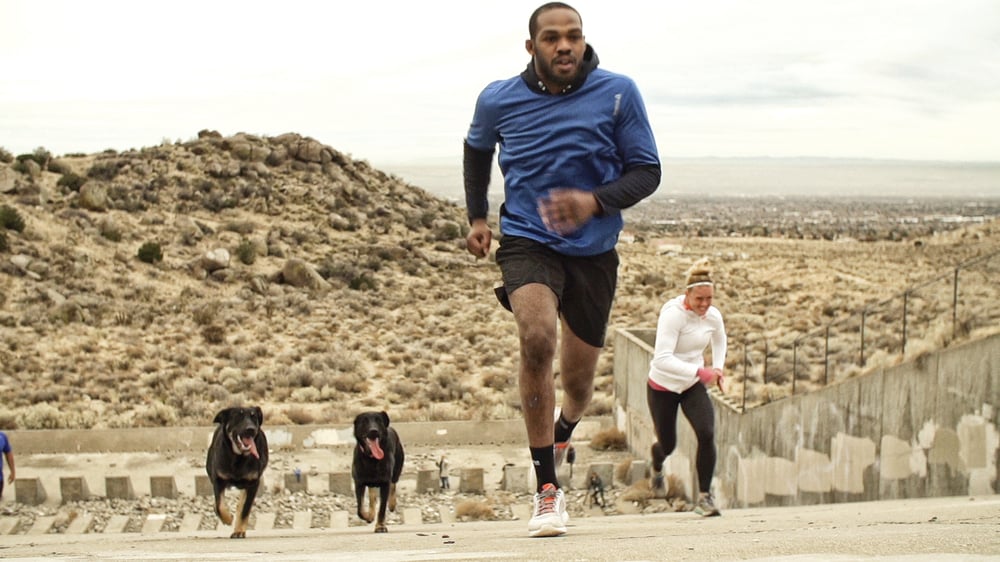
It’s unlikely that you’ve ever watched a fighter sprint across the Octagon to flatten an opponent and thought, “You know what did that? A nice steady five-mile jog.” MMA isn't an endurance event played at one speed. It's a series of violent interruptions. Merab Dvalishvili shoots, scrambles, and repeats before his opponents have finished processing the first attempt. Ilia Topuria covers distance so quickly it often looks like he's been fast-forwarded. The biggest moments in a fight usually last only a few seconds. That's what caught the researchers' attention. They point out that MMA is dominated by repeated high-intensity bursts lasting between one and six seconds, separated by brief recovery periods before the next explosion. That's near identical to repeated sprinting. Rather than sending fighters out for long, slow runs, the study built its six-week program around sprint drills, agility work, and MMA-specific intervals that mirrored how fights unfold. Sprinting teaches the nervous system to recruit more fast-twitch muscle fibers and generate force more quickly. In fighting terms, that's the difference between beating your opponent to the jab, getting underneath a takedown before they sprawl, or exploding back to your feet before they settle into side control. It's probably no coincidence that agility improved even more than straight-line speed in the study. MMA rarely runs in straight lines. It cuts angles, changes levels, and reacts in fractions of a second. Sprinting simply teaches the body to do all of those things faster.
THE TRACK RECORD GETS LONGER
A dozen MMA fighters sprinting faster is enough to make you raise an eyebrow. Finding similar results across other combat sports is when you start looking for your running shoes. A 2025 systematic review went digging through 212 papers on interval training before narrowing the field to six studies involving BJJ, judo, taekwondo and karate athletes. Taken together, the evidence pointed in the same general direction: high-intensity interval training, particularly when mixed with sport-specific techniques, strength work or plyometrics, can improve the collection of physical qualities fighters spend their lives chasing, including aerobic and anaerobic fitness, strength, speed and agility. For all that, the sprinting evidence came with an interesting warning label. One study split 12 teenage taekwondo athletes between technique-specific HIIT and repeated sprint training for four weeks, with both groups training three times per week. The technique-specific group actually produced more responders in several measures, including jumping and kicking performance. In other words, nobody needs to sell their gloves and buy a pair of track spikes just yet. Sprinting can help, but actually practicing fighting remains rather useful. Another study involved 40 national-level male karate athletes who completed eight weeks of short-sprint intervals, resistance training, or a combination of the two. Every training approach improved physical fitness, but combining short sprint intervals with resistance work kicked up the wow-factor, with improvements across jumping, sprinting, shuttle runs, strength, and anaerobic power. Elsewhere in the review, four weeks of technique-specific HIIT produced a 15.2% increase in squat-jump height and a 1.7% improvement in change-of-direction ability in young karate athletes. That's a fairly decent return for a month of suffering. The bigger lesson isn't that sprinting has suddenly cracked the secret code of combat sports. The review actually concludes that the best results tend to come when high-intensity intervals are integrated with the things fighters already need to do, particularly technical, strength and plyometric training. It also warns that athletes don't all respond the same way and that the existing studies vary considerably in their methods, so we're nowhere near declaring the running track sacred ground. But alongside the new MMA findings, the direction is becoming difficult to ignore. Sprinting isn't replacing fight training. It may simply be one of those useful ingredients that MMA left sitting at the back of the cupboard for too long.
THE 45-MINUTE SPEED SESSION
The researchers didn't publish the exact workout their athletes completed, but they did reveal the blueprint: three sessions a week for six weeks, with sprint drills, agility work, and MMA-specific movements performed at high intensity. Here's a 45-minute session built around those same principles that you can add to your training.
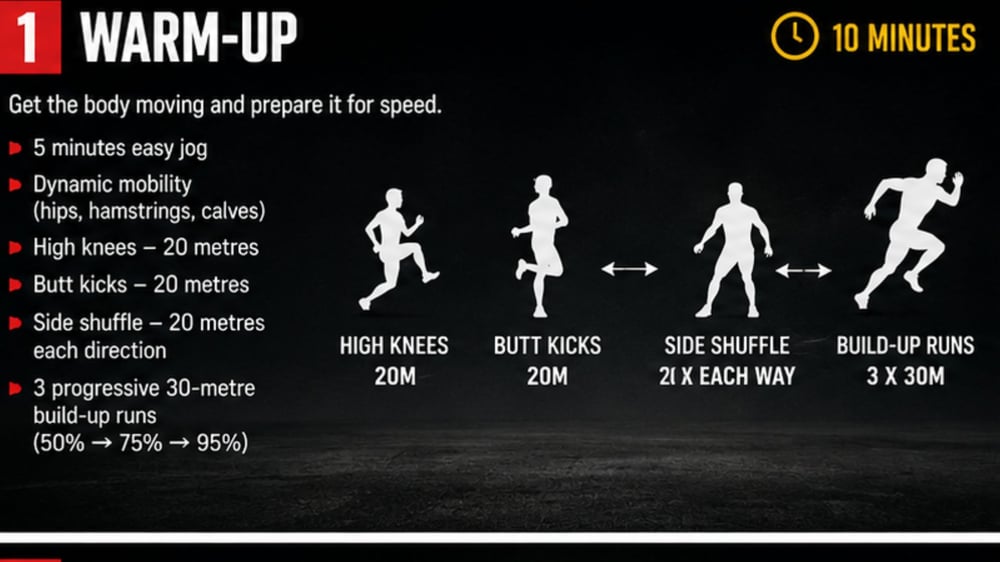
Warm-up (10 minutes)
Spend five minutes jogging at an easy pace before waking the body up with some dynamic movements. Try marching forward into high knees for 20 meters, then kick your heels up to your backside for another 20 meters, and finally side-shuffle 20 meters in each direction. Finish with three gradually faster 30-meter runs, building from about 50% effort to almost full speed.
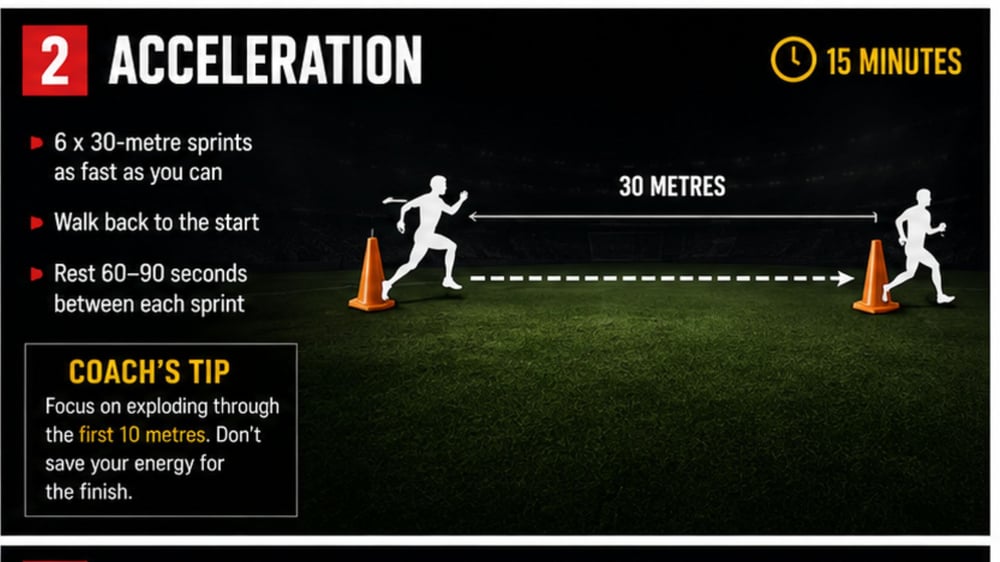
Acceleration (15 minutes)
Sprint 30 meters as fast as you can, then slowly walk back to the start. Take a rest for one minute, or until your chest has stopped huffing and puffing, and repeat this six times. Really try to focus on exploding through the first 10 meters rather than saving your energy for the photo finish.
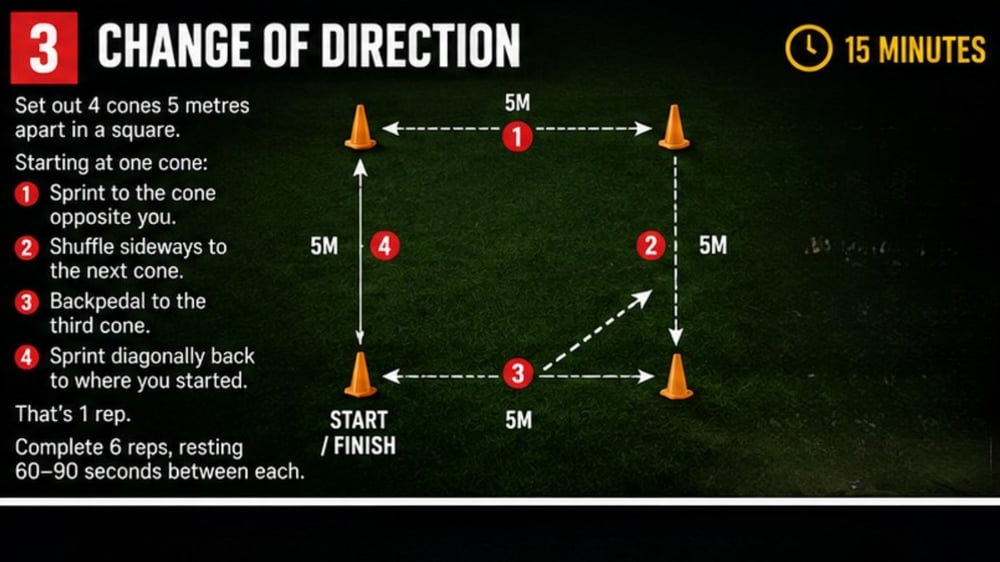
Change Of Direction (15 minutes)
Set out four cones five meters apart in a square. Starting at one cone, sprint to the cone opposite you. Next, shuffle sideways to the next cone and backpedal to the third cone. Finally, sprint diagonally back to where you started. You can consider that as one repetition. Make sure you complete six reps, resting about 60 seconds between each. The constant changes of direction better reflect what actually happens during a fight than simply running in a straight line.
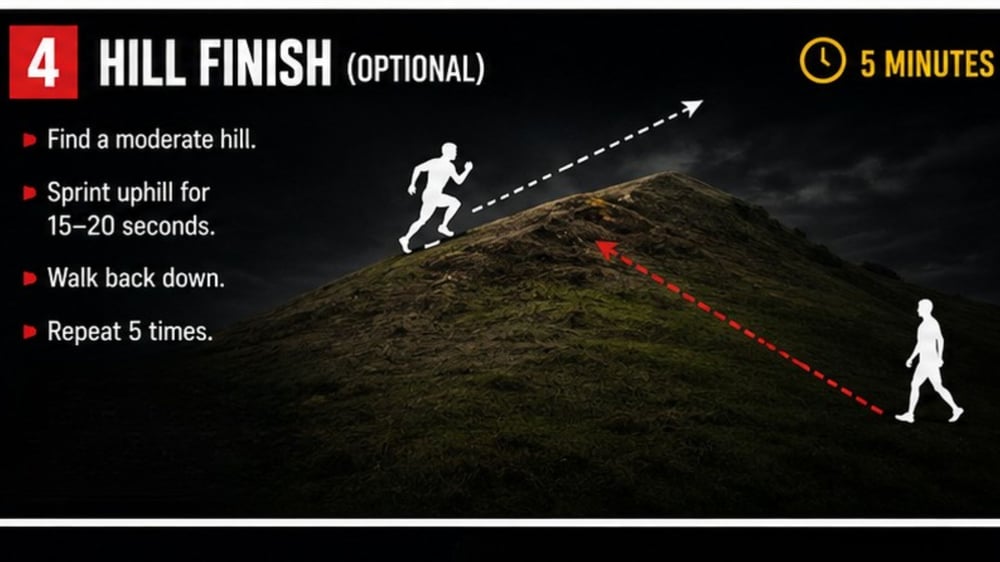
Hill Finish (5 minutes)
Find a moderately steep hill. If it scares you a little, then you’re in the right place, but work with what you’ve got as good hills are hard to come by. Sprint uphill for 15–20 seconds, then slowly walk back down to regather your breath. Repeat this five times. If you don't have a hill, replace these with five more 30-meter backward flat sprints.
SCIENCE PLAYS CATCH UP
If there’s a single consistency when it comes to sports science, it’s that it has a habit of spending years proving what a few stubborn athletes were already doing. Nick Diaz looked like he'd joined the wrong sport when he felt triathlon ribbons break across his chest. GSP and Khabib were charging up hills while everyone else was wondering why they weren't doing another round on the pads. Maybe they all understood something the rest of us were slow to catch. Fights aren't won by the person who can jog the longest. They're won by whoever gets there first. The first punch. The first takedown. The first scramble. This MMA study doesn't claim that sprinting is the missing ingredient in becoming a champion. What it does suggest is that if your training never asks you to move as fast as you possibly can, don't be surprised if your opponent does. Sometimes the newest research doesn't uncover a revolutionary idea. It simply reminds us that the old ideas were never old in the first place. They were just waiting for someone in a white lab coat to put a stopwatch on them.
...