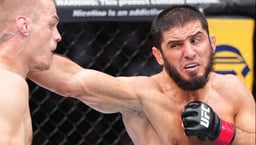

Islam Makhachev’s move to welterweight has already forced the former lightweight champion to adjust his approach, and Dan Hardy believes those adaptations will become even more important if Makhachev remains at 170 pounds.
Makhachev moved up to welterweight and captured the UFC title with a victory over Ian Machado Garry at UFC 330. While Makhachev has carried his elite grappling and control game into the heavier division, Hardy believes the physical differences between the weight classes will present a unique challenge.
Speaking on Submission Radio, Hardy emphasized that welterweights are not simply larger because they weigh more on the scale.
“Makhachev stepped up into a weight class where guys are — and I'm going to use these words very clearly — people are weighing in 15 pounds heavier. They're not 15 pounds heavier. They've got more muscle mass, they've got bigger frames,” Hardy said.
“You're getting guys that are in there that are like 6'2", 6'3", you know, 6'4". Some of these welterweights are getting really, really big broad shoulders, long arms, long legs, difficult to take down because there's always a limb that's going to connect to the floor.”
According to Hardy, those physical differences mean Makhachev can no longer rely solely on the advantages he enjoyed at lightweight. Instead, the Russian may need to build his welterweight game around pace, pressure and sustained activity.
“Makhachev's game has had to change and this is where I think this is where Makhachev will adapt if he stays in the welterweight division,” Hardy said.
“If he wants to stay and try and keep defending the belt I think it's going to be much more about hustle.”
Hardy pointed to former UFC champions Merab Dvalishvili and Alexander Volkanovski as examples of smaller fighters who overcame physical disadvantages by building their games around their strengths.
“This is where someone like Merab (Dvalishvili) made up for being shorter in the division. He just forced people to work much harder. Same thing with Volkanovski,” Hardy said.
“There's something to be learned from both of those guys, smaller in the division but just as effective because they crafted their game around their assets.”
For Hardy, that could be the blueprint Makhachev needs to follow as he establishes himself at welterweight. Rather than trying to physically overpower larger opponents, Makhachev may have to rely increasingly on his conditioning, technique and ability to maintain a relentless pace.
“And I think Makhachev needs to realize that he's now not going to be one of the bigger bullies in the weight class anymore because there's going to be some big boys that he has to deal with,” Hardy said.