

Issue 232
August 2026
Ray Klerck asks sports psychologists why some fighters would rather break than quit, and when their greatest strength becomes their most dangerous weakness.
There is a perfectly sensible moment when a fighter’s brain is due a systems check and concludes the current plan is experiencing technical difficulties. The legs have the composure of wet cardboard, one eye flickers toward the ref, and gravity keeps sending increasingly aggressive reminders that the canvas is available. Evolution has spent millions of years developing survival instincts specifically for moments like this, yet some fighters apparently have theirs set to airplane mode. Cheick Kongo provided perhaps one of the most notable examples against Pat Barry in 2011. Barry dropped him twice, watched him stagger on spaghetti legs where Joe Rogan questioned why the ref hadn’t called a stoppage, but Kongo got up undeterred to unleash a combo that knocked Barry unconscious just 2:39 into the first round. This never-say-die attitude remains one of MMA's strangest reminders that being awake and being operational aren't necessarily the same thing. Almost 15 years later, the sport is still producing fighters who seem to possess a questionable relationship with the off switch. At UFC Freedom 250, Justin Gaethje absorbed the full force of Ilia Topuria throwing with 72% accuracy for multiple rounds, then stepped back into the pocket to somehow turn a near physical collapse into a victory when Topuria's corner stopped the fight. Jeremiah Wells recently found another route to the same destination at UFC 330 when he was two rounds down against Myktybek Orolbai. Wells unleashed a right hand, grabbed a Ninja Choke during the resulting takedown attempt, and beat Orolbai at 1:24 of the third. Apparently, being 10 minutes into a losing fight is merely an administrative inconvenience if your brain refuses to accept the paperwork. But the question is how?
GETTING KNOCKED OUT ISN’T ENOUGH
From the outside, we call these things heart or having a chin forged in the fires of Mordor. A fighter’s brain decides how much unpleasantness you're allowed to endure before it starts dimming the lights. To this end, the elite spend thousands of hours training to interfere with that perfectly sensible arrangement. And, remarkably, even when the KO does come, they don't necessarily reconsider the agreed-upon terms. An August 2026 study looked at 705 UFC fighters who suffered a KO or TKO from head strikes between 2015 and 2023 and subsequently competed again. Only 3.5% returned within 3 months, 34.2% returned between 3-6 months, and the remaining 45.7% returned between 6-12 months. It means more than four out of every five fighters in this returning cohort were competing within a year of their previous KO. That speaks to not quitting in the long term, but what’s potentially more interesting is what happens in the short term while they’re in the throes of battle, where they’ve become exceptionally good at ignoring the voice telling them to stop. So, we took this mindset to experts in this field. We wanted to know what actually happens inside the head of someone who can be exhausted or frighteningly close to unconscious and still choose to move forward. Is this extraordinary resilience, or simply a brain that has become exceptionally talented at ignoring its own customer service department?
WHEN LOSING BECOMES WHO YOU ARE
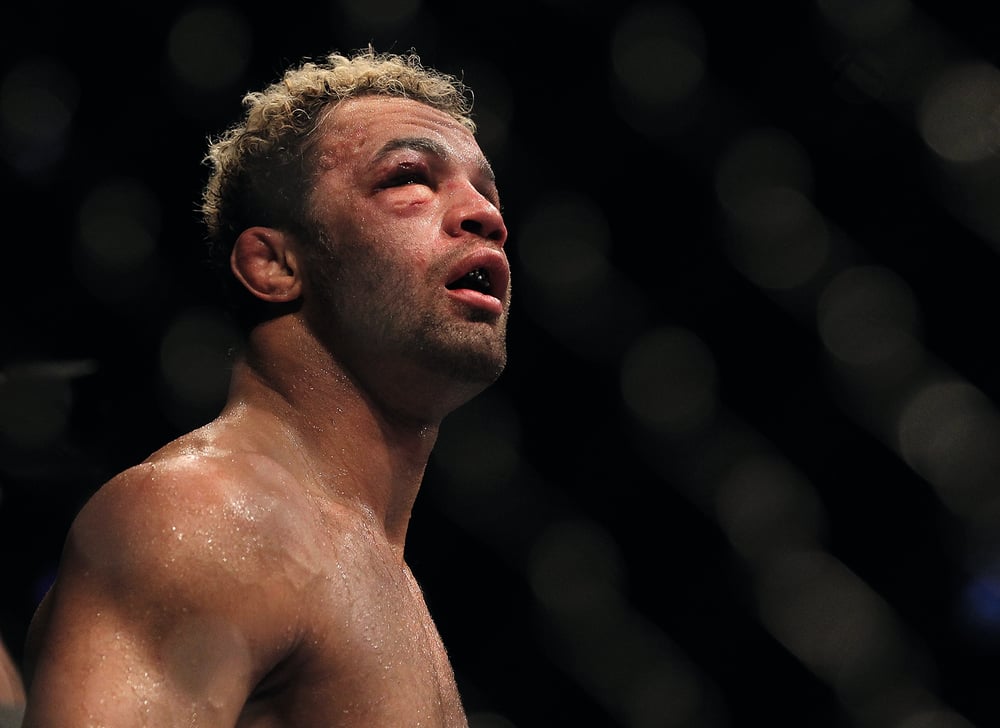
Dr Paul McCarthy, a sports psychologist with 25 years of experience who specializes in MMA, believes the answer to this character trait may lie somewhere beyond a high pain tolerance.
“One of the biggest differences is not courage, toughness, or heart, but identity,” he says. “For some fighters, losing is something they do. For others, losing feels like something they become.”
That distinction means they've potentially spent years constructing an identity around being the person who cannot be broken.
“If a fighter's sense of self is heavily tied to being ‘the warrior,’ ‘the toughest person in the octagon,’ or ‘someone who never breaks,’ then quitting can feel psychologically more threatening than the physical consequences of continuing,” he explains.
This is quite extraordinary mental arithmetic. Your body can be presenting increasingly persuasive evidence that today isn't your day, while the alternative of surrender is calculated to be even worse.
“Pain, risk, long-term consequences, and even tactical decision-making can become secondary to a single overriding goal: survive this moment. Stay in the fight. Keep moving forward. When people describe a fighter as having a ‘refusal to lose’, what we are often seeing is a refusal to stop pursuing a deeply meaningful identity-driven objective.”
In other words, tapping out might mean moving their hand a few inches, but for some fighters, those could be the longest few inches of their lives.
SOMETIMES TOUGHNESS IS JUST AWKWARDNESS
That soldier identity doesn't always need to come from somewhere particularly heroic. Ned Dickeson is a registered clinical psychologist with roughly 20 years of experience in mental health who works with combat sports athletes across MMA, boxing, Muay Thai, BJJ, and Judo. He's also a BJJ brown belt who has competed across several combat sports, and his work with fighters has given him a slightly less romantic explanation for why some refuse to quit.
“The assumption most people probably make is that the professional fighters we watch on TV who endure a hellish beating despite it being clear they have no chance of winning must have some type of superhuman mental fortitude,” he says. “In truth, they’re often motivated by the same type of social anxiety and ego-preservation that anyone can relate to. Specifically, while losing a fight isn’t ideal, quitting in one is unforgivable.”
That sits neatly beside McCarthy's idea of identity but removes the superhero cape. A fighter may continue because being the one who stopped feels worse than being the one currently taking the rough end of the pineapple. Dickeson points to something he's heard from amateur fighters after TKO losses.
“I knew I had lost, I thought briefly about tapping but then decided I would look better if I just took my beating until it was over.”
There is another psychological trap waiting once the damage has already been done. Dickeson highlights sunk-cost reasoning, where everything you've already invested or lost makes abandoning the endeavor increasingly difficult. In ordinary life, that's how you end up three terrible seasons into a television series insisting it has to get good eventually. In combat sports, the investment can be considerably more anatomical. Which suggests that the fighter who refuses to quit isn't necessarily tapping into a secret reserve of courage unavailable to the rest of us. Sometimes the same brain that keeps ordinary people trapped in terrible TV series gets handed four-ounce gloves and a considerably more dangerous problem.
SHOULD YOU EVEN TRAIN TOUGHNESS?
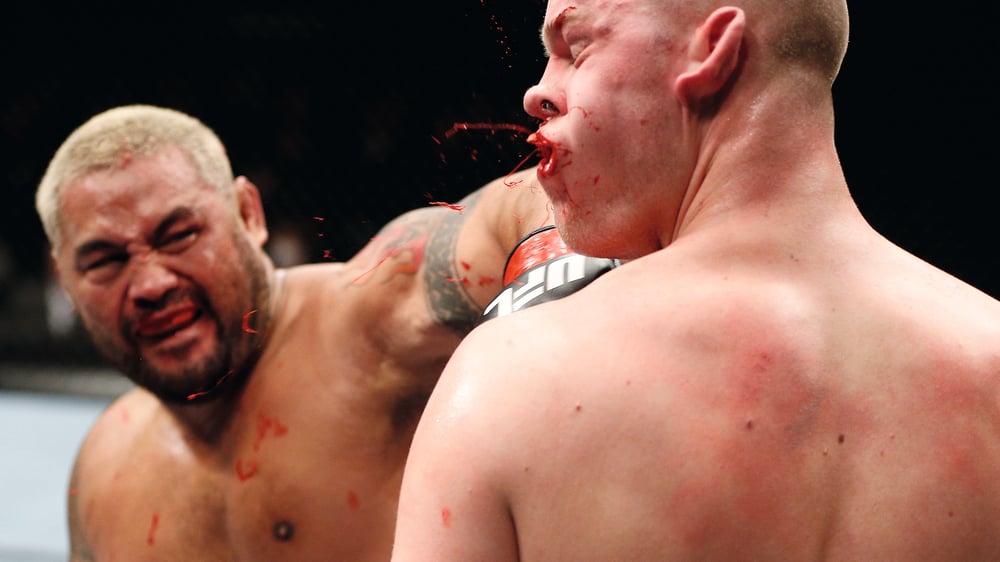
If refusing to quit can occasionally be as much a psychological trap as a superpower, the obvious next question is whether fighters can actually train themselves to become better at it. McCarthy believes they can.
“Mental toughness can absolutely be developed through exposure to adversity, demanding training environments, learning to tolerate discomfort, and building confidence in one's ability to cope under pressure,” he says. “Fighters repeatedly rehearse pushing through fatigue, pain, fear, and uncertainty.”
But he believes some of the strongest foundations are laid long before anyone wraps their hands.
“The strongest drivers, however, are often biographical and psychological rather than technical,” says McCarthy. “Many elite fighters grow up valuing perseverance and resilience. Over time, these values become woven into their identity (identity foreclosure as a fighter). The athlete is no longer simply practicing toughness. They come to see themselves as a tough person.”
Dickeson is a little more cautious about how much of that mindset can be manufactured.
“An identical type of hardship can seem to make one person more resilient and determined, while another person becomes entirely traumatized and dysfunctional,” he explains. “Therefore, I personally suspect that mental traits such as grit or a refusal to quit are typically underestimated in terms of the extent to which they are determined by innate or genetic factors.”
So both experts leave room for nature and nurture, but Dickeson raises a more interesting question: even if you can deliberately become harder to break, should that actually be the objective?
“I wouldn’t necessarily advise a fighter to try to develop a ‘refusal-to-quit’ mentality,” says Dickeson. “This would be analogous to only training late-stage escapes in submission grappling, at the expense of developing correct form and body positioning to reduce the likelihood of getting into such a compromised position initially.”
It is a skill that can be trained. A 2026 study suggests this kind of mental toughness can be trained. After 12 weeks of mental exercises, including goal setting, visualization, and positive self-talk, 18 MMA fighters became mentally tougher and less anxious before competing. Proof that you can do anything you set your mind to.
“It can be difficult to make a general comparison here between fighters, but oftentimes we'll see a fighter throughout their career respond both ways,” explains Dr Adam Gallenberg, a Principal Sports Psychologist who works with MMA athletes. “From a psychological standpoint, one difference is whether or not that situation was trained or if it truly caught them off guard. For example, a fighter is able to better appraise a threat situation if they are anticipating it, therefore less likely to tap out. A lot of this comes down to the appraisal of the situation and what ‘quitting’ means to the fighter in that moment. Appraisal and composure are both mental skills that can be trained and optimized, so I would argue the ability to ‘refuse to quit’ is trainable and that training process is also dictated by the fighter's identity.”
PUNCTURING THE MYTHOLOGY
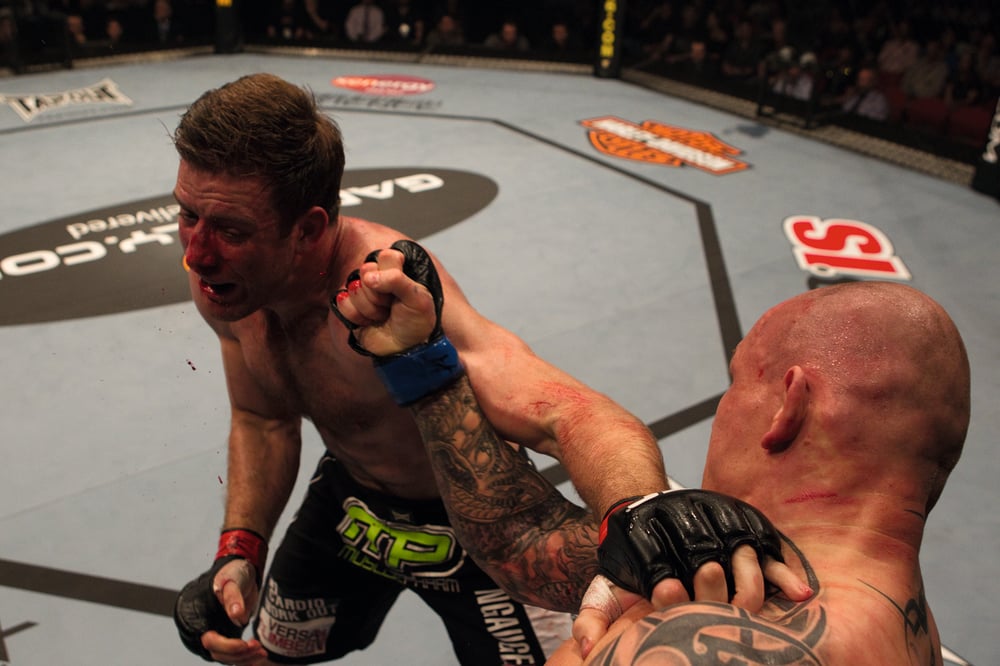
Training yourself to survive a burning building isn't necessarily as useful as training yourself to remember where the fire exit is. McCarthy arrives at a somewhat similar destination from another direction.
“The healthiest form of resilience is flexible,” says McCarthy. “It allows an athlete to distinguish between productive suffering and unnecessary self-destruction. The psychologically strongest competitors are not always those who endure the most pain. Often, they are the ones who can accurately assess the situation and make the decision that gives them the best chance of future success.”
The skill might be to understand when to endure and when continuing no longer serves any useful purpose. Dickeson would rather that someone focus on their confidence and the ability to reset mentally, while McCarthy warns that resilience can become counterproductive when it becomes too rigid.
“A fighter who literally cannot stop may be acting from fear of appearing weak, fear of disappointing others, or fear of losing a valued identity,” says McCarthy. “At that point, what looks like mental strength from the outside may actually reflect psychological inflexibility.”
Which produces one of MMA’s ironies. We celebrate the fighter who cannot be broken, but psychologically, the healthier fighter might be the one who can be broken, recognize it, and make the correct decision so they can come back and fight another day. The problem is that quitting can threaten the identity you've spent half your life constructing, and it asks an awful lot of the clearly damaged brain. And that’s why corners are still allowed to throw in the towel and do it for you.

WHEN SOMEONE ELSE HAS TO QUIT FOR YOU
Mohammad Yahya hit the canvas six times against Steven Nguyen at UFC Abu Dhabi in 2025, setting a UFC record for knockdowns in a single fight. Six. Yet Yahya kept fighting until the contest was finally stopped at the end of the second round, his badly swollen eye making a third round increasingly difficult to justify. Once a fighter’s refusal to quit becomes psychologically inflexible, there is an obvious flaw in asking them whether they’ve had enough. McCarthy believes this is where the difference between useful and destructive resilience becomes crucial.
“The important psychological question is whether the behavior serves the athlete's long-term goals,” he says.
Sometimes the psychologically stronger decision is recognizing that whatever you're proving is no longer worth what you're paying for it. And if the fighter can't make that calculation, MMA has refs, doctors and corners who can. The last of those, Dickeson argues, can be strangely reluctant to get involved.
“For whatever reason, MMA has not adopted a cultural norm of corner stoppages as professional boxing has,” he says. “Corner stoppages between rounds are rare, while to my knowledge there’s only been one example of a towel thrown mid-fight in the entire history of the UFC (Nate Diaz vs Josh Thompson).”
This is only one of three times when this has happened, and it creates an odd loophole in the psychology of quitting. A fighter can know the comeback has gone from unlikely to requiring divine intervention, yet voluntarily stopping still means accepting the one thing their identity has spent years learning to reject.
“Examples of fighters continuing to take damage despite no longer expecting to win can be observed on almost every fight card,” says Dickeson. “Commentators bemoaning corners to stop fights, saying ‘Fighter X needs to be protected from themselves’ has effectively become a catchphrase.”
He thinks even that familiar line gives the situation slightly too much poetry.
“Personally, I think that a more accurate description would be ‘Fighter X needs to be protected from getting any more brain damage.’ The obvious point being that they’re typically trapped in a situation that they can’t voluntarily end while still maintaining dignity.”
That's where resilience can perform its neatest psychological trick. The same quality that helped somebody become an elite fighter can eventually prevent them from making the decision most likely to preserve their ability to remain one.
The towel isn't necessarily proof that a fighter lacked toughness. Sometimes it's the thing that saves them from having too much of it.
KNOW WHEN TO TURN IT OFF
Perhaps that’s why we’ll never completely solve one of the sport’s great ironies. MMA demands that you become unusually comfortable with discomfort, then rewards those who can keep functioning when every alarm bell is going off. Sometimes that produces a Cheick Kongo comeback. Sometimes it produces six knockdowns and a doctor deciding the home crowd has seen enough. The psychology behind both can come from surprisingly similar places. Heart, identity, ego, experience and resilience can keep a fighter moving forward long after most of us would be looking for the comfort of an intravenous drip. That's part of what makes MMA fighters extraordinary, but it might also be why toughness has been slightly misunderstood. The hardest fighter isn't necessarily the one willing to suffer the most. Sometimes it's the one secure enough in who they are to know that losing a fight doesn't mean losing themselves. Because after spending a lifetime learning how not to quit, knowing when to stop might be the toughest skill of all.
...