

Issue 232
August 2026
Fighters Only interviews Carlos Prates about escaping the flower-shop 9-to-5 and preparing to deliver Islam Makhachev a nightmare.
Carlos Prates is pretty much everything that an MMA fighter shouldn’t be. Before the UFC victories, fame, and the opportunity to test himself against Islam Makhachev, ‘The Nightmare’ earned a living in a place that had more buds than thuds.
“Oh, at first I worked at a, like a flower store, you know?” he recently said. “Like, I did deliveries to bring the flowers and things like that. Eight hours per day, bro. I don't like.”
It’s an origin story which you’d imagine had plenty of room for the smoke breaks he’s famous for. What’s striking is the lack of grandiose speeches about destiny or childhood promises to wrap UFC gold around his waist. He walked into the full-time working week and decided getting punched in the face might offer a more attractive career path. And it is a decision has worked out rather well. Prates entered the UFC through Dana White’s Contender Series, has suffered only one defeat in the promotion and knocked down former welterweight champion Jack Della Maddalena. Now he says his new deal comes with something considerably more appealing than the smell of buttercups.
“I’m the next for the title, basically,” said Prates after recently signing an eight-fight contract. “New contract, the next one for the title, and let’s go!”
The UFC has not officially confirmed Makhachev’s next challenger, with Michael Morales also occupying a seat in the waiting room. Prates, however, appears to regard the matter as largely administrative. He has already told Morales that more work will be required before the unbeaten contender gets his turn.
“Bro, I think he’s going to fight, I don’t know, maybe Belal Muhammad or some other fighter,” said Prates. “But he needs to fight one more.”
Prates is similarly clear about how he thinks things will play out.
“I will knock you out, bro,” Prates said when asked about it. “I will knock you out. I will bring that belt to Brazil. The first welterweight champion from Brazil.”
BORING FIGHTS, INTERESTING MAN
There is something wonderfully incompatible about Carlos Prates. He earns his living in MMA but does not particularly enjoy watching MMA. He wants to fight one of the finest grapplers in the sport, yet finds grappling about as entertaining as the eight-hour shift he originally escaped.
“I think [Makhachev] is boring,” Prates said during an appearance on The Ariel Helwani Show.
That assessment may not endear him to anyone who enjoys a beautifully timed takedown, but Prates is not pretending to be an MMA historian to sell a title fight. His viewing habits are brutally simple. Friends are acceptable. Strikers are preferable. Knockouts are the main reason to remain seated.
“I don’t like watching fights at all. Striking fights or some friends, of course, I like to watch. But especially if there’s a grappler fighting, I don’t like to watch. I like to watch people getting knockouts, a lot of action and things like that.”
The contradiction gets better. While Prates has little interest in watching grappling, it has become the part of training he most enjoys.
“It’s crazy because now I really like to train grappling more than striking, but I don’t like to watch grappling and fighters going to the ground and boring fights.”
That is part of the Prates appeal. His answers do not sound as though they have spent three rounds being wrestled by a media adviser. He can call the champion boring, admit he would rather not watch most fights and then explain that the matchup is attractive precisely because it is difficult.
“I know I’m [the] underdog,” said Prates. “But I really want to fight him, not because of the title or money, because I want to test myself against him. I’m really excited to do this. I really think I can win. I can shock the world. I can make everybody surprised. I will do this.”
For somebody who entered MMA because eight hours of ordinary employment sounded unbearable, Prates has found himself contemplating a particularly demanding assignment. Islam Makhachev represents the championship, the stylistic test, and the kind of opponent Prates ordinarily would not bother to watch. Fortunately for him, this time he will be allowed to hit the boring part.
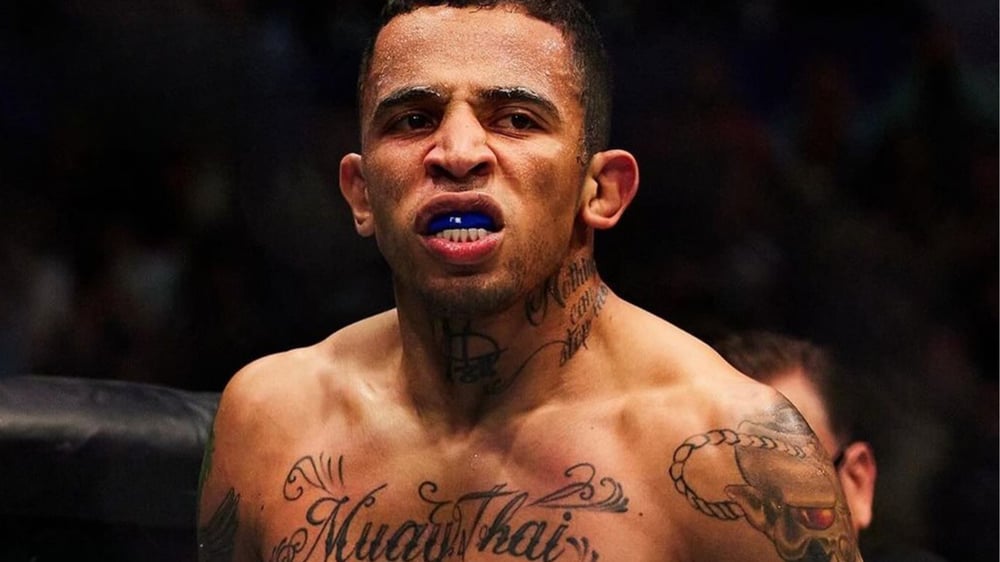
TOO MANY HUGS
Watching Islam Makhachev fight from a television screen is one thing. Watching him operate in person, with your own championship ambitions sitting somewhere uncomfortably close to the action, as Prates did, is professional development at its finest.
“It was a really good performance,” Prates told Fighters Only. “Everybody expected this already, and it was an interesting fight. And I think that fight was really good for me, because it went the full five rounds and also now, we have a lot of things we saw that stood out about Islam. So, I think it was a really good fight.”
Makhachev retained his title by decision, but Prates saw evidence that the champion’s game could be interrupted.
“I think because Islam is bigger and maybe heavier, you know, so he had to work a lot during the fight, and he tried a lot of takedowns because Ian Machado Garry got up many times and it was a really good fight.”
Respect is important in martial arts, but Prates apparently prefers it without the complimentary cuddling package.
“Yeah, I think he fought really well and all. Ian defended some takedowns when he went to the ground; he got up. So, he didn't get submitted, and I think he should have been a little bit more aggressive, but yeah, he fought really well. I mean, it's really hard to fight Islam because he's really good with his game plan. He controlled the fight.”
That missing aggression matters because it separates Prates’ imagined version of the matchup from the one he watched. He does not intend to spend the intervals demonstrating international friendship.
“Ian was a little bit too respectful,” smiles Prates. “It's not the way I like it, but everybody has his own way to do things and if he feels good doing that, but I don't really like this. I prefer not too many hugs like Ian did between rounds.”
This is not Prates claiming that Makhachev looked ordinary. Quite the opposite.
“I’m impressed with everything. Everything he can try to control in the fight, Ian was fighting a lot to escape, and he was doing well striking. I think he should be a little bit more aggressive, but he was doing well too. So yeah, I'm really excited to do this.”
For most people, watching Makhachev impose his game across five rounds would be a good reason to suddenly develop an interest in another division. Prates left Philadelphia wanting the fight more.
“Watching Islam fight live gave me more confidence. I saw Ian defend some takedowns, the way Islam didn't submit Ian, and the way he fought. I think I have a really good chance to beat him. I really want to test myself against him.”
The champion gave Prates five rounds of material to study. Unfortunately for Makhachev, his prospective challenger appears to have spent most of them counting takedowns, noting escapes and becoming increasingly offended by all the coziness.
AN OVERNIGHT SUCCESS SINCE 14
Prates’ arrival among the welterweight elite has been quick enough to cause a slight neck strain. One moment he was collecting bonuses and climbing the rankings, and the next he was signing a new contract and discussing the champion as though somebody had already started printing the posters.
“I'm feeling good,” when Fighters Only asked about the career surge. “I'm working hard for this. And I feel like I grew up really fast, fight by fight, you know, like you learn a little bit more. I think I'm in my prime now, winning, getting bonuses, I got a new contract, title shot. Everything is going really well. I'm really excited.”
It sounds like the standard overnight-success package, provided nobody looks too closely at how long the night lasted.
“Anderson Silva is my biggest idol, and yeah, I started when I was 14 years old,” he explains. “My first MMA fight was when I was 17, and we kept it riding. Working hard after this without stopping, just working, fighting, growing up, and now we are here.”
That first fight brought the usual collection of teenage emotions, except Prates was experiencing them while preparing to compete on one of Brazil’s biggest shows rather than waiting outside the principal’s office. The event was being shown on television, giving him an unusually public place to discover whether this career choice had any legs.
“I was a little bit nervous, a little bit excited to fight,” he told us. “Yeah, but it was a really good opportunity because I was fighting on a biggest show in Brazil. They pass on TV at the time. I was really happy. So could it couldn't be a better debut.”
There is an appealing straightness to the way Prates tells the story. He started young, fought young and kept going. No mystical fork in the road. No claims that the universe placed four-ounce gloves beneath his pillow. Just years of working, fighting and improving until the flower delivery driver somehow found himself waiting for Islam Makhachev.
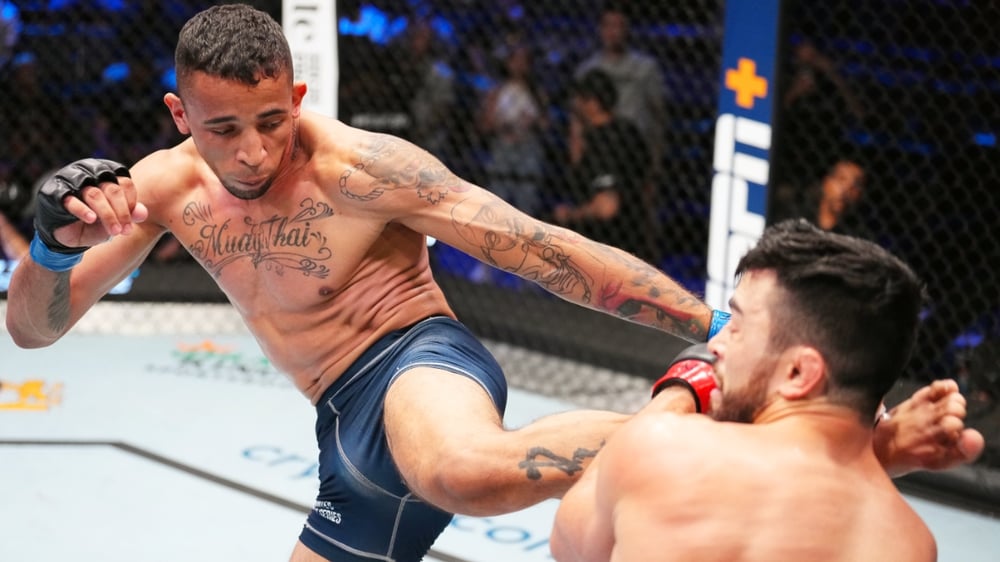
VINTAGE NIGHTMARE
The road into the UFC can be complicated, but the final instruction is generally straightforward. Impress Dana White.
“I was really happy that the first time Dana said I was getting the contract, I didn't understand,” he explains. “And then I saw everybody say, ‘Go there, go there, go to meet him.’ And I was like, ‘Oh, I got this.’”
Prates had delivered the necessary performance on Dana White’s Contender Series, but the good news required a brief group translation before the celebration could begin.
“Yeah, it felt really good to impress the UFC CEO. Dana said I was looking like a vintage Anderson Silva. So I was really happy at the time.”
Comparisons to Silva are usually handed out whenever a Brazilian lands something with a degree of imagination, but this one carried considerably more weight for Prates. He had already named the former middleweight champion as the figure who inspired him, and now the man handing out UFC contracts was using Silva’s name to describe him.
NOT AN ANDERSON SILVA REVENGE TOUR
The Anderson Silva comparison creates an obvious promotional temptation, especially considering Makhachev has now broken Silva’s record. All the ingredients are sitting there for a revenge story, provided nobody asks Prates whether he is interested in starring in it.
“Yeah, Islam Makhachev broke Anderson Silva’s record,” he told us. “But I try not think about this and I’m just trying to think about my legacy, about my friends who work with me, my teammates. They deserve it also, you know. It's not only to myself. It's to everybody, to my gym, my friends, my, my coaches, everybody working together to help me to get my dream. So that's what I think of. To go to the fights, get the belt, bring the belt for Brazil. And that's it.”
That final sentence does a lot of heavy lifting. Prates is not carrying Silva’s record book into the Octagon and demanding historical justice. His motivation is closer to home. The belt would belong to those closest to him and in the middle of that group is his coach, Cristian Nogueira, who leads the Vale Top Team. Prates describes him as a mentor but refuses to reduce the rest of his preparation to a single important training partner.
“First, out of all of them, my coach Chris, who is like my father,” said Prates. “And after this, all of my teammates, like we work together and all, like, I cannot just say one guy, like he's all the team. With my boxing coach, Bam Bam. I like to have the same corner for all my fights.”
There is an appealing consistency to that approach. The opponents change, the stakes rise, and the contracts become longer, but Prates wants the same people behind him. In a sport where fighters frequently rebuild their camps whenever something goes wrong, he appears to prefer keeping the machinery intact and teaching it to handle a larger job. He wants to build his own legacy, reward the people who built it with him and bring the welterweight belt home. The revenge movie will have to find another leading man.
ENEMY TERRITORY WITHOUT ENEMIES
Traveling to the other side of the world to fight somebody surrounded by Australian supporters should feel like a fish out of water, unless you’re Prates.
“No, it wasn’t difficult because I don't feel like I’m in the opponent's house and all like Australia was really nice,” he told us when quizzed about how it felt to win so far away from home. “It's a really nice country. People like me a lot there. So, I don't feel like I’m in enemy territory like that.”
Australians have always had a weakness for fighters who appear capable of showmanship without behaving as though they have spent six weeks rehearsing threats in a bathroom mirror. Prates fits comfortably into that category. He knocks people down, speaks plainly and carries himself with the relaxed energy of someone who might be heading outside for a cigarette rather than into a fight.
“It's really nice getting the love from all the fans,” he said. “It was really nice. And I like to talk with them. I try to do as much as I can. I try to take pictures with everybody, talk with everybody. Of course I can't, but I really like this.”
That willingness to stop, talk and take photographs offers another contradiction in a career increasingly full of them. The man called ‘The Nightmare’ is uncharacteristically very pleasant to meet. The fighter who dislikes unnecessary hugs between rounds is considerably more welcoming once nobody is trying to take him down. It also explains why Prates travels so well. Supporters do not need a complicated sales pitch to understand him. He likes knockouts, dislikes boring fights, and says what he thinks before anyone can sand down the interesting edges. That personality crosses borders rather easily, particularly with Australians.
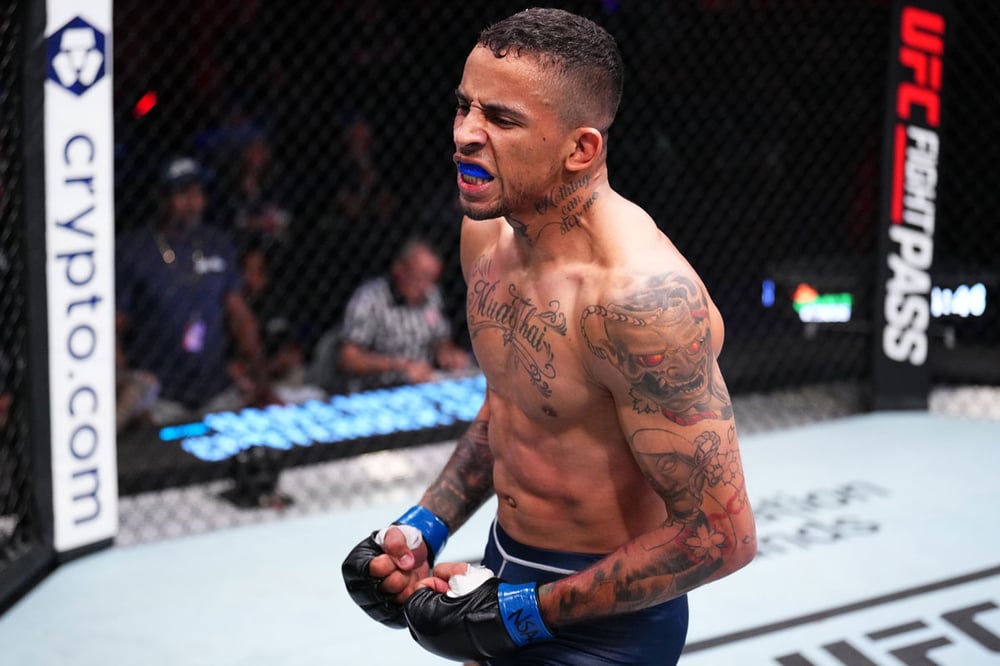
WAITING FOR THE NIGHT SHIFT
The great joke in Prates’ escape from conventional employment is that he accidentally chose a career requiring far more patience. MMA removed the timesheet but replaced it with years of training, uncertain contracts and long stretches where the most important decision in your life belongs to somebody sitting in an office.
“I’m hoping that it’s going to happen maybe at the end of this year, but I don't believe this,” he smiles when pressed about it. “I hope so. But I don't think. But if it's not, it's okay too. It's more time to start this long game and train a little bit more. I really would love to fight in December, but I don't know if it's going to happen. Obviously, I hope so though.”
There is no attempt to manufacture certainty where none exists. That is the strange privilege of becoming a genuine title contender. You spend years trying to become impossible to ignore, then discover the final stage involves checking your phone and remaining professionally dangerous. Perhaps that is why the waiting seems unlikely to trouble him. Prates has been at this since he was 14, long before anyone was discussing championship records, eight-fight contracts or promotional timelines. He may hate an eight-hour working day, but he has shown a remarkable tolerance for the long game. Now there is potentially one shift remaining, with no flower deliveries, no lunch break and a welterweight belt waiting at the end of it. For the first time in his working life, Carlos Prates may be hoping the boss puts him on the roster.