

Issue 232
August 2026
How much of becoming successful is actually luck? We examine why this might be MMA's most forbidden word.
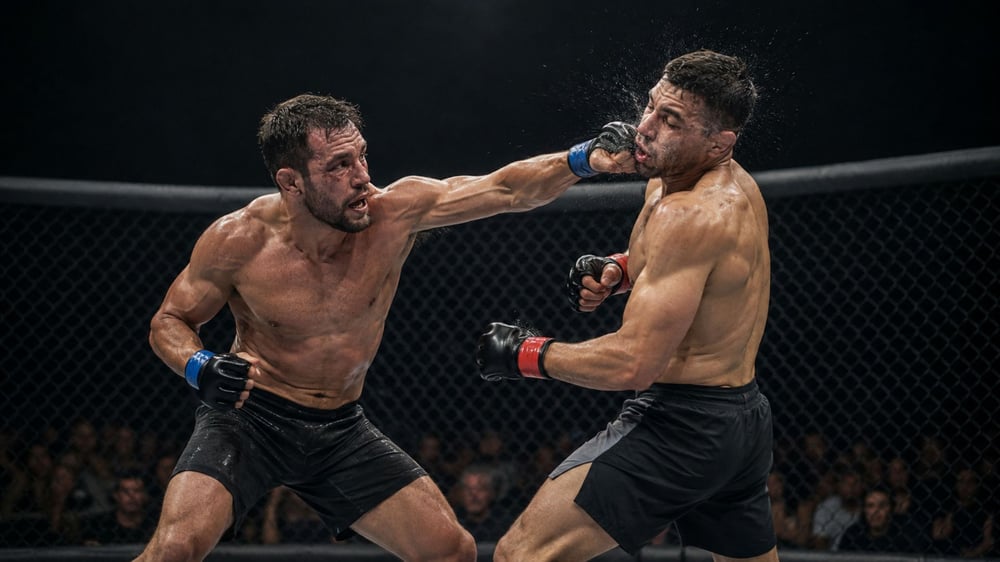
Things can either go for you or against you. Regardless of a fight’s outcome, there is a myth around complete control. Then there are the lucky breaks, but with respect to this, you’ll almost never ever hear a winner claim luck was on their side. Wins come from skills and dedication. Losses? Well, that’s a different story, because their opponent very often gets lucky. That does not make champions lucky, despite all their meticulous preparation. Only losers. Yet the distance between contender and champion can be decided by things neither fighter trained for. MMA is beautifully unpredictable, and even the best pre-fight models have only 67%–75% accuracy, whereas tennis can predict results with almost 93% accuracy. In the fight game, luck might be at play when the right name becomes available at the wrong time. A split decision falls your way. Only one healthy knee survives camp. Suddenly, the belt is close enough to touch, but if things don’t fall your way, then luck becomes something people believe in. When Sean O'Malley suffered a dead leg in the first round after Vera unloaded a calf kick that struck a nerve, leading to O'Malley rolling his ankle and being finished via ground-and-pound. O'Malley famously refused to accept the loss as a legitimate skill defeat, labeling the nerve strike a fluke.
“Chito didn't do s***,” O’Malley said after the fight. “He got lucky. Kicked my nerve. I'm 12-0. In my mind, I didn't lose s***. It was a fluke.”
The media and fan narrative was that landing that kick right on the peroneal nerve was a freak, one-in-a-million shot. Vera might reasonably argue that kicking somebody in the leg and damaging their leg is less a lottery win than the basic job description. Still, it showed how easily a fight can turn on a few inches of shinbone and one rather uncooperative nerve. Conor McGregor said Poirier got lucky at UFC 264. Stipe Miocic said he slipped on the canvas’s logo, which gave Stefan Struve his lucky break. And the list goes on, but that only serves to reflect the uncomfortable part of luck in MMA. It rarely arrives carrying a four-leaf clover and announcing itself. It looks like an injury, a short-notice phone call, or a generous scorecard. Skill determines whether a fighter can exploit t the opening, but luck sometimes decides who gets one. Every champion unquestionably earns the belt. However, the more interesting question is how many also needed the MMA gods to briefly stop throwing banana peels, or logos, in their path and place one beneath someone else.
WHEN THE SPORTING GODS GET BORED
Luck is a dodgy haircut. Given enough time, it normally grows out, but that is not much comfort on the day everybody starts taking photographs. Sport works much the same way, which is why there are always attempts to measure how many competitions give luck the chance to disappear. A 2025 study cited earlier research that found luck exerted the greatest influence on individual MLB games and the least on NFL games. That sounds backward when baseball plays enough fixtures to require its own calendar, but it depends on where you stop counting. One baseball game can be gloriously unpredictable. However, when measurements are taken across a huge season, the statistical oddities have months to sober up and go home. MMA fighters might compete twice a year, giving a minor injury or a judge with an adventurous interpretation of the scoring criteria enough room to swallow half a season. To draw a comparison, the researchers also followed seven leading European football leagues across three seasons. They attributed roughly 60% of the variation between expected and actual performance to luck, although they acknowledged that missing variables and limitations in the predictive model could have inflated that figure. Their exploratory simulations still produced a different champion in an average of 33.9% of cases. MMA offers far fewer opportunities for those random swings to correct themselves. A football club can come back next weekend. A fighter gets a meager 15 minutes, or 25 in a title fight, followed by an ice pack and several months to explain that the other bloke got lucky. Skill may determine what happens during the fight, but fortune can have an alarmingly large say in which fights happen, when they happen, and whether the winner receives a belt or another bout buried beneath the undercard.

WHEN EVERYONE IS TOO GOOD
Luck gets particularly dangerous when the ability is high. Statistically minded experts have developed a way to measure whether competitions consistently reward skill. Their premise was very simple. If a team kicks butt during the first half of a season and remains good during the second, skill is probably leaving fingerprints all over the result. If the two seasons’ halves look like they are catfishing each other, chance may be doing more of the matchmaking. They found everything you might expect, which is that the influence of luck also depends on how closely matched the competitors are. If a random person entered an Olympic archery final, their shortage of Olympic-level archery ability would make the result fairly resistant to fortune. But put the world’s best archers in the mix, and the margins become so small that one badly timed gust of wind can help separate gold from silver. MMA title fights occupy this same unpleasant postcode. Both fighters belong there, but the closer they are in ability, the smaller the lucky event would be to prize them apart. A damaged nerve or unintentional eye poke can become that gust of wind. Nobody accidentally becomes UFC champion, but when two people are qualified for the job, luck may still decide who gets to take the belt home.
WINNERS ADMIT IT
In MMA, the word luck is treated like a positive drug test. Losers are free to use the word liberally, but winners appear bound by an unwritten rule that every victory must be explained through sacrifice and strategy. If someone were ever brave enough to admit that fortune helped, it risks getting a bigger matchup next time. The silence around this swear word is perhaps what makes its absence so loud. Fighters routinely blame losses on bad luck, yet when we searched for a victorious fighter mentioning it, there was almost nothing. One of the rare examples came from the Australian regional circuit, where Stephen ‘Astroboy’ Erceg may not yet have received the big leagues memo. Before joining the UFC and challenging for its flyweight title, Erceg reflected on a string of early finishes.
“I don't know what it means, whether I'm better than I thought or I got lucky again,” he said. “It is nice to sort of put out there that this stuff isn't necessarily just luck - it's happening for a reason.”
Even then, Erceg could not leave the word unattended. He mentioned luck and immediately escorted it from the premises by insisting his victories were happening for a reason. And when he got to the UFC, he never mentioned it again. The other rare admission came from Mickey Gall, although his honesty concerned the opportunity rather than the victory. Gall had been plucked from relative obscurity, paired with CM Punk and placed on a huge UFC pay-per-view card.
“I know people say, ‘You did it, you called your shot,’ this and that, but I got lucky,” said Gall. “I was in the right place at the right time.”
These are less confessions than carefully negotiated peace treaties with chance. Erceg wondered whether luck helped, then reaffirmed his ability. Gall admitted fortune opened the door but never suggested it helped him win once he walked through it. Neither man surrendered the achievement, and nor should they. Perhaps that is why luck remains MMA’s dirtiest clean word. Admitting it gives the opponent oxygen, trims a little shine from the winner and interferes with the comforting belief that enough work grants complete control. The reality is less tidy. Skill gets you close enough to hear opportunity knocking, but luck may decide whether it visits your door, your rival’s door or the bloke down the corridor who happened to answer his phone on six days’ notice. Winners can acknowledge that without handing the belt back. It’s just that they very rarely do.
FORTUNE LEAVES FINGERPRINTS
Luck will never replace skill or the thousands of miserable hours spent repeating the same movement until they lose the will to live. Instead, luck hangs around the edges, waiting for a ligament to twang or punch to land one milimeter further north. The best fighters train until fortune has barely enough room to squeeze through the door. MMA simply leaves that door open wider than most sports. With only a few fights each year, one random moment can squat in a career for months without paying rent. That does not make champions lucky. It just means every belt carries a few fingerprints that mysteriously disappear by the time the victory speech begins.
...