

issue 234
October 2026
Before championship belts were on the line, the world's greatest fighters were locked in their own battles. We delve into the gritty and inspiring MMA origin stories that forged these warriors into the legends they are today.
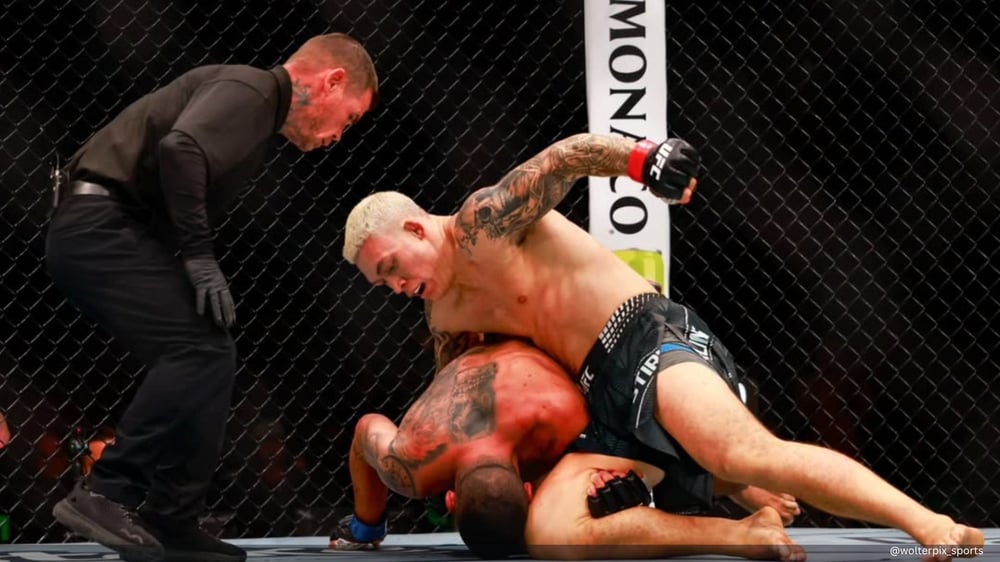
NAVAJO STIRLING – THE CALM DESTROYER
Rongotehengia Navajo Hunter Stirling was born on November 7, 1997, in Upper Hutt, New Zealand. Like most Kiwi kids, sport meant a rugby ball was in his hands, which he played competitively throughout his school years at Upper Hutt College. But the team dynamic eventually grated on his competitive spirit, so he left rugby and took up karate. Then, in his teenage years, fighting became far more serious than anything in training. While trying to protect a friend, Stirling was jumped by a group of five men. It was an encounter that could have ended very differently and one that changed his perspective.
“When it happened to me, I was like, ‘Whoa,’ I could have lost my life here,” he told 1News NZ.
He used that moment to offset the danger and focus on improving his skills, but for much of his late teens, he still had no great idea what he wanted from life.
“I started fighting because I had no direction in life,” he told UFC.com. “I was just a lost kid trying to figure out what I was meant to do.”
At around 19, it became something he might actually be able to build a future around when he watched fellow Kiwi Carlos Ulberg win King in the Ring. In 2020, Stirling visited his brother in Auckland and tagged along to a training session at City Kickboxing, a place that was producing some of the world’s highest-level fighters. Stirling saw Israel Adesanya and Carlos Ulberg plying their trade and, rather than feeling out of place, he came away wondering why he hadn’t put himself there sooner.
“That visit made me realize I should have been here ages ago,” he told 1News NZ.
He returned to Wellington with more direction and began structured striking training under Sone Vannathy at Arch Angels Thai Kickboxing Gym before fighting professionally out of The Lion Pit. The kid who had struggled to find something worth committing himself to had finally found somewhere to put all that energy. Results came quickly. In 2020, Stirling won the King in the Ring 92kg tournament. By early 2021, he moved to Auckland and joined City Kickboxing full-time. Another King in the Ring triumph followed, this time at 100kg, making him a champion across two weight divisions. The bigger prize, however, was the room he now occupied every day. City Kickboxing gave Stirling access to fighters and coaches who understood exactly what competing at the highest level required.
“It's awesome to be a part of, and I feel real confident having them as my third pair of eyes,” he told Te Ao Māori News. “When you get to the high professional (level), you need those close guys in your corner to be able to call other shots you're not seeing and make those calculated reads. That's why we're elite.”
For all the progress, there was no immediate transition into the glamorous life of a full-time professional athlete. Stirling continued working while building his fighting career, right up until the opportunity that would eventually take him into the UFC.
“I worked a full-time job leading right up until my contender series fight, and even then, I was loving it,” he told Sport Nation Fight Club Podcast. “So now that I'm fully immersed in it, I'm just really grateful. I've learned so much through all of my hardships as well, and then everything came to me at the right time. Now that I am here, I feel like I've just got a chip on my shoulder and something above all of my competitors. I really have that gratitude. I see some of these other fighters. They get comfortable. They turn into divas. You have to really come from something to perform at this level.”
That working life matters to Stirling because he believes it gave him something that success can slowly knock out of fighters: perspective. He knows what it feels like to train while holding down a job because he was still doing exactly that on the doorstep of the UFC.
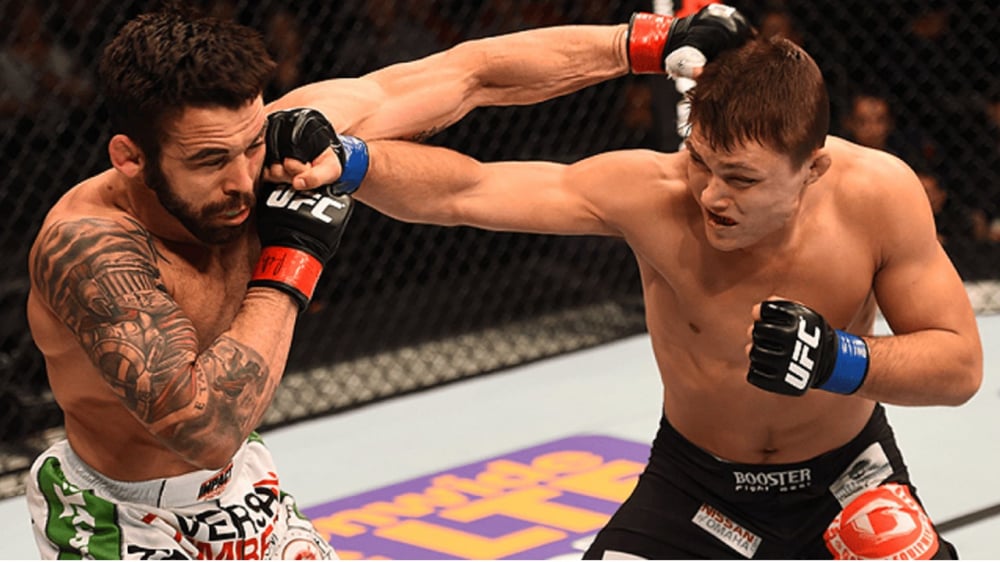
DREW DOBER – THE OMAHA STRIKER
Andrew Martin Dober was born on October 19, 1988, and raised by a single mother in Omaha, Nebraska. Growing up in the American Midwest, his athletic trajectory was far from that of a future power-punching lightweight contender. In fact, he entered combat sports because he had no other natural aptitudes.
“So, my go-to answer is I can't run, jump, or catch a ball,” he told the Savage Gentleman Show. “So, my options were limited. But no, honestly, I was just a nerd growing up, and I fell in love with Bloodsport, Jean-Claude Van Damme movies, Dragon Ball Z, Japanese anime.”
That passion for martial arts media led a 12-year-old Dober to take matters into his own hands. Looking through the yellow pages, he found a local gym in Omaha. When he found out it was $50 a month, he immediately walked to a neighboring fast-food restaurant to get a job to pay his own tuition.
“Everything that I've learned as far as resilience, courage, and a little bit of stupidity, I got from my mother,” Savage Gentleman Show. “And I mean, she raised me like a boy, and then she was pretty much my mom, dad.”
His martial arts journey officially began at age 13 when he walked into Mid America Martial Arts.
“Complete lack of coordination,” he told MyMMANews when asked about his first sessions. “Two left feet. It was like learning to dance. Aggressive dancing. It was bad.”
Despite the awkward start, the practical nature of combat sports immediately clicked. Enrolled at a hybrid gym that offered a mix of disciplines, he stumbled into Brazilian jiu-jitsu after staying late after class. Watching one particular professional matchup opened his eyes to the intellectual depth of combat.
“Jeremy Horn takes the back, lifts, goes for a return, and as Frank Shamrock was getting lifted, he hooks the leg and falls into a kneebar,” he said on the Savage Gentleman Show. “And I went, no, that wasn't athleticism. That wasn't, you know, bravado. The toughest man won. That was the most intelligent man. It's physical chess. And I fell in love with that.”
To round out his skill set, he joined his high school wrestling team, which his weedy frame needed.
“I was a scrawny nerd in high school,” he told MyMMANews. “Competing in high school wrestling taught me work ethic.”
While wrestling gave him a defensive foundation, Dober’s true passion lay in Muay Thai and stand-up striking. He competed in kickboxing and Muay Thai bouts in between his early regional MMA fights, eventually winning two amateur Muay Thai national titles.
“I've always preferred Muay Thai and striking over jiu-jitsu and ground fighting, and every chance I got I would try to take kickboxing and Muay Thai fights in between my MMA fights,” he told Muay Thai Authority. “I joined my high school wrestling team, so I had the ability to stay on my feet. I believe that Muay Thai and even traditional Muay Thai can and will win me fights in both the ring and in the cage.”
That dedication to mastering his craft meant making major sacrifices throughout his late teens and early twenties. So while his crew was out partying, Dober worked odd jobs, including a two-year stint as a baker to support his fight career, and put in endless hours on the mats.
“The reason that I get to be here and I can order whatever, I can practically buy this bar, was because I wasn't ever here when I was 20,” he told Bullets, Barbells, and Barbecue. “If you want to be the 1%, you got to live like the 1%. If you want to stand out, you can't fit in. You can't do what everyone else is doing because you're trying to do something better, different.”
That relentless work ethic launched an amateur title run in Nebraska and a dominant regional career across promotions like Victory Fighting Championship, Bellator, and RFA. When the call to step into the UFC on short notice finally arrived while he was sitting in an Omaha diner eating chicken-fried steak, Dober was ready. From a self-described scrawny, anime-obsessed nerd who got a fast-food job to fund his training, Dober proved that you don't need initial athletic perfection. Sometimes, you just need a kid from Omaha who has the iron-chin-work-ethic to punch his way to the top.
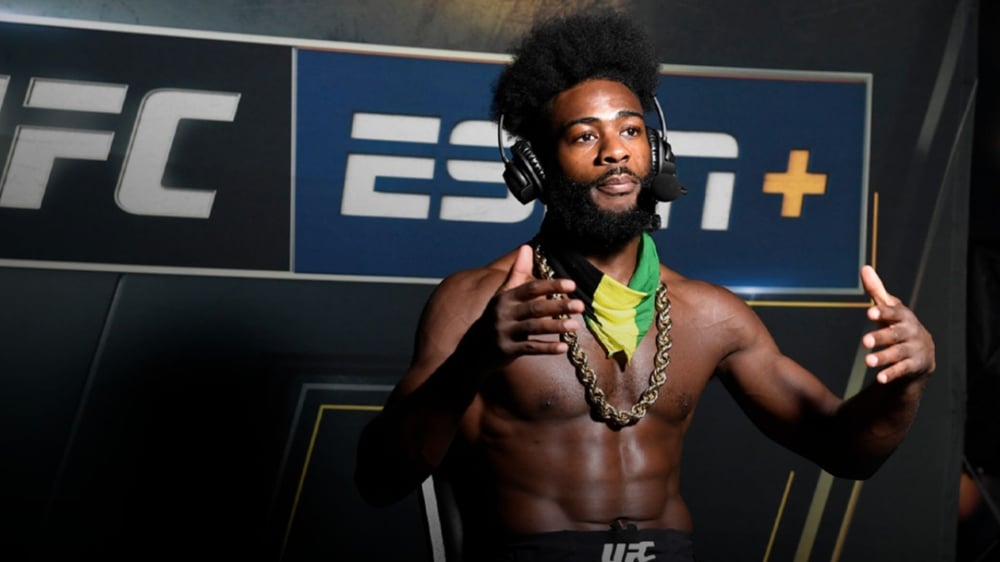
ALJAMAIN STERLING – THE FUNK BEFORE THE FAME
Born on July 31, 1989, Sterling grew up in Uniondale, New York, in a Jamaican American family so large that finding somebody willing to fight wasn’t too difficult. Sterling describes himself as coming from a very big family and, according to him, his siblings had their own highly unofficial fight club.
“People think I have like a kicking background,” he told Joe Rogan. “I'm like, no, I just watched a lot of VHS tapes when I was a kid and played White Tiger, White Lion, and all that stuff with my brothers growing up.”
No dojo or coach corrected his technique. Just whatever they had watched and could reproduce afterward.
“Basically, we just see what we did on the TV and just start imitating it, and we'd have these battles. I'm a family of 20, so I got a huge family.”
His summary of those early training sessions was considerably simpler.
“Well, the boys. We went to war with each other.”
The organized version of combat came through wrestling. Sterling joined the wrestling team at Uniondale High School as a freshman in 2004.
“I wanted to do something to keep me out of trouble and keep me active,” he told UFC.com. “I've always loved competing and testing myself.”
Wrestling suited him. Sterling developed the unpredictable, scramble-heavy style that would eventually earn him the nickname ‘The Funk Master,’ and he carried it into college. He initially attended SUNY Morrisville before transferring to SUNY Cortland, where he became a two-time NCAA Division III All-American. SUNY Cortland records Sterling’s collegiate career with an 87-27 record, and it’s where he earned his degree in Physical Education. That degree matters because pro MMA was hardly the safe career option in front of him. Sterling crossed paths with Jon Jones at Morrisville, and Jones’ move into fighting exposed him to a sport where his wrestling could become something more. From there, he learned about the mechanics behind what he had spent years trying to copy from television.
“I forget the guy's name, but when I was at Team Bomb Squad in New York when I was in college, and I was just starting off as an amateur and early pro. And that's where I first, first started learning how to do like traditional Muay Thai kicks.”
Sterling later worked with Primo Bela Rose, but his striking education remained an unusual mix of lessons from different coaches, his wrestling athleticism, and those childhood experiments. After college, Sterling eventually returned to Long Island and the Serra-Longo Fight Team. Under Ray Longo and Matt Serra, the pieces began coming together. The wrestling pedigree was already there. Now there was an environment capable of turning it into something built specifically for MMA. Sterling went 6-1 as an amateur before turning professional in 2011. He began collecting wins on the regional circuit and captured championships with Ring of Combat and Cage Fury Fighting Championships before the UFC finally came calling.
Nothing particularly glamorous happened, and even then, arriving in the UFC didn’t mean the ordinary jobs disappeared. Years later, Sterling was still trying to balance training camps with the financial reality of living on Long Island.
“You need the money,” he told Rogan. “You need the money. I'm living in New York at the time, so Long Island's ******* expensive. And I'm subbing as a teacher. I'm coaching. Wrestling.”
That line probably says more about the climb than any championship statistic ever could.
Sterling had reached the UFC, but getting there and making a comfortable living were two entirely different achievements. Fighting required training. Training required time. Living in New York required money. Somewhere in between, the extra jobs helped keep the whole thing moving.