


issue 234
October 2026
MMA sports science is discovering new ways to keep fighters in the game, but that doesn't mean there aren’t scientific advancements brewing to keep them in longer.
Sean Strickland claims the UFC has a retirement problem. And it’s even got legends like Demetrious Johnson talking about it. Specifically, Strickland believes MMA’s retirement fund is little more than a few shiny belts and a knee that clicks like a glow stick at a rave.
“The UFC builds a legacy; they keep you right here, but they build a legacy, and they don’t pay you enough, so you have to come back and ruin your legacy,” Strickland recently complained.
Whinging about UFC pay is nothing new. Over the years, it has had fairly predictable outcomes. Leave. Sit. Or lose negotiating leverage. Ngannou walked for boxing’s millions. Demetrious Johnson got traded to ONE Championship. Jon Jones sat out for three years. Some got paid, others got out, and everyone got a reminder that negotiating with Dana White boils down to his well-worn adage: if you don’t want to fight, don’t fight. That said, Strickland may have a point worth investigating. Israel Adesanya and now Alexandre Pantoja have hit career slides after 35. Conversely, Alexander Volkanovski is 38 and still defending his featherweight crown. Yet here's the irony. While Strickland argues fighters can't afford to retire, sports science is investing heavily in helping them compete late in their 30s so they can cash that retirement check. The UFC’s own Performance Institute offers everything from advanced recovery and rehabilitation to sports science, nutrition, and strength training. It's a world-class setup designed to keep athletes performing at their best, potentially well beyond the age when previous generations started falling apart. But an uncomfortable question lurks behind all that expensive equipment. If science can help fighters squeeze another five years out of their bodies, is that a wonderful opportunity to extend their careers or just a way to fund retirement? Here’s the cutting-edge stuff on the table that’s keeping their bodies in the game.

THE FUTURE IS ELECTRIC
Since the dawn of time, few things have spoken to the future quite like electrodes protruding from an athlete’s head while their brain gets plugged into a power supply. Research published in September 2026 is exploring this Frankenstein-esque direction in combat sports. Scientists are investigating transcranial direct current stimulation, which involves popping electrodes on the scalp and passing a weak electrical current through them to influence brain activity and potentially improve movement, attention, and decision-making. Lightning bolts are often a no-show. For MMA fighters, results were promising, at least on paper. After stimulation, the fighters' laboratory attention scores rose from 13.2 to 17.3, a 31% improvement. Their numerical-memory scores rose from 8.4 to 11.1, a 32% increase. Scores in the control group remained unchanged. For a sport where concentration matters and one lapse can end with someone inspecting the arena lights, it's an intriguing prospect. But there's a sizeable difference between performing better on a memory test and remembering to keep your hands up. The experiment didn't establish improvements in actual fighting performance, reaction times inside the cage, or career longevity. So, does a little electricity upstairs improve the fighter downstairs? For now, it’s a work in progress, but it’s an intriguing sign of what’s to come that may lighten the training load, especially on recovery days.
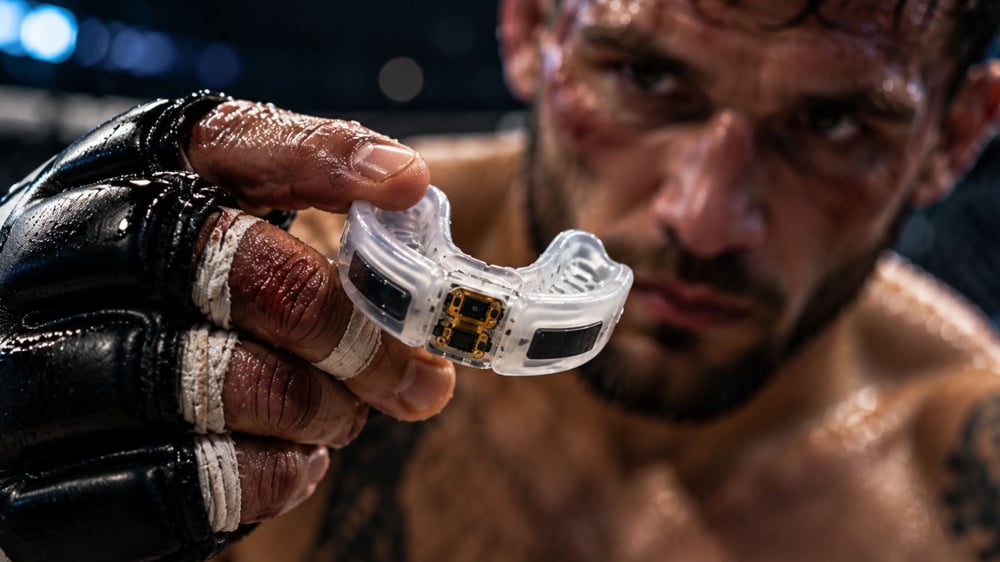
PUNCH COUNTING MOUTHGUARD
For years, sparring damage was measured by counting headaches. More recently, the UFC wants actual numbers. The UFC Performance Institute announced a partnership with PROTECHT smart mouthguards, which use sensors to measure head impacts and heart rate. The idea is to track how much punishment fighters absorb alongside how hard their bodies are working, giving coaches information to help manage training loads and recovery. The technology first appeared at Noche UFC in September 2024, when five fighters, including Sean O'Malley and Merab Dvalishvili, wore the mouthguards during competition. You might remember how The Sphere broadcast their heart rates live on its enormous screens. Everyone could see ‘Suga’s’ heartbreak by numbers. But fans may not see this again, because it’s really built for coaches who can record head impacts across training sessions, spot exposure patterns, and make better decisions. Sure, these sensors do measure impact, not brain damage, and can’t diagnose a concussion or prevent one. No evidence shows they prevent injuries or extend careers, but with this tech in their grill on the daily, a fighter can monitor how much damage they’re taking in training and how it affects them physically and emotionally. You’ll never make getting punched in the head healthy, but you can stop collecting unnecessary shots like they're loyalty points. The smartest way to extend a fighting career might be to take fewer punches before the fight even starts.

THE INJURIES NOBODY'S COUNTING
A bout may last 15 minutes or less, but the damage can start months before anyone checks the gloves. In a February 2026 study of 112 MMA fighters, 68.2% got their niggles during training rather than competition. MMA’s most dangerous opponent might be the training buddy you sink beers with when watching a fight. The solution might be to make sure the paperwork keeps up with the punishment. A separate 2026 paper compared ringside medical reports with questionnaires completed by fighters roughly a week after competition. Across 250 responses from MMA, Muay Thai, and boxing, 23 injury-related cases prevented athletes from training, yet 18 had no corresponding injury record from the ringside physician. That’s the knowledge gap. The researchers calculated that combining immediate medical assessments with post-fight self-reports could capture up to 4.6 times as many time-loss injury cases as physician records alone. Their proposed solution is gloriously low-tech: ask fighters how they're feeling again after they've gone home. They recommend knocking up some standardized digital records and getting them to do follow-up questionnaires within 24–72 hours and further medical assessments when symptoms emerge. So simple it’s stupid, but neither study proves that these measures prevent injuries or extend careers. But together they expose two problems worth fixing: fighters are getting hurt in the gym, and some competition-related damage isn't showing up in their medical records. Before sports science can help fighters last longer, it needs better systems to understand what they're going through, and this dialogue could keep them in the game. 
LESS WEIGHT MORE PUNCH
MMA wants power, but building power requires strength, and that wears on the body. To the rescue may be a system called blood flow restriction training (BFRT). It has been around for decades, but learning how it can help stand-up artists like Pereira and Prates is new. Strikers may be able to build punching power without spending quite as much time wrestling heavy barbells. A 2025 study recruited 30 competitive amateur boxers to investigate BFRT, which uses inflatable cuffs, like those used for blood pressure tests, to partially restrict blood flow during exercise. Over eight weeks, one group trained with cuffs using just 20–30% of their maximum lifting weight, while the control group lifted 50–60% without cuffs. The BFRT group's bench press improved by an average of 13.6kg, compared with 2.6kg in the control group. Their dominant-hand jab force increased by 201 newtons, compared with 63 newtons in the control group. Uppercut force also improved more in the BFRT group, with a 257-newton gain compared with 81 newtons. The training itself sounds complicated, but it’s super simple. Three times a week, the boxers performed exercises including bench presses, dumbbell flys, curls, and triceps extensions using light weights. They completed three sets of six to eight repetitions, resting 30–40 seconds between sets. Pneumatic cuffs were fitted high around their upper arms, with pressure individually calibrated to 40–50% of limb occlusion pressure and released immediately after each set. This wasn’t an invitation to get a few elastic bands and see how purple your arms could get. Researchers used Doppler ultrasound to establish cuff pressures and supervised the sessions. Fighters interested in BFRT should work with a qualified practitioner who can assess whether it's appropriate and apply it safely. There's also a scientific catch. This was a study of boxers, not MMA fighters. We can't credit the cuffs alone for every improvement, and the researchers didn't measure injury prevention or career longevity. Still, for fighters looking to maintain or increase strength without adding heavy lifting to their training load, BFRT offers an interesting option to explore. The science is older than the application to striking performance. The next question is whether it can help MMA fighters stay in the game longer, with less wear on their joints, while still producing force; perhaps training smarter is the longevity fix.

THE STEM CELL GAMBLE
One big injury rarely makes retirement come knocking. Over 75% of MMA retirements follow a losing streak or repeated knockouts. However, this form failure is usually driven by physical wear and tear, because athletic performance drops sharply after roughly 9 to 10 years of active fighting or after age 31. This is not golf. Now, regenerative medicine is dangling an intriguing carrot. In April 2024, the UFC announced a partnership with Mexico-based Cellular Performance Institute (CPI), naming it the promotion's official stem cell therapy provider. For fighters whose bodies have absorbed more punishment than a heavy bag at American Top Team, the attraction is obvious. A treatment that could restore damaged tissue would be considerably more appealing than another lifetime subscription to ibuprofen. Does it work? A 2024 review examined stem cell treatments for sports injuries, osteoarthritis, cartilage damage, and ligament problems. They wanted to know if the body can be persuaded to do a better job of fixing itself. But here's where the hype train gets ahead of the science cart. The review describes promising research into osteoarthritis, tendon injuries, and ligament damage, yet provides no pooled success rates or figures showing how much faster athletes recover. The authors also acknowledge limited long-term safety and effectiveness data, nonstandard treatment protocols, and that researchers still haven't established which cell sources work best. For fighters tempted to give it a shot, three questions matter. What exactly is being injected? What controlled human trials show it works for that particular injury? And has the treatment received regulatory approval? Sure, stem cell research has been around for decades. President Barack Obama lifted restrictions on federal funding for certain embryonic stem cell research, helping expand scientific investigation. That wasn't permission for clinics to start selling replacement knees by the syringe. The FDA regulates regenerative products and warns that stem cell and exosome therapies have not been approved for orthopedic conditions such as osteoarthritis or tendon injuries. It could eventually change how fighters recover and extend their careers, but there’s still no convincing evidence that commercial stem cell injections reliably rebuild worn cartilage, eliminate the need for surgery, or add years to an MMA career. Until the clinical evidence catches up, fighters should remember that the promise of a brand-new knee is considerably easier to sell than it is to deliver. Particularly when the old one has spent 15 years being kicked by professional lunatics.

THE LONG GAME
Is Strickland right? Well, to give the UFC credit, it is investing heavily in keeping its athletes healthier for longer. And that makes good business sense. Nobody spends years building a superstar only to watch their investment fizzle out before the contract expires. The UFC Performance Institute partnered with Oura to introduce smart rings that monitor sleep, skin temperature, and other health indicators. It's a considerable improvement on the care MMA athletes used to get, which is normal for a growing sport. The UFC has also shown willingness to support rulebook changes. Oblique kicks to the knee are on the chopping block, with Dana White backing the proposal. Jon Jones built his career on using them, and Strickland had a close encounter after Khamzat Chimaev launched one at him during their press conference tiff. Of course, these are just a handful of the longevity strategies being explored. Wearable technology, regenerative medicine, smarter strength training, and better injury monitoring are part of a growing effort to keep fighters performing longer. Some have solid science behind them, others are still experimental, and a few have marketing departments that could probably use a little less caffeine. None will make MMA safe. But here's the financial catch. A longer career isn't necessarily a more profitable one. For the fighter, it only makes financial sense if those extra years translate into enough earnings to justify the punishment. Otherwise, longevity becomes an expensive way to postpone unemployment. Which brings us back to Strickland's complaint. Competing in the UFC has given Sean Strickland 1.4M social media followers, and for most, that should kick up a pay day, but he has very few sponsors or brand deals because, well, he acts like Sean Strickland. He's always complaining about something, and his unpredictability risks making him poison for most mainstream brands, so his own actions limit his earning potential. Most fans love him for it, but that doesn’t make him marketable, and nothing stops him from starting something of his own. Maybe Strickland's smartest walk-away move has nothing to do with sports science. It's figuring out how to make money without having to get punched. Maybe he needs to speak with Conor on how to make it when people dislike you.
...