


issue 234
October 2026
Before buying another tub of powdered ambition, find out which supplements have earned their place in a fighter’s routine.
‘May contain traces of a six-month suspension’ would certainly make the supplement label more useful. Sitting out of competition thanks to something you didn’t need to take is a big risk, but this is the penalty Jaqueline Amorim recently accepted after two drug tests detected low levels of a banned substance called ostarine. She’s not the first, as 15 UFC fighters have been caught taking this banned performance enhancer alone. Even Sean O’Malley tested twice for ostarine, but that was ruled to be due to contaminated supplements. For Amorim, her results were consistent with contamination rather than intentional use, with no significant performance advantage. Still, she lost six months of eligibility. There was no meaningful edge, but plenty of consequences. It’s enough to make you eye your supplement cupboard with a healthy amount of suspicion. Somewhere between the scientific-sounding ingredients and a jacked fighter online who has muscles in places most of us don’t have places, the supplement evidence has taken a back seat to marketing. A new October 2026 review of Brazilian Jiu-Jitsu (BJJ) nutrition research gives us a reason to examine whether grappling-specific supplements are worth your time and money.
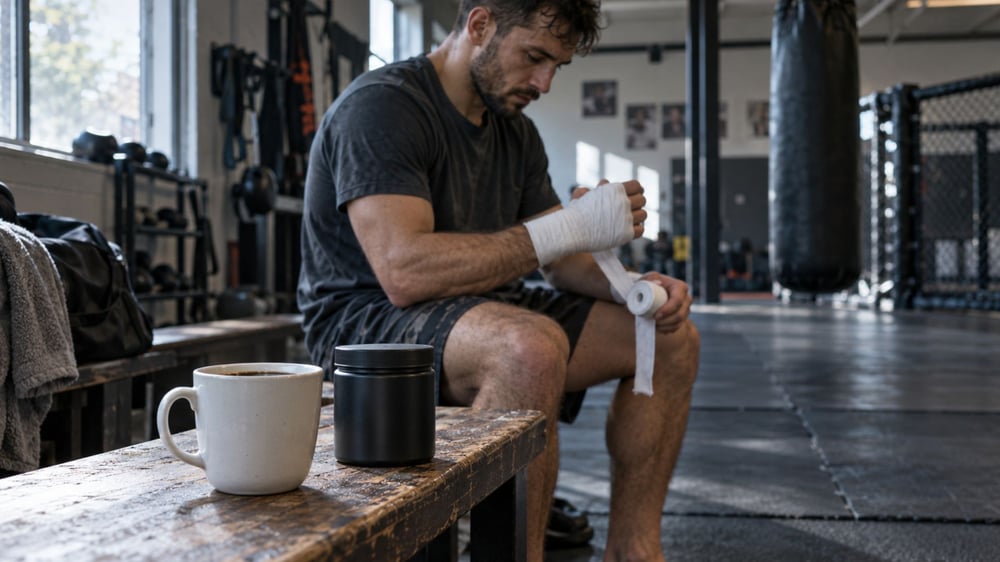
CAFFEINE NEEDS TO EARN ITS KEEP
Caffeine may be the only thing standing between you and a disciplinary meeting before 9 am, but its usefulness when someone is trying to strangle you deserves a closer look. The BJJ review included two small caffeine studies. In one, 14 elite athletes took caffeine or a placebo before two simulated bouts. After caffeine, they spent more time performing offensive actions in both bouts. Their physical-test results also improved before the first bout, although the benefits weren’t consistently maintained as the bouts progressed. More attacking is promising, but it doesn’t mean opponents spent more time tapping. A separate experiment on BJJ athletes found average grip strength rose from 50.9 to 53.3 kg, while bench-press max rose from 90.5 to 93.3 kg. Respectable improvements, but a barbell rarely fights for an underhook. These were physical tests, so we can’t award caffeine a submission victory on their behalf. Both experiments used 3 mg per kilogram of body weight, equivalent to 240 mg for an 80 kg athlete. Caffeine earns consideration because BJJ research shows benefits, but it still needs to fit the fighter and the session. Count what’s already coming from your coffee, energy drinks and supplements before adding more, and pay attention to the sleep bill. That doesn’t give every caffeinated pre-workout a clean bill of health. Other ingredients or contamination may still create problems. Evidence for caffeine earns caffeine some credit, not everything sharing its tub.
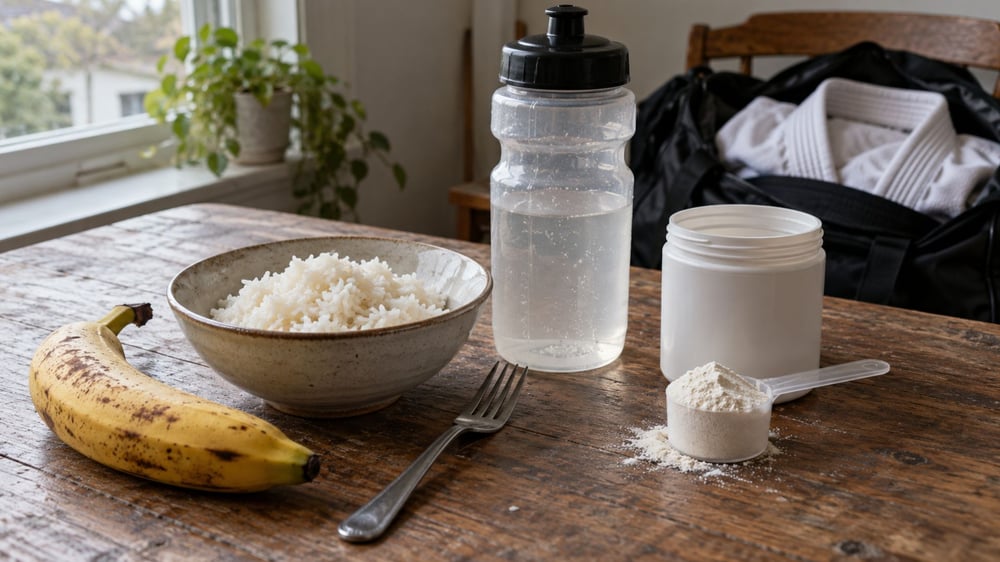
CARBS WOULD LIKE THEIR REP BACK
Carbohydrates have spent years being treated like they were caught stealing from the gym’s lost property box. Put them in an expensive powder, however, and suddenly they’re marketed as performance nutrition. Maltodextrin, the carbohydrate used in two studies covered by the BJJ review, offers a useful opportunity to examine what you’re actually paying for. One small experiment involved 12 athletes split into three groups: no supplement, carbohydrate immediately before a bout, or carbohydrate 30 minutes beforehand. Grip strength and blood glucose increased significantly from before to after the bout only in the 30-minute group. The group taking no supplement also said that training felt harder. Encouraging, but with four people per group, we could assemble a larger sample by asking whose car is blocking the driveway. The result gives us a reason to investigate carbohydrate timing, rather than declare that a scoop before rolling will improve everyone’s grip. Neither carb experiment compared maltodextrin with an ordinary high-carb food. This means it cannot tell us whether the powder offers something food wouldn’t. Nor do these findings show that better grip test results translate into better submissions or more wins. Worth buying? Carbs are good, but you probably don’t need the risks of a specialist product. Before giving another tub cupboard space, figure out if your problem is low energy, and then see if it helps.
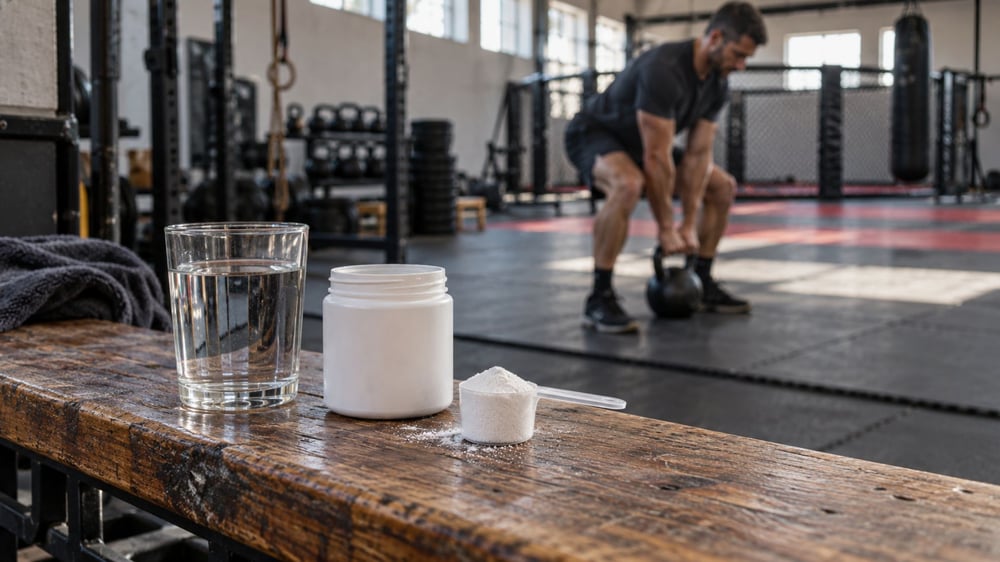
CREATINE AGAIN YES WE KNOW
We’ve written about creatine often enough that it should probably contribute to this publication’s rent. But its reputation in the weights room gets stretched into promises about what happens in a real fight. A broader 2025 review of combat-sport supplements includes creatine research across other disciplines, widening the picture without making every finding speak to MMA. The findings don’t all arrive carrying flowers. In a trial on 20 wrestlers, five days of creatine supplementation failed to improve upper-body power during repeated tests designed to mimic a competition day. That doesn’t overturn its wider benefits. It means ‘creatine works’ but needs to be followed by ‘for what?’ before anyone starts making promises about your next round. Does it earn a place in your supplement cupboard? For supporting strength and high-intensity training, it has a credible case. The best bet is to take 3–5 g daily without loading, which can increase your muscle stores over roughly four weeks. Plain monohydrate is the form with the substantial research behind it. You can leave the creatines that have seven adjectives and a furious gorilla on the label where you found it. Go for the plain stuff, and you’ll be in safer territory.
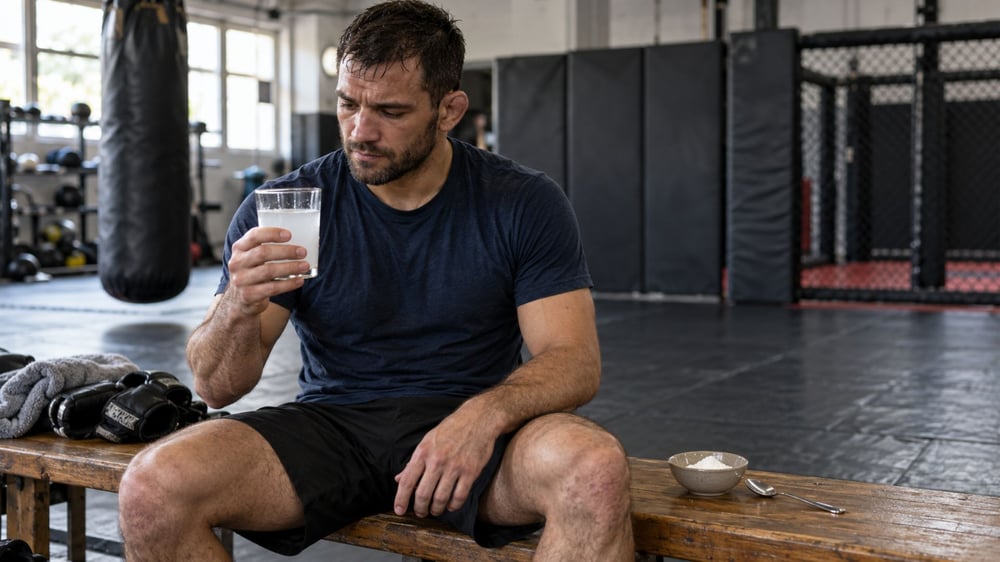
BICARBONATE HAS SOME EXPLAINING TO DO
Sodium bicarbonate has punched above its weight for something that started life in the baking cupboard. The theory around it is that bicarbonate can increase the blood’s buffering capacity, potentially supporting certain high-intensity efforts. The question is whether your grappling benefits enough to justify swallowing it. The BJJ review included a trial involving 10 athletes. Bicarbonate changed measures of blood acid–base balance but didn’t significantly improve maximum-strength or repeated reps. A July 2026 study, published after the review’s search window, delivered another lukewarm reference. Twelve male BJJ athletes performed repeated sets of gi-grip pull-ups after bicarbonate or a placebo. It didn’t significantly improve repetitions, grip strength or perceived exertion. So, should it be a regular? Bicarbonate has some slick evidence in some exercise settings, but these BJJ trials haven’t shown a compelling return on investment. Any use deserves planning with a sports dietitian and a trial during training. And even if you tolerate the ingredient, that doesn’t prove the product's quality. With uncertain grappling benefits, a potentially mutinous stomach and the contamination question still hanging over the tub, bicarbonate needs a better sales pitch than ‘this might help.’
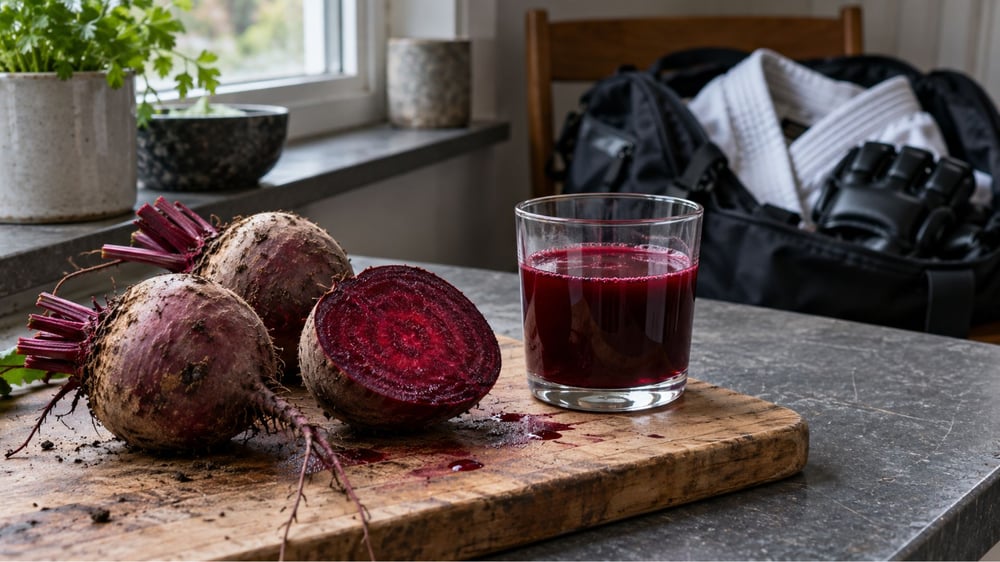
BEETROOT WANTS A BETTER JOB
Beetroot has spent decades permanently staining whatever you wear. Its move into performance nutrition is more respectable. Dietary nitrate, found in beetroot, has evidence for improving performance, but whether that means better grappling needs its own examination. The BJJ review included a study of 12 jiu-jitsu athletes comparing a nitrate-rich beetroot gel with a nitrate-depleted version. After eight days of supplementation, the nitrate-rich gel improved maximal grip strength and forearm muscle oxygen saturation. However, it didn’t significantly extend the time athletes could keep cranking the handgrip exercise before they got too tired to carry on. That matters when the sales pitch starts wandering towards better endurance on the mats. This was a small laboratory study, not a tournament. It offers a promising grip-strength result rather than permission to credit beetroot with your next submission. So, should you go and buy it? Well, there’s something to investigate, but the research doesn’t establish an endurance benefit for grapplers. Before buying, look for a clearly stated nitrate dose and appropriate independent batch testing for prohibited substances. That testing helps manage your contamination risk, but it can’t prove the product will improve your performance. Beetroot deserves credit for the results it produced, not a promotion to your cupboard based on the colour of its tracksuit.
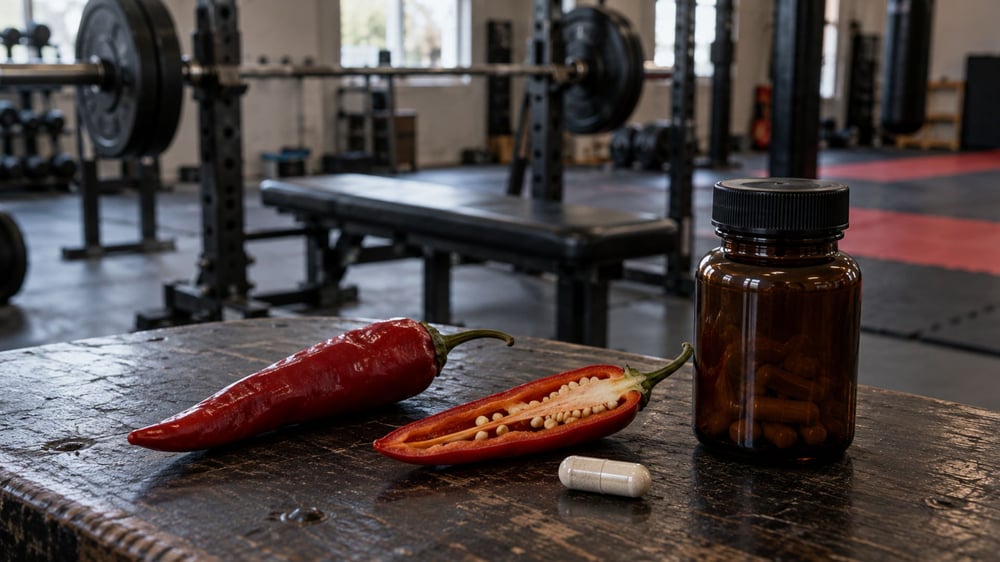
CAPSAICIN BRINGS HEAT AND HOMEWORK
Capsaicin gives chillies their bite. Putting it in a capsule saves your tongue the argument, but your wallet still deserves a say. When 12 male BJJ athletes took 12 mg of purified capsaicin or a placebo. They performed four sets of five bench-press reps. Capsaicin improved mean power output and peak movement velocity. Useful findings, although this was a bench press conducted by grapplers, rather than grappling itself. The bar wasn’t trying to pass anyone’s guard. Among 18 BJJ athletes, capsaicin extended the time they could hold an isometric pull-up by an average of 2.83 seconds compared with placebo. However, handgrip strength, pull-up performance and how hard exercise felt didn’t differ significantly. Neither experiment meant they’d do better in an actual match, but it does seem to work for people. Worth its place? Capsaicin remains a promising extra but still has some homework outstanding. A few additional seconds in one strength-endurance test deserve further investigation, but they don’t yet make a compelling case for another capsule in every fighter’s routine. Add the need to verify product quality, and the buying decision becomes less urgent. Let the evidence do a few more rounds before your credit card gets involved.
ARGININE NEEDS MORE THAN BLOOD WORK
Arginine has the sort of job description that t gives marketers plenty of scientific furniture to arrange. Whether that makes you a better grappler requires more than an impressive biochemical LinkedIn profile. When 39 male BJJ fighters followed a low-carbohydrate diet for four days before testing, arginine barely moved the needle. They had a smaller exercise-related rise in blood ammonia and circulating lymphocytes, a type of white blood cell, but it didn’t make them grapple harder, last longer or recover faster. The US National Institutes of Health concludes that arginine supplementation has little scientific support for improving strength, athletic performance or muscular recovery. It’s worth giving this one a wide berth. This BJJ study doesn’t show a performance boost worth the expense, possible side effects, and product-quality risks. That leaves arginine with a rather thin application for cupboard space. Better-looking blood results might interest a researcher, but before they interest your wallet, someone needs to show what you actually get out of it on the mats.
TINGLING ISN’T A PERFORMANCE REVIEW
Beta-alanine might make your skin tingle, but those pins and needles may be just for the feels. The broader combat-sport review includes a trial completed by 37 male athletes: 16 judokas and 21 jiu-jitsu competitors. After four weeks, the beta-alanine-only group increased total work during repeated upper-body sprint tests by approximately 7% from its starting level. The placebo group showed no improvement. Athletes taking beta-alanine alongside bicarbonate improved by approximately 14%, significantly more than either supplement alone. These were small groups of nine or ten athletes, performing four 30-second efforts on an arm-cranking machine. Nobody demonstrated that they could grapple 14% better. That means the tingling is just a weird side effect to manage, rather than a receipt proving you bought something effective. It does seem to have a credible case for particular repeated high-intensity efforts, with less certainty about actual fighting performance. It needs a consistent, appropriate protocol and a product whose quality you’ve checked. Adding it to a mystery blend because the scoop makes your ears fizz is a considerably weaker purchasing strategy.
MAKE THE POWDER PROVE ITS POINT
Your supplement cupboard doesn’t need to look like you’re preparing to open a small pharmacy. Caffeine and creatine have credible uses. Other ingredients offer promises that still need more work. Start with the job you need done. Then check whether the evidence matches it. More bench-press power isn’t automatically better grappling, a change in blood chemistry isn’t a tournament medal, and tingling skin isn’t your black belt arriving. Sometimes the most useful result of reading the research is discovering you can leave something in the shop. Amorim’s case brings the stakes back into focus. A product doesn’t have to deliver a meaningful advantage to leave a fighter dealing with consequences. Independent batch testing can reduce contamination risk, but it can’t make a supplement effective or remove every risk. Deciding whether an ingredient earns your consideration and whether a particular tub earns your trust are separate decisions. Keep the food, training and recovery in order. Get qualified advice where it helps. Buy for a specific purpose, rather than because somebody with bowling-ball shoulders gave you a discount code. The aim is to become a better fighter, not the proud owner of expensive urine and a cupboard that rattles. Every supplement should earn its place because your wallet should always tap before you do.