

Issue 226
February 2026
Ray Klerck uses hard science to show why MMA doesn’t create thugs, it exposes whether your wiring makes you a disciplined weapon or a viral liability.
It seems the surest way to find out if you’re a true MMA technician or just a social enforcer is to get into a verbal spat. Especially if it’s at a party hosted by Rampage Jackson. Just ask YouTuber Deen the Great, who is an influencer boxer with 7 ‘fights’ under Misfit Boxing. Last month, he learned the hard way that when professional-grade elbow met his unrefined ego. The result was a viral clip of the former UFC fighter Tiki Ghosn’s wrath finding a brief home on Deen’s temple. With much self-aggrandizing pomp, Deen was refuting Ghosn’s claim that he didn’t know who he was, which was followed by a threat from Deen, which triggered the elbow. What followed was social media doing what social media does. And we got to watch a live case study in what aggression regulation looks like. It’s not for us to judge whether this reaction was wrong or right. We’re just observers of a situation that’s been played out many times before by the likes of Diaz, Ortiz and Rutten. Deen later claimed he was just intoxicated and that the Ghosn’s strike was purely for the cameras, but the incident captures a psychological divide in the fight game. It highlights the division where one man might stay cool while another sees red over a tone of voice and a threat. The reason may come down to internal filter characteristics, which decide whether MMA training turns you into a disciplined sniper or a liability. To the uninformed, fighters are blood thirsty thugs, but the data shows that the sport is actually a masterclass in mindfulness that can curb depression and shut down impulsive aggression before it ruins your life. By breaking down how MMA rewires the brain, we can see why many find peace on the mats while others might be smoking guns in a social setting.
1. ALEXITHYMIA
While alexithymia sounds academic, it translates very simply into not knowing what you’re feeling. Something we’ve probably all felt. The December 2025 study on 60 MMA athletes found higher levels of alexithymia were strongly correlated with higher aggression scores, particularly physical aggression and hostility. If you’ve seen Deen’s video, those feelings matter because if you don’t know whether you’re feeling frustration, embarrassment, or insecurity, your body may default to a surge of aggression. It just doesn’t label it. The less emotionally aware you are, the more likely you are to act aggressively. That’s not because you’re violent. It’s because your brain can’t label the surge. In a heated exchange in a social setting, one man might feel his ego flare and recognize it for what it is. It could be insecurity, pride, or alcohol amplifying the volume. Another fighter might just feel heat. Tight chest. Rising pulse. No label. The elbow isn’t planned. It’s emotional static discharging. Longer years in MMA were associated with lower alexithymia, suggesting that structured training can sharpen emotional awareness. The mats can teach you to read your opponent and, eventually, yourself.
2. ATTENTIONAL IMPULSIVITY
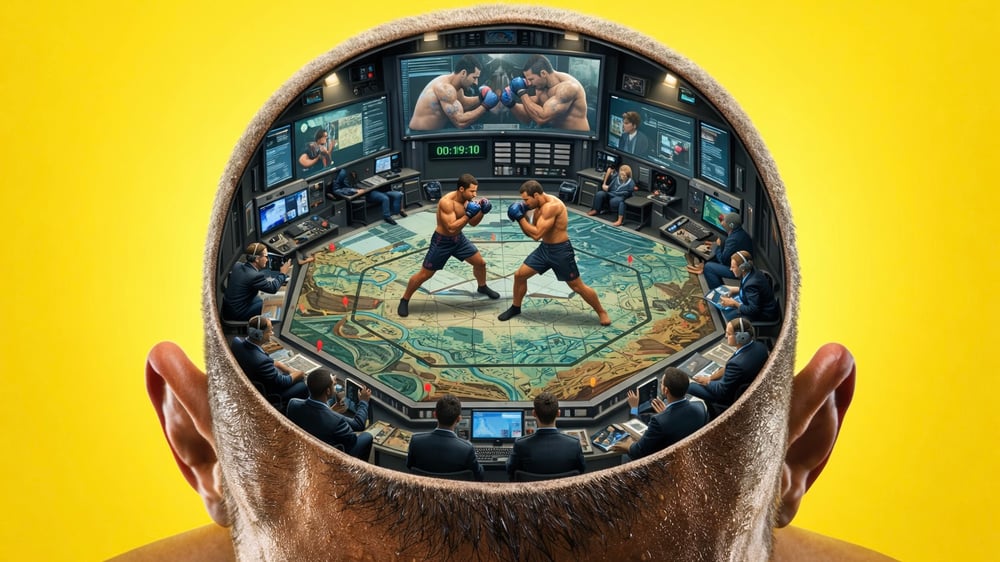
The strongest pathway in the study wasn’t just emotion and aggression. It was how emotion, coupled with poor attention control, resulted in aggression. Fighters who had difficulty staying mentally focused were significantly more likely to let emotional surges turn into physical reactions. Attentional impulsivity means your brain locks onto one stimulus and ignores the wider picture. When the aggression happens in a street fight or a tense party confrontation, attentional impulsivity is usually the culprit behind the wheel. In a social confrontation, that can be dangerous. You stop seeing the room. The cameras. The consequences. Inside the Octagon, narrow focus can be an asset. Outside it, it risks becoming tunnel vision. For a fighter, attentional impulsivity is the inability to filter out distractions or maintain focus under duress, leading to snap decisions that prioritize immediate relief (like throwing an elbow) over long-term strategy. The study highlights that while alexithymia predicts impulsivity, long-term MMA training targets the emotional regulation side. This is why a disciplined fighter like Ghosn can identify the threat and choose a single, precise response. One, he later got an apology for from Deen.
3. AN AGGRESSION PIVOT
How do you categorize aggression? There is a big difference between hostile aggression and performance-oriented assertiveness, which aims to win. The study notes that through structured MMA, the fighters move away from violent, hostile expressions toward a state in which aggression is harnessed as a positive, goal-oriented drive. This shift allows a fighter to stay aggressive under extreme stress without losing their sportsmanship. By integrating mindfulness and psychological skills training, such as diaphragmatic breathing, fighters learn to modulate the emotional states that often lead to impulsive outbursts. This transition is what turns a bloodthirsty reputation into a masterclass in self-regulation and mental health. What’s interesting is that while a longer MMA experience was associated with better emotional awareness, it did not automatically reduce impulsivity. Training alone doesn’t erase the urge to react. Which means discipline isn’t built by rounds alone. It’s built by learning when not to move. And that’s where the liability line is drawn.
4. A SELF-EFFICACY SHIELD
While toughing it out is the training mantra, the real trait that prevents a fighter from cracking under pressure, even in a social situation, is self-efficacy. That’s a fancy way of saying that you genuinely believe you can handle the moment without losing your head. A study of 110 MMA athletes found that self-efficacy is a critical protector that helps you make better choices when you’re faced with stress and adversity. Fighters who trust their own ability to manage stress respond smarter under pressure instead of reacting like a fire alarm with legs. It doesn’t make you softer. It makes you harder to rattle. Many fighters rehearse the worst-case scenarios and visualise exchanges, trash talk, bad rounds, and hostile crowds. In a Deen–Ghosn type spat, low self-efficacy feels like panic. One man hears disrespect and feels the need to prove something. The other hears it and thinks, I’ve handled worse.

5. COGNITIVE FLEXIBILITY
MMA might be the ultimate IQ test under pressure. 5. COGNITIVE FLEXIBILITY And the trait that separates a public liability from a technician is cognitive flexibility. That’s your brain’s ability to switch tactics the second Plan A stops working. When researchers looked at 3845 athletes who competed in unpredictable environments like MMA, they performed much better on cognitive flexibility tasks than athletes in closed sports like sprinting or swimming. This is an ability that improves with experience. The longer you train in an environment where nothing is fixed, the sharper your mental gear shifts become. Fighters who become a liability can get stuck in one emotional lane. Same line. Same escalation. Same need to win the exchange. A disciplined fighter recognises the pattern. He senses when tone changes. He notices when pride starts driving the conversation. And he pivots. That’s executive function doing its job, where it’s overriding ego with strategy. In a competitive environment, that control wins exchanges. Outside it, it prevents unnecessary ones.
6. A PARASYMPATHETIC BRAKE
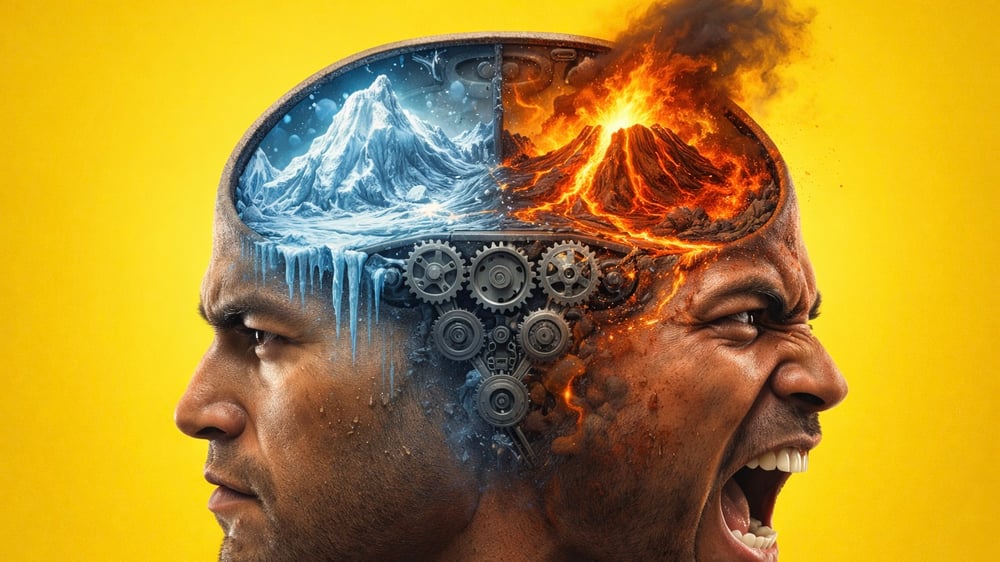
Some fighters get owned by their heartbeat. Others can read it like a dashboard. This speaks to the concept of interoception, the ability to feel what’s happening inside your body. It might be a climbing pulse, a shortening breath, or a jaw tightening. This is the choice to understand what it means before it takes over. A review on interoceptive ability and emotion regulation found that people who are better at keeping tabs on their internal signals can regulate their emotions more effectively, especially under stress. It means the better you can read your internal surge, the less likely you are to be hijacked by it. Disciplined fighters train this without even realising. Hard rounds force you to sit inside that serious discomfort without panicking. You learn the difference between adrenaline and danger. Between ego flare and actual threat. The one type of fighter feels his heart spike and thinks, I’m under attack. The trained fighter feels it and is happy that the system is online. That’s the parasympathetic brake. It’s not about suppressing emotion. It’s about riding it without crashing the car.
7. PERFORMANCE ASSERTIVENESS
There’s a big difference between throwing a punch to win a round and throwing one because someone bruised your ego in front of a few party girls and a camera phone. Research on MMA athletes shows experienced fighters don’t even define aggression the way outsiders do. They describe it as something you use cleverly. A tool. A volume knob. Not a personality trait. Recent work breaking fighters into aggression profiles found that seasoned competitors cluster toward controlled, performance-focused aggression. This was not the blind, reactive type. That’s the divide. Hostile aggression is personal. It’s about harm. It’s about “I’ll show you.” Performance assertiveness is tactical. It’s about timing, distance, and outcome. In a fight, you’re supposed to be aggressive. That’s the job description. At a party, the job description changes. The disciplined fighter knows aggression has a postcode. Inside a fight? Full send. Outside? Switch it off. And that’s why some men can elbow through a career without it bleeding into their real life, while others end up trending for all the wrong reasons.