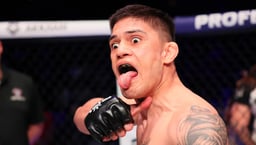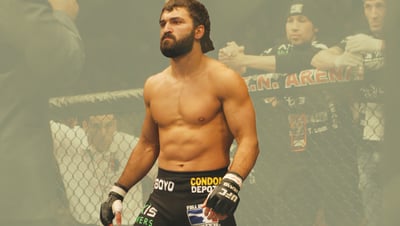

Jay Jay Wilson made a massive statement in Belfast’s SSE Arena on Thursday night, that echoed around the world.
In just 37 seconds, Wilson (12-2) dismantled the previously unbeaten Darragh Kelly (9-1) in the main event of PFL Belfast, silencing a partisan crowd and handing the Irish prospect his first professional loss. Fighting as the clear road competitor, Wilson embraced the hostile environment and delivered one of the most emphatic finishes of his career.
“The Māori Kid” has now won four of his last five bouts, and the performance immediately positioned him as a serious contender in the PFL’s impressively stacked lightweight division. But if there was any external narrative about him being overlooked heading into the fight, Wilson made it clear afterward that he doesn’t internalize that noise.
“I never really buy into the media that much. I don't really watch it,” Wilson said. “I know what I'm capable of, I know what I can do, so I'm always confident within my own abilities, because I train hard. I put all my confidence within my preparation for fights. I don't let what people say or what gets posted online affect my mentality.”
That internal confidence translated directly into execution. The finish itself came from a well-drilled sequence, one Wilson was eager to explain in detail.
“Yeah, so that kick I landed there, the left kick, is actually (from) one of my very good friends named Saeed,” he said. “He's a heavyweight, but this heavyweight moves like a lightweight. The guy is crazy. He's very good. So we named the kick after him. It was called ‘the Saeed kick.' And I landed that Saeed kick and I sat on my base. I saw that the body kick landed, sat on my left hook, and then he fell. You know, I was like, 'Oh my God, it worked.' And then I ran and I got the finish.”
Beyond the technique and the result, Wilson’s post-fight comments revealed a deeper layer to his motivation, one rooted in identity, responsibility, and lived experience. Representing his Māori heritage on an international stage is not just symbolic; it’s central to how he views his career.
“Yeah, most definitely. And I want to thank you for asking that question. That’s a question I don’t get get asked very often,” Wilson said when asked about being a role model. “You know, Māoris in general and New Zealanders in general, we have a high suicide rate, and that comes from we have this mentality where we cannot talk about our problems, we cannot share our issues, and we're surrounded by not the right environment.
“So, for me, I feel like I'm a person that is in New Zealand, that the youth, that the kids, and even the adults can look up to and be like, 'Hey, listen. He did everything that he did correctly and look where he is. And he can make it, so maybe we can as well.’ Because I'm just a little Māori boy from New Zealand, you know? I was sleeping under bridges when I was a kid. Now I'm fighting (in the) main event in Belfast. So if I can do it, anyone can do it. So for me, I want to lead the way for not only Māori, for troubled youth across the entire world.”
With momentum now firmly on his side, Wilson is already looking ahead and he has a specific name in mind. A matchup with Alfie Davis (20-6-1), a recent title challenger, is at the top of his list.
“Yeah, I think my next fight it should be Alfie Davis in June,” Wilson said. “There’s a card in San Diego, so I'm definitely looking to fight Alfie Davis in June. I think that'll be a great fight. He's in need of somebody with a big name to be able to get a title shot again. You know, I'm the guy I just came off a big win, so I'll go out there and finish him, and then I can be in line for a title.”