

Issue 228
April 2026
Sean Strickland is a glitch in the simulation where modern PR and accountability go to die, but why do we love him? Ray Klerck investigates to find out how he pulls you in
Sean Strickland’s non-existent social filter means his brain and mouth have a non-compete agreement anytime there’s a mic around. He’s a world-first phenomenon who can seemingly only exist in the UFC ecosystem, where Dana nods behind him and defends the right to free speech. There are those, like Jake Shields or Colby Covington, who have tried and failed to get to Strickland’s level, but they rarely seem as genuine. Outside the UFC, finding a direct comparison to Sean Strickland is near impossible because most professional sports leagues have morality clauses that would deliver lifetime bans for even 5% of what he says. An NBA player could get suspended for a vaguely suggestive tweet or an NFL star loses a Nike deal for a single hot-mic slip, yet Strickland stands on a global stage calling reporters infections and openly fantasizing about taking a life in the Octagon. He’s MMA’s shock-jock trapped in the weaponized body of a world-class fighter, and one of the reasons he isn't de-platformed is that his job is to cause grievous bodily harm to others while risking brain trauma to do it. Since he can bite down on a mouthpiece and endure twenty-five minutes of blunt-force trauma for your entertainment, he is granted a social license that almost all other athletes are denied.
ONLY IN MMA
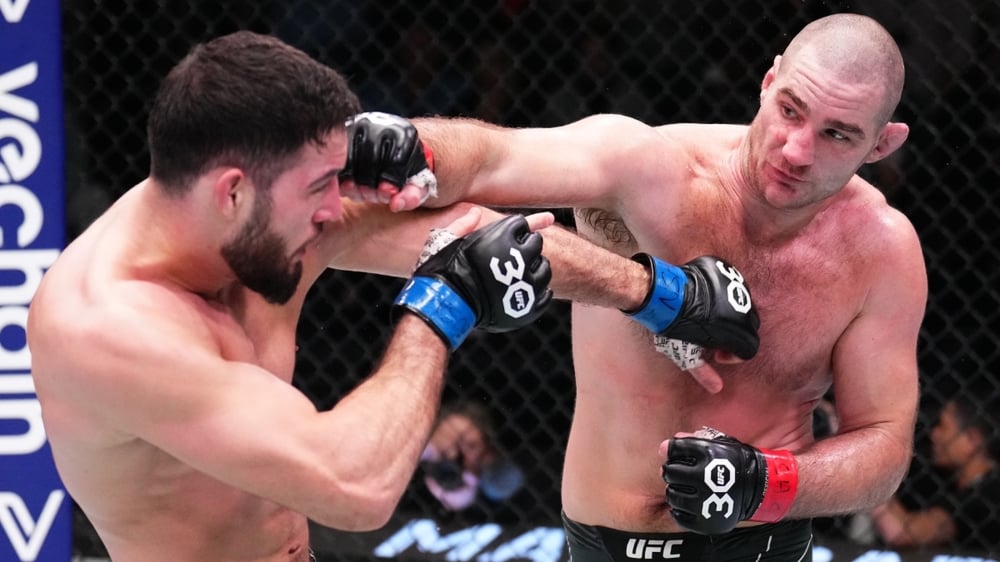
Why does a politically correct world give MMA so much social leeway? The UFC is most popular among men in their mid-40s to early 60s, a demographic that’s already swayed toward Trump-style politics. And it’s no secret that Trump knows this, which is why he’s often in the front row, but it’s Strickland’s anti-woke rhetoric that resonates with this group. The sport is also gaining popularity among younger fans, and 2026 has seen a 208% increase in the 18-34 demographic and a 190% increase in the 18-49-year-olds. This suggests that Strickland’s honesty might be finding a home with a younger, male audience who may feel alienated by traditional, and what you could say are, sanitized sports. Some of this comes down to why people watch sports, and 35% say they enjoy it as their escape. However, unlike 46% of NBA or NFL fans who prefer sports to be an escape from social commentary, UFC fans say they watch because they hero-worship the fighters and enjoy the violence. For many of these fans, a fighter’s raw honesty during a press conference is an extension of the realness they show when the gloves are on. This is something that’s starting to show up in viewing stats. After Sean Strickland beat Anthony Hernandez in late February, he was part of a media blitz that in some ways anchored the UFC’s historic transition to CBS and Paramount+. Though he wasn't on the UFC 326, March 7 card, the UFC used some of his viral momentum and unedited persona as a marketing hook, which helped the event to peak at a decade-high 3.21 million linear viewers. Controversy sells, and he was part of the engine behind the sport's record-breaking network debut. This culminated in the mid-March announcement of his upcoming title grudge match against Khamzat Chimaev, effectively turning his ‘uncancelable’ status into the UFC's most profitable promotional tool. The men in black behind the scenes pretend to tell him to calm it down, but perhaps that’s just for show because nobody wants that. Certainly not the bean counters.
LOVEABLE ANTI-HERO
The reason we’re so obsessed with fighters like Diaz or Strickland is that he taps into a primal part of the human brain that rewards authenticity above almost anything else. We’ve been conditioned to live in a world of HR-approved statements and carefully curated LinkedIn profiles, so when someone comes along and smashes that professional mask with a sledgehammer, it feels gloriously real. And that’s everything we want from MMA as it acts like a modern age gladiator arena. Research found that people who publicly break social rules are seen as more powerful because they’re signaling that they’re big enough to ignore the consequences that would ruin anyone else. In this space, Strickland might serve as an outlet for an audience that feels choked by modern etiquette. So, when Sean says the forbidden thing and doesn't get fired, his fans feel a sense of shared rebellion. We don't just watch him because he’s an elite fighter. We watch him because he’s the only person in the room who refuses to pretend, and in a sanitized world, that kind of raw dominance is a drug we’re all addicted to. So how far can he really go, and is it real?
REWIRING THE SOCIAL FABRIC
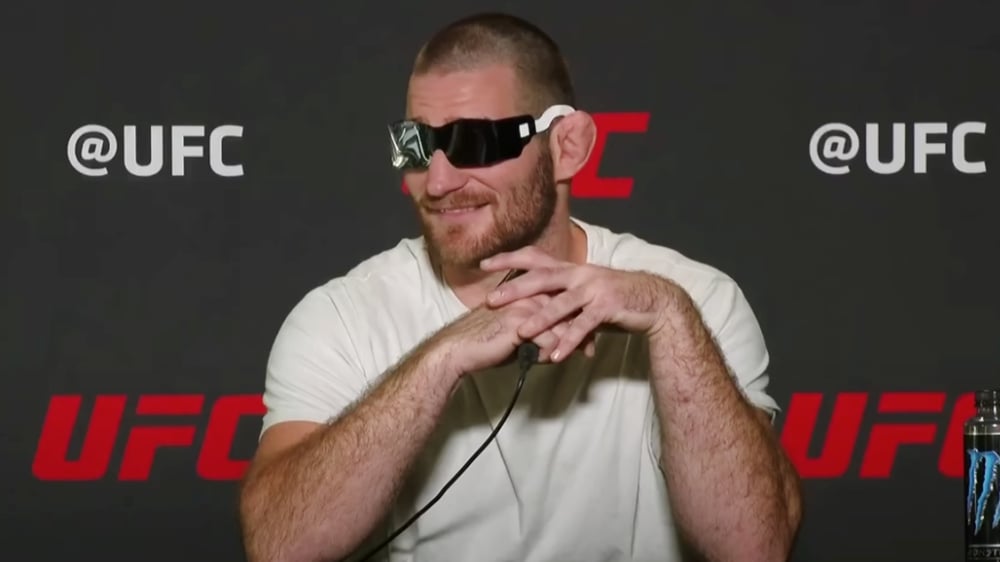
Few issues grab the society’s jugular harder than gender equality, so if you want the most bang for your controversial buck, this real estate is easy pickings. He chose to start in his backyard with comments like this.
“Not many people give a f*** about women's MMA in general, you know? It's like the WNBA. No one gives a f*** about women's sports. Like, who cares? You're watching two f***ing chicks. You take the weakest, softest motherf***er here, and you guys would beat up Amanda Nunes. The only reason people watch female fighters is for jerking off.”
Then came along Nina Drama, who humanized him in some ways by making fun of him to his face and getting away with it, so he became an almost relatable psycho who people loved even more. Next came Kayla Harrison, whom he openly mocked and called a can crusher. But when they met at American Top Team, he posted a photo of her with an apology, then said they were somehow friends, and months later, at a press conference, complimented her on how beautiful she was. Amidst all of this, there were still comments that women shouldn’t be allowed to vote and other disparaging remarks.
“Women don't need to work, they need to stay home and raise a family,” Strickland told reporters. He added he would turn cannibal and lose the will to live if there were no women on the planet to look after him.
“I've got to make my own food, fold my own laundry, what is the f***ing point?”
Therein lies the beautiful juxtaposition that is perfectly Strickland. At his core, he may say inflammatory things but has the respect of almost everyone who has bothered to get to know him. Chael Sonnen, the UFC’s first king of controversy, has almost always sung his praises.
“I just want you guys to meet him,” he said on his podcast. “I really do, even just in passing. I hope you see him and you’re intimidated. He’s one of the guys who would intimidate you from coming and saying hello. I hope you go and say hello. Strickland is not only not crazy, okay. Strickland’s not only a decent guy. Strickland’s a gentleman. That’s not a word you can just throw around.”
Sonnen went on to say he’s respectful and soft-spoken but doesn’t want his interviews on TV while his kids are in the room. There’s an openness about Strickland, and you love him because he’s real, but he can also put the money where his mouth is.
BACKING IT UP
Strickland is famous for sparring every day, and he’s one of the few pros who do this, but perhaps it works for him since he seems to need to let out his raw aggression every day. It’s not a part of his personality that he’s ever shied away from.
“If you like to f***ing hurt people, you’re in the right sport,” Strickland once said. “I would love nothing more than to kill somebody in the ring. Nothing more. It would make me super happy. I would own that sh**, too. I don’t know if it would make me liable, I might have to say I’m sorry if the cops came, but I would own that sh**. Own it. Be a psychopath, it’s f*cking fun!”
But what does that kind of mentality bring to a training environment? In yet another juxtaposition, he’s someone who compassionately looks after his team, and years before their upcoming bout was booked, Strickland famously told Khamzat Chimaev to be nice because he was better than everyone else and hurting them. That’s probably where their beef originally started because he’s the everyman standing up to bullies, but is also quick to forgive. After the loss to Dricus Du Plessis, Strickland’s coach Eric Nicksick went on The Ariel Helwani Show and delivered a blistering performance critique.
“It was just uninspired fighting to me,” said Nicksick. “It just seemed like he was just sleepwalking. It was tough, man. I think he needs to evaluate what he wants to do in this sport. If it's just to make money, then that's great. Let us know. I want to coach world champions, so my motivations are different. To just show up and do that, and not really back it up, to me was just kind of uninspiring.”
And while some say he’s impossible to coach mid-fight, which is where Nicksick’s frustrations were probably aired, Strickland is every gym’s heartbeat.
"Internet beef never spills into the gym,” said Nicksick on the Versus Us Podcast. “Sean's role as a resource and leader in the gym is huge. He is back on good terms [after the fallout] within a week because he is the guy who shows up every day.”
Strickland treats training like a daily necessity because he lives like a man who found the one place in the world where his wiring finally makes sense. It’s less about sharpening skills and more about keeping something inside him in check while being a walking contradiction who can spar like he’s settling a score and still be the guy holding the dojo together. In a sport full of calculated personas, Strickland’s edge is very simple. He doesn’t act like a fighter. He just is one.
THE COST OF BEING HIM
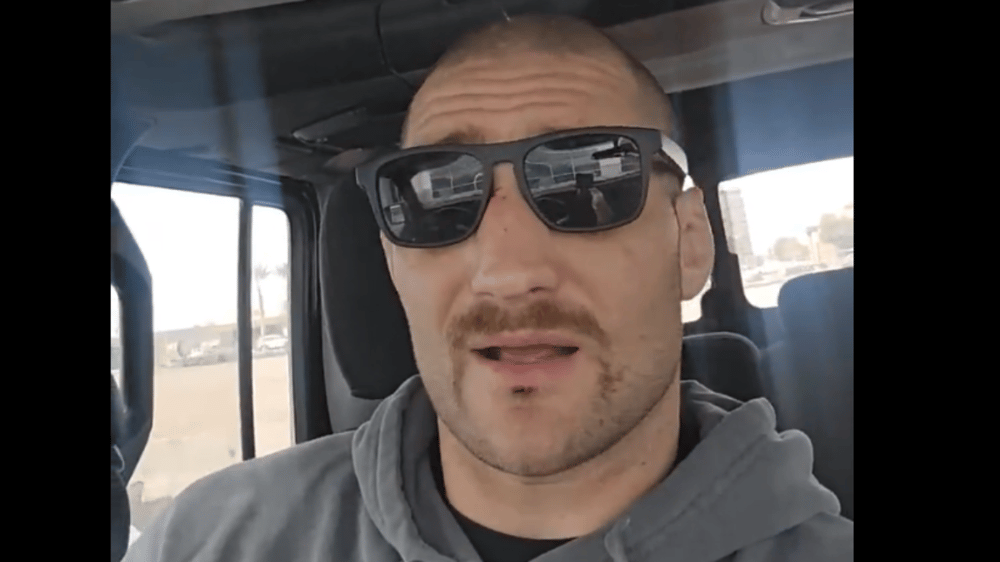
For all the outrage and the daily sparring sessions that look like therapy, there’s a thoughtfulness running through Strickland that keeps giving us glimpses of. It speaks to the everyman in all of us and is maybe more honest than any other fighter, as a recent video showed.
“I get in these like mindsets to where, like, I want to burn everything down in the world. I want to have nothing, so I can just f***ing lose it and just take out everything on people, you know? I think that, like you guys, in a weird way, like my family, like I've shared some s*** with you guys and you guys have shared some s*** with me, that like, I feel more connected with my fans. I think most people feel just 'cause we've gone through, we've gone through a lot together. I have everything I want, dude. I still struggle with mental health, you know?”
That’s the part that makes Strickland cherished. It’s not the insults or the headlines, but the fact that he doesn’t dress any of it up. He’s not selling a clean narrative or pretending success fixes anything. If anything, he’s proof it doesn’t. Peer-reviewed research released in 2026 categorizes this tension as a battle between Instrumental and Hostile Aggression. While Hostile Aggression is rooted in anger and a diminished capacity to learn the lesson, often manifesting as the “burn it all down” mindset Strickland describes, Instrumental Aggression is the deliberate, strategic application of force to gain a competitive advantage. For Strickland, MMA is where he can convert broken coping mechanisms and hostile impulses into goal-oriented outcomes that are his career. According to the research, without the rigid structure of a training regime, athletes with this psychological profile often experience a breakdown in emotional regulation. For Sean, MMA isn’t just a career. It’s a biological need that acts like a release valve for a mind that he admits is a “danger to people” when left to idle. The fight game gives him somewhere to put it, somewhere to manage it, and maybe that’s why he keeps showing up every day. Not just to get better, but to keep it all in check.
VERBALS THAT SELL
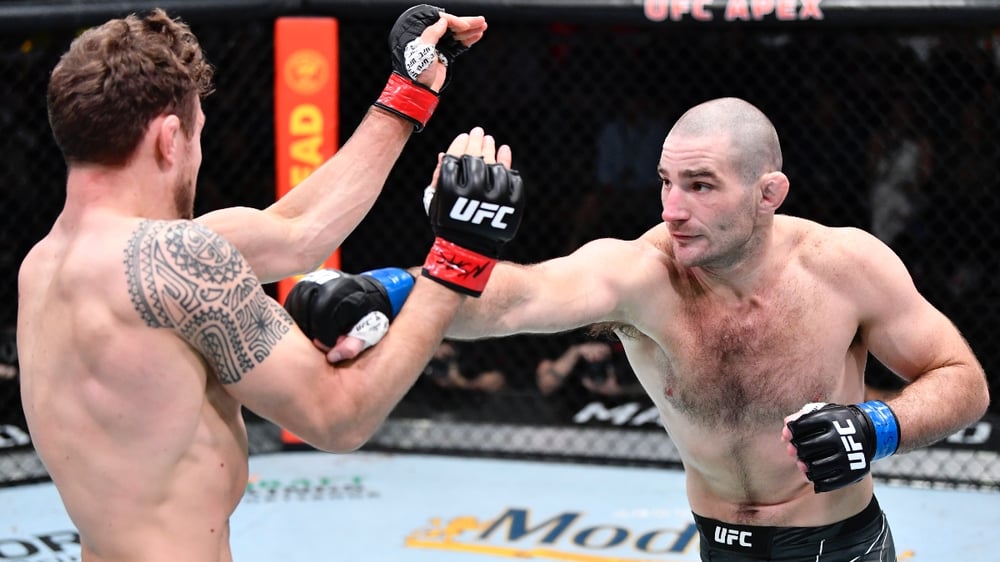
Strickland has never done the basic throwaway trash talk. Instead, he goes straight for identity, ripping into manhood, family, nationality, anything that makes a fighter who they are, because that’s the quickest way to strip away the polished veneer and expose something real. It’s maybe what they’re trying to hide, and it lands because it mirrors the same intent he brings. If you’re his opponent, he doesn’t just want to beat you. He wants to dismantle you from the inside out. And by the time his title fight at UFC 328 rolls around in May 2026, the machine will have turned every unfiltered rant into revenue, stacking millions on top of millions of moments that may have ended careers anywhere else. But that’s the point. Strickland thrives where others would fold, and in a sport built on confrontation, he’s the purest version of it. He’s not playing the villain. He’s making sure you feel something. And in this game, that’s worth more than being liked.
...