

issue 229
May 2026
Giancarlo Aulino sat down with Ken Shamrock to revisit the terrifying birth of modern MMA, the brutality that built his legend, and why “The World’s Most Dangerous Man” still refuses to fade quietly into the background.
Long before MMA became a billion-dollar machine with performance institutes, nutritionists, and TikTok walkouts, Shamrock was fighting in a world that looked like a deleted scene from a post-apocalyptic action film. There were no rounds, barely any rules, and certainly no guarantee you’d leave the cage with all your teeth still arranged correctly. Yet somehow, Shamrock became one of the faces carved into the foundation of the sport itself and might be the ultimate MMA pioneer, having begun in Japan’s Pancrase and competed at UFC 1, ending his career with a 28-17-2 record. With a tough upbringing and trouble with the law, MMA helped him turn his life around to the title of ‘The World’s Most Dangerous Man.’ As the first UFC Superfight champ and first inductee into the UFC Hall of Fame, we caught up with him to reflect on what life looks like now.
INTRODUCTION TO MMA
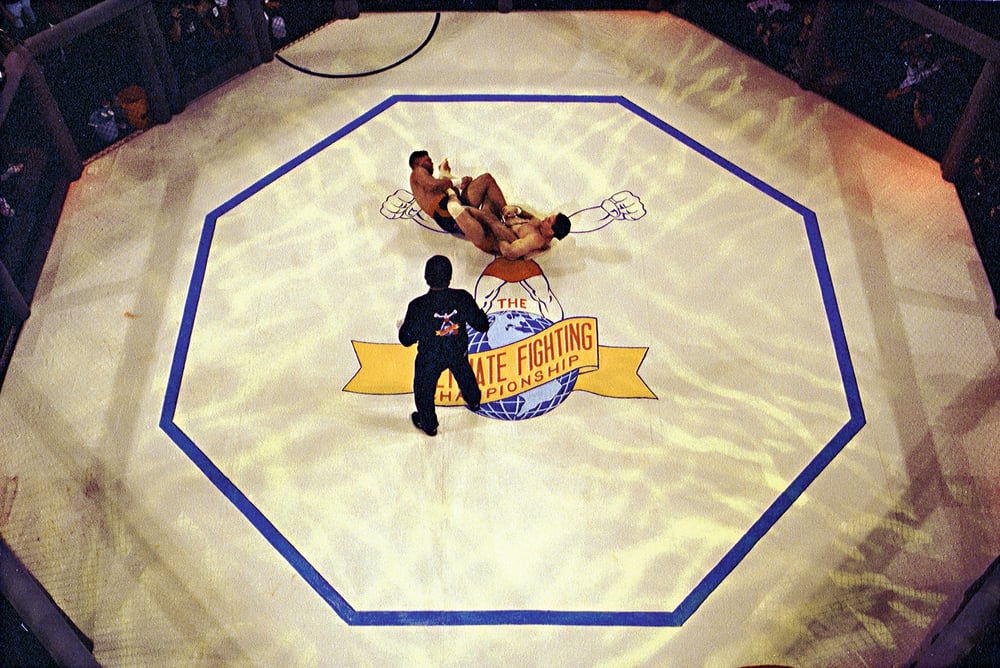
When Shamrock began MMA, it was a totally foreign concept nobody had seen before.
“I look back on it, and I just feel so blessed, man,” Shamrock smiles. “I know I’m putting this up there with some crazy things, but for me as a fighter, as a combative person, to be able to be involved in that kind of landing on the moon-type inspiration. To be at the beginning of this thing and understand that this is the beginning of something very special. Going from Pancrase to the UFC and having the opportunity to jump in there and have success right off the bat, other than the hiccup with Royce Gracie, it was a really good transition for me.”
There were plenty of risks at play that aren’t always accounted for.
“I don’t think most people really grasp this. When we went into this, there were no rules. No time limit. Anything goes. You can kick a guy in the head on the ground. You could pound his face into the ground. You think about the military, and they go to war, their lives are on the line, and they jump out there, man. You move that down a few steps to where we’re at, and we’re competing in hand-to-hand combat. You could die. That was literally the standard. And therefore, the understanding in most of us in the beginning was you could be put into a coma.”
FINDING A PLACE TO TRAIN
Unlike today, fighters then had difficulty finding a place to train and develop their skills.
“I would go into karate school and go, ‘Hey, I want you guys to kick me, and I’m going to take him down.’ And they’re like, ‘We won’t do that.’ I go to the wrestling club and say, ‘Hey, I’m going to strike at you. You guys try to take me down.’ They’re like, ‘Yeah, no. We won’t do it.’”
Thanks to these difficulties, he created his own gym, called the Lion’s Den.
“I literally built that plan to be able to have a training center, a house for fighters to live in, and be able to train and just be able to experience just fighting without having to have other things involved in their lives. And I built that universe around me. There was a reason for that. It was to help me have a place to train and sharpen my skills without having to leave my family. And so that’s kind of where all that came from.”
BRINGING BACK THE LION’S DEN
Shamrock feels that now is the right time to return to that and bring a camera along for the ride.
“We’re doing a series. Reality shows seem to be the big thing now for the last few years. And so, what I want to do is try to bring the ‘Lion’s Den: Returns.’ Bring back the aggressive training style that I implemented for the tryouts and guys that would come in and want to be a part of the team. And then of course they got to live in the house, and they have their gym, food, and everything paid for. I’m going back to that now and not actually putting myself in the middle of that universe. I’m going to pull myself out of that and allow it to naturally, organically build itself with the nucleus of fighters that actually make it, and continue on their fighting careers. And we will follow them through the video. We do different types of training, and exercises, and drills to find out how many of them really want to be a part of this. We’re going to be releasing that, I believe, in August or September. And once it airs, then we’ll start doing a follow-up to that, where we’ll bring in more fighters who want to come in and train, and win a grand prize. Cash prize. At the same time, we get to follow all these different individuals into their fighting careers. So, it’s going to be a very unique opportunity for people who come in and actually pass these tryouts. They get to go on and do their fighting careers, but we’re going to actually be behind them and help them market their careers.”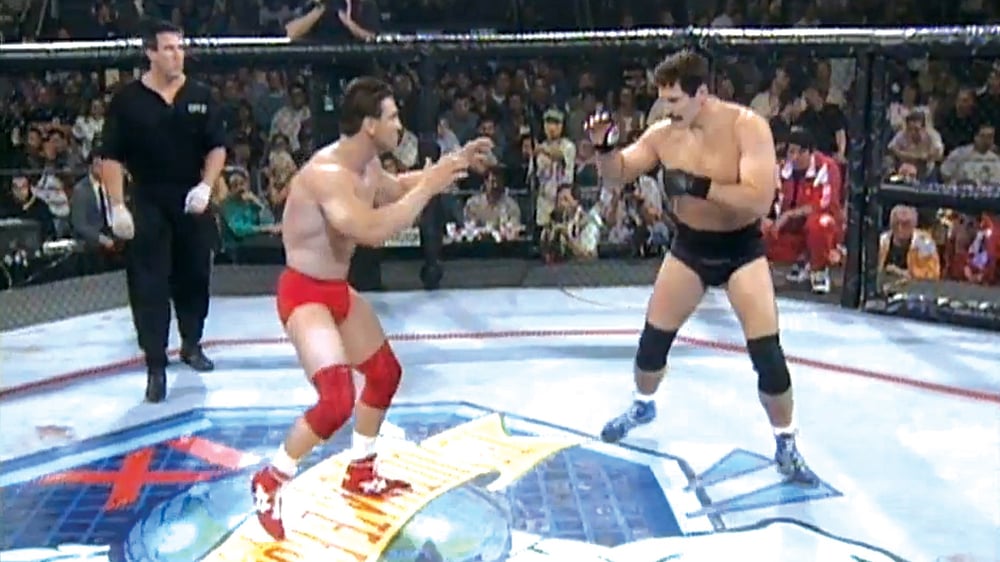
CHAMPION’S MINDSET
Joe Rogan has stated that he believes past greats, including Shamrock, would be successful in today’s UFC due to their champion’s mindset.
“I usually walked around at 217-219 lb. That was pretty normal for me. So, I think I probably would compete as a 205-pounder. I guess I think differently than most people. But in my mindset, there’s nothing really different when it comes to the person. Whether you drop them into the 60s, 70s, 80s, the 2000s, that person is still that person and has all the tools that make him great. And the desire and the determination he has in him separates him from the guys that are good from the guys that are great.”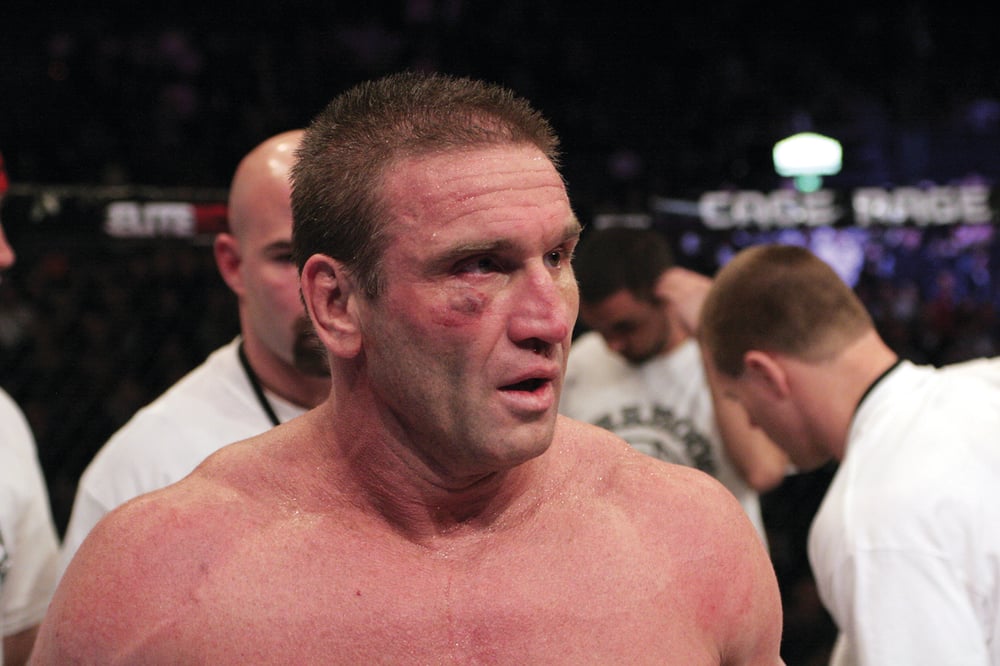
WORD TO HIS YOUNGER SELF
Shamrock received stem cell treatment and returned to the ring for TNA Wrestling in 2019.
“I know other people have done it, and some of them didn’t feel the effects. But for me, I felt it because I had so much inflammation and so much scar tissue and damage. They gave me the full treatment, and in about six months, man, it was like the fountain of youth. It was unbelievable. I would recommend it, but I think you have to temper your expectations.”
He is grateful for his legendary career, and won’t be back, however if he could see his younger self, he would emphasize one thing.
“First of all, I would say stay out of the clubs. And I would probably say be a little more patient when making decisions because some of the decisions I made, I made through aggressive passion, I guess. Things I love doing and wanting to do instead of looking at the whole picture and understanding some of the ramifications that could occur off those decisions.”
He will forever be a cult-like figure for MMA and is proof that a fighter can leverage reputation and become a powerhouse in other industries.