

issue 229
May 2026
9 April 2005
Las Vegas, Nevada, USA
The Ultimate Fighter 1 Finale
By Ray Klerck
MMA is always evolving, but some believe it’s become a sterile, high-stakes chess match played on a damp mattress. This is the era of control time and positional dominance, where elite grappling is so efficient it almost feels like two accountants aggressively spooning while Joe Rogan swoons over wrist control. For the casual fan, the bloke who fell in love with the visceral thud of something soft hitting something hard, like a face, the sport may feel alienating. To those fans, we offer a challenge: go back to the archives. Go back to a time when two men faced off, never to secure a transition, but to see who would mentally and physically quit first. There are fights that crown champions, and then there are fights that save entire sports from flatlining. The TUF 1 Finale was always far from technical perfection. However, it was 15 straight minutes of two exhausted maniacs who actually looked like accountants, treating the world to a taste of MMA’s golden era.
THE LANDSCAPE OF 2005
By early 2005, the UFC wasn’t an international juggernaut being welcomed into the presidential chambers. It was a barely breathing experiment that was bleeding money faster than Nate Diaz on a Netflix stream. It was still known as human cockfighting, and politicians hated it, and pay-per-view numbers were pathetic. The company’s entire future rested on a $10 million reality-TV gamble called The Ultimate Fighter (TUF) on Spike TV. It was a very special Trojan Horse because the UFC couldn’t advertise the live fights, as TV executives deemed them too violent. Instead, TUF was a reality drama show about human relationships and the athletic struggles of people the audience initially thought were thugs but who turned out to be likable, normal guys. Encapsulating this new narrative were two light-heavyweight prospects fighting for a single six-figure contract that meant absolutely everything. Forrest Griffin was a former cop with a political science degree, dry humor, and the posture of a dude who looked surprised to be winning fights. Stephan Bonnar was a sports medicine graduate with a chin made from whatever they build airport runways out of. They were educated, relatable, middle-class guys who just happened to love MMA. Neither of them knew they were carrying the future of the UFC on their backs.
THE PRESSURE BEHIND THE CURTAIN
What modern replays don’t show is the sheer panic backstage before the walkouts. The UFC owners had already sunk more than $40 million into the promotion and were reportedly ready to pull the plug entirely if the finale bombed. The fighters had spent six claustrophobic weeks trapped in a house with no phones, no television, and enough air-borne testosterone to tranquilize a brahman bull. For Griffin and Bonnar, this was also a moment of financial CPR. Griffin had quit his job as a cop and was so broke he’d reportedly been living out of his car before entering the TUF house. Bonnar was buried in debt. When they stood across from each other, they were fighting for purpose and enough cash to finally stop eating instant noodles with protein powder sprinkled on top.
ROUND ONE: THE WAR BEGINS
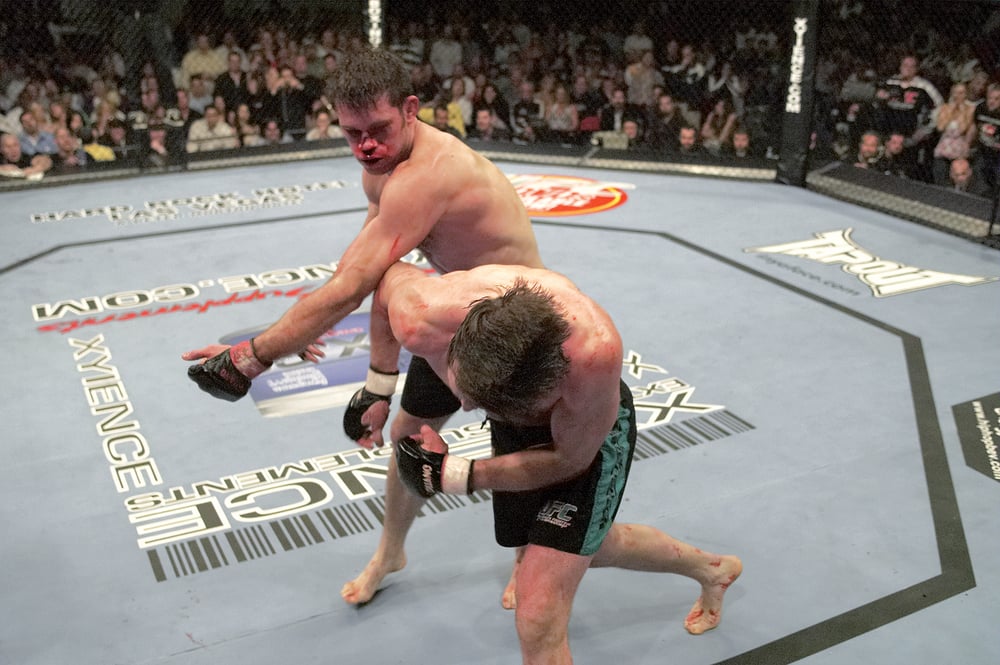
The opening bell rang, and any expectation of a cautious feeling-out process immediately exploded into the Las Vegas air like a cheap firework. Griffin and Bonnar skipped the pleasantries, ignored the concept of defense, and marched straight into a phone-booth brawl. Forrest came out throwing high-volume combinations while Bonnar happily stood in the center like a man who wasn’t remotely worried about getting knocked out. It was a breathless back-and-forth slugfest that Joe Rogan instantly compared to Hagler vs Hearns, which at the time was about the highest compliment humanly possible. What the cameras didn’t capture was the collective tightening of every UFC executive’s sphincter ringside. Every punch thrown felt like another heartbeat keeping the company alive. There was no stalling, no fence hugging, no tactical calf-kick symposium. Just two blokes slinging leather like overdue rent depended on it. The back-and-forth brawling was so even that you would hate to have been the one scoring the initial round, which was made even more breathtaking by the fact that Griffin had Bonnar in an arm bar with 10 seconds to go. Any longer on the clock, and the fight would have been his and the UFC could have been a distant memory.
ROUND TWO: THE CRACK IN THE OPTICS
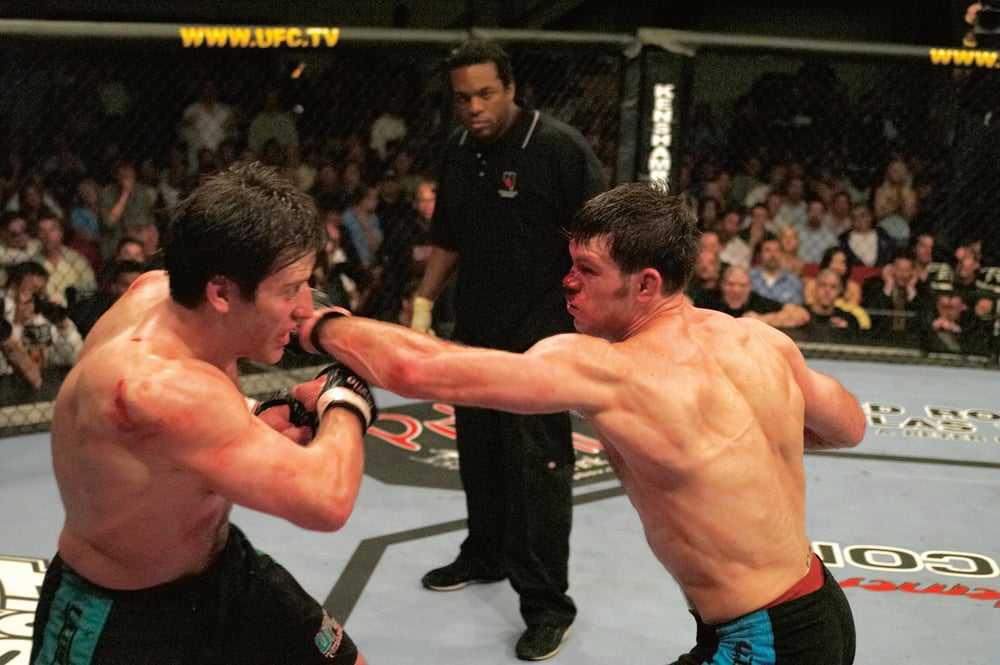
The second round brought blood, and with it, a complete shift in the emotional gravity of the fight. Early in the frame, a stiff jab from Bonnar split the bridge of Griffin’s nose. The referee paused the action while a doctor inspected the rapidly forming crime scene on Forrest’s face. For a brief moment, the future of the promotion hung in the balance on whether one exhausted ringside physician might decide if a nose was in good enough condition to hang on until the end. Backstage, the production staff was panicking. Someone asked Dana a question, clearly about what would happen next, and he can be seen shrugging with a “I don’t know.” If the fight got stopped because of a cut, the reality show’s grand finale would end with the emotional payoff of a wet sandwich. Griffin got cleared, and the restart gave birth to a slugfest where neither man was willing to stop throwing. Bonnar swarmed him with knees from the clinch while Forrest fired back through a haze of blood and survival instinct. Neither man looked interested in self-preservation, but Bonnar seemed to have the upper hand. It was once again called the greatest fight of all time as both men became drenched head to toe in blood, a spectacle that probably no other sport had brought to the TV screen.
ROUND THREE: THE SOUL OF THE OCTAGON
By the final frame, both men were operating deep in the red. It was clear their lungs were screaming, their punches had slowed, and their bodies looked like they’d been left in a tumble dryer full of bricks. Somehow, neither stopped moving forward. Behind the scenes, Spike TV executives were watching the live ratings climb in real time. Viewers were calling friends mid-fight, telling them to switch channels immediately. The word-of-mouth explosion was happening live, right there during the broadcast. MMA wasn’t just surviving anymore. It was mutating into something impossible to ignore. This was the deep-water modern fighters are trained to avoid through positional safety and tactical risk management. Griffin hacked away with low kicks and clinch knees while Bonnar answered with tight combinations and raw stubbornness. Every time one landed a shot that should’ve ended things, the other simply blinked, reset, and kept marching forward like a malfunctioning Terminator. The Cox Pavilion crowd stomped so violently that the arena shook. The fight never slowed into exhaustion. It just seemed to accelerate into mythology.

THE FINISH WITHOUT A FINISH
There was no knockout. No submission. No viral one-shot highlight. Just two shattered, blood-soaked men leaning against each other after spending every ounce of themselves for 15 straight minutes.
29-28.
29-28.
29-28.
Griffin got the unanimous decision and the contract, but the performance was so legendary Dana White famously handed Bonnar a six-figure deal inside the cage anyway. The official record books show a winner, but the real victory belonged to the sport itself. The aftermath felt almost cinematic. As soon as the broadcast ended, Spike TV executives reportedly walked straight up to the UFC owners and offered a new multi-year television deal on the spot. That night, millions of viewers suddenly understood MMA wasn’t just violence. It was drama, suffering, and resilience wrapped in four-ounce gloves. It remains the greatest blueprint for what a real fight is supposed to feel like. Like your favorite pub brawl somehow wandered onto national television and accidentally saved an entire industry.
...