

issue 230
June 2026
Ray Klerck digs into the numbers behind modern MMA and discovers how the lighter weight classes find their finishes
It’s not hard to remember the spectacular finishes. Joaquin Buckley's award-winning spinning back kick. Yair Rodriguez's no-look up-elbow. Chris Weidman sleeping a showboating Anderson Silva. Those are the shining moments that live forever on highlight reels and make every fan spill their Bud Light. But spend enough time around coaches and fighters, and you'll notice something strange. For all the flashy finishers that are impressive enough to get replayed a million times on mainstream news, the techniques that actually end most fights are almost insultingly simple. The same weapons that worked when Royce Gracie and Mark Coleman were active remain very effective today. Research published last month shows that, even though MMA has evolved at a ridiculous pace, the finish itself hasn't changed much at all. Here’s why the oldest tricks in the book are still the hardest ones to stop.
THE HIGHLIGHT REEL IS LYING TO YOU
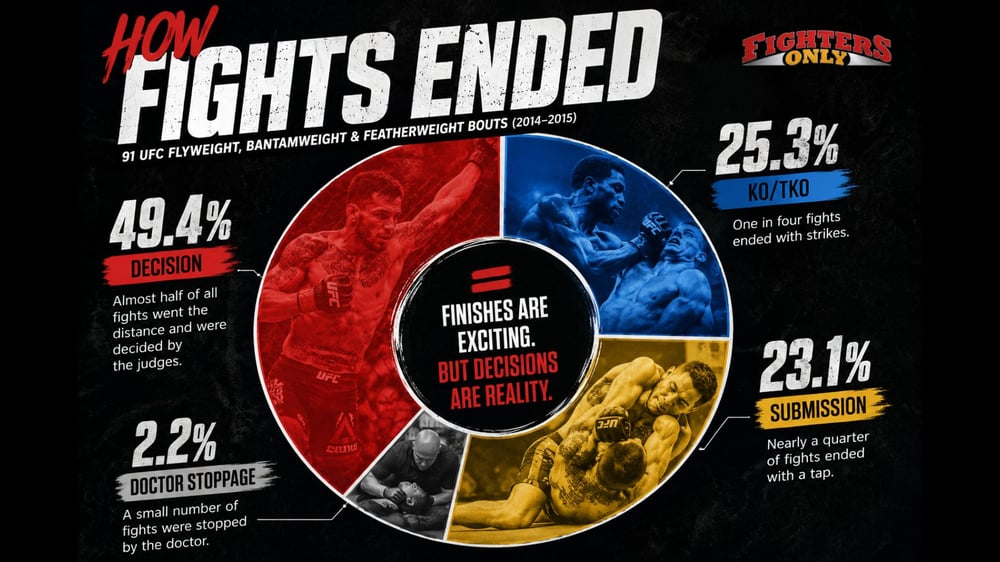
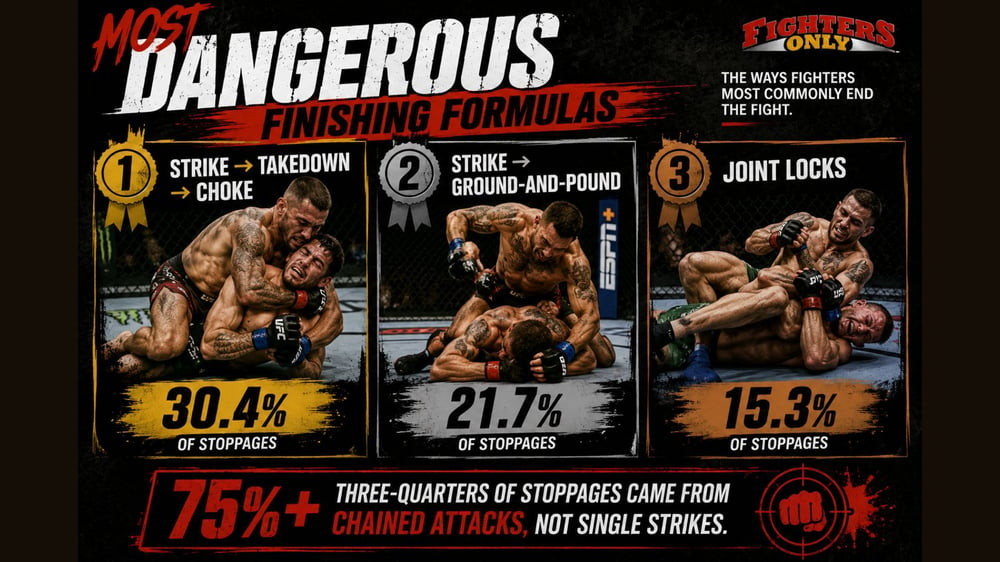
Watch enough KO compilations, and start to believe that's all there is, which is like thinking that drives Lambos because that's all you see on Instagram. However, the winning numbers behind the professional game tell a different story. Journal research published in early 2026 went back and painstakingly broke down 91 UFC flyweight, bantamweight, and featherweight fights from 2014 and 2015, slow-moing everything from UFC 168 through UFC 194. A decade later, despite calf kicks, Dagestani handcuffs, and every spinning attack known to mankind entering the sport, their findings still feel strangely familiar because they found that almost half reached the judges, with decisions accounting for 49.4% of outcomes. But among the fights that did end early, there was very little Hollywood magic involved. More than three-quarters of stoppages came from fighters chaining techniques together rather than betting the house on one big shot. The most successful formula was striking an opponent to force them into a takedown position before finishing them with a choke, which accounted for 30.4% of stoppages. It’s the exact blueprint featherweight icon Max Holloway used during his legendary 13-fight win streak, where he systematically dismantled opponents on the feet before drowning them on the canvas. Stand-up strikes flowing into ground-and-pound produced another 21.7% of the wins, a stat perfectly embodied by bantamweight champion T.J. Dillashaw, who used high-volume striking to drop Renan Barão twice at UFC 173 before finishing him with ground strikes. Upper-limb joint locks added 15.3%, unless you’re Ronda Rousey who won 76% of her fights thanks to armbars. The male fighters in the study spent nearly half the contest on their feet and another 36.2% on the mat, yet spinning kicks appeared only 29 times in the entire study. Apparently, MMA's greatest finishing weapon isn't creativity. It's good old-fashioned efficiency.
THE FIRST ROUND IS WHERE DREAMS GO TO DIE
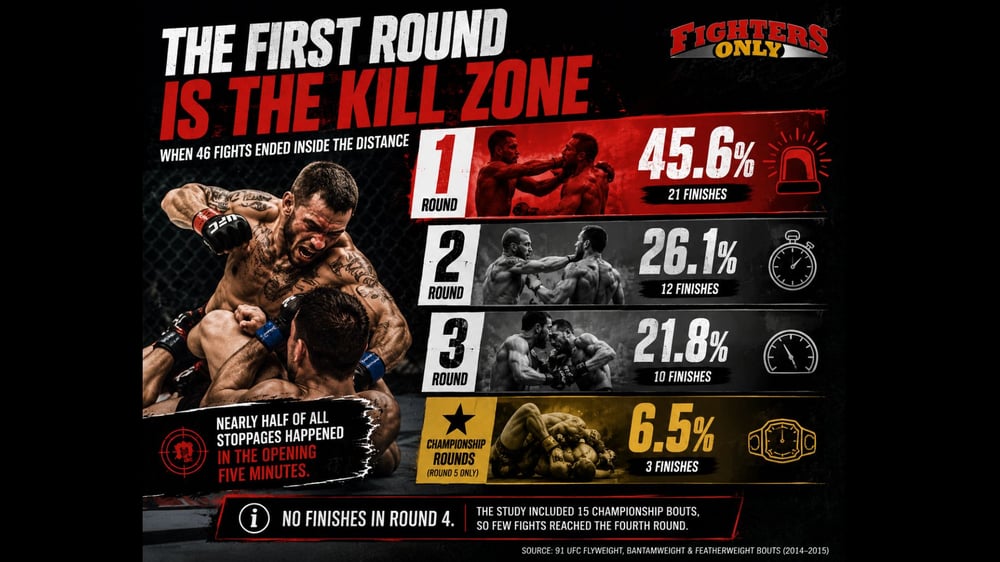
For the lighter weight classes, the first round is a bit like New Year's Eve. Everyone kicks off their celebrations with grand plans, plenty of energy and the belief that boxes will be ticked off in a perfect sequence before the final fireworks. Five minutes later, somebody's crying in the driveway and someone else has lost one of their shoes. The same thing kind of happens in MMA. Of the 46 fights that ended before the final bell, 45.6% were over in the opening round. Round two accounted for 26.1% of stoppages and round three just 21.8%. In championship fights, only three finishes came in round five and none arrived in round four. The message was clear. If disaster is going to strike, it usually doesn't wait around. The researchers believe the opening round is so dangerous because fighters are at their freshest, their confidence is ultra-high and neither fighter has had time to fully decode the puzzle standing across from him no matter how much video footage they’ve seen. Featherweights alone produced 15 first-round finishes, more than any other round in the study. Which helps explain why seasoned veterans like Dominick Cruz, who built a historic bantamweight career on elusive footwork and an elite 68% strike defense rate, treated the first round like a reconnaissance mission rather than a pub brawl. Even the most dominant champions learned to respect the early clock; during this exact era, flyweight king Demetrious Johnson defended his title by avoiding early traps altogether, often dragging fights deep into the championship rounds where he secured historic late-game finishes, like his jaw-dropping fifth-round armbar at 4:59 against Kyoji Horiguchi. Survive the opening storm and the fight often becomes less about unpredictability and more about skill. But underestimate those first five minutes and your night can end before Bruce Buffer has had time to clear his throat.
YOUR BODY STILL HAS FACTORY SETTINGS
If Apple designed the human body, they'd have released at least seven software updates by now. Unfortunately for MMA fighters, evolution works at dial-up internet speed. While techniques have changed dramatically over the last three decades, the body parts they attack haven't. Which is exactly why a June 2026 review examining the anatomy behind common grappling submissions found that the rear naked choke and armbar remain so brutally effective. The previous study identified striking into takedowns before finishing with a choke as the sport's most successful finishing formula, accounting for 30.4% of stoppages. The June review helps explain why. The rear naked choke, or Mata Leão, which translates to ‘lion killer,’ doesn't simply cut off air like many fans believe. It compresses both sides of the neck and reduces blood flow to the brain. Researchers noted that previous reports have linked vascular neck compression techniques to carotid artery injuries and even rare cases of stroke. Which helps explain why even the toughest fighters are smart enough to tap quickly when they’re in this position. There are plenty of muscles you can strengthen in the gym, but there isn't a neck day exercise that teaches your brain how to function without blood.
ELBOWS WERE NEVER MEANT TO BEND THAT WAY
Anyone who has ever stepped on a Lego barefoot in the middle of the night knows the body comes with a few design flaws. The elbow is one of them. The June 2026 review found that armbars work by controlling the shoulder and forearm before forcing the elbow beyond its normal range of motion. By using the hips as a lever, fighters create enormous force through a joint that was only ever designed to bend one way. Push things far enough and it's not just pride on the line. Researchers identified the collateral ligaments, flexor tendons and even the biceps attachment as structures at risk. It might be why big-gun fighters like Paulo Costa have never lost to via armbar. With all these structures at risk it’s no wonder fighters don't wait around for a second opinion once their arm starts pointing in a direction. The upper-limb joint locks accounted for 15.3% of finishes in the lightweight study, making them one of the sport's most reliable fight-ending weapons.
TRAIN THE BORING STUFF UNTIL IT'S BEAUTIFUL
There’s an old saying that amateurs practice until they get it right while professionals practice until they can’t get it wrong. The numbers behind lightweight MMA suggest there’s plenty of truth in that. If you're looking for the next secret technique to revolutionize your game, you might be disappointed. The data suggests you’d be better off sharpening your straight punches, improving your double-leg entries, developing a nasty top game and learning to finish a rear naked choke with the same care a surgeon uses to remove an appendix. The findings also serve as a reminder that the first round isn't the time to start fighting like a human Red bull can. Fresh opponents are dangerous opponents, and understanding when your opponent is at their most dangerous can help fighters manage risk while forcing the other man to make mistakes. More importantly, the research highlights that the body still has weaknesses no amount of toughness can overcome. Elbows still bend one way. Brains still need blood. And joints still wave the white flag long before the mind is often willing. For fighters in the lighter weight classes, where speed and volume often steal the headlines, there is something comforting about all this. Despite a decade of evolution, the statistics suggest that flyweights, bantamweights and featherweights still live and die by the same fundamentals that made legends out of Demetrious Johnson, Dominick Cruz and José Aldo. Highlight reels might light up your socials, but the numbers belong to the basics. Sometimes the perfect finish isn't the one nobody saw coming. It's the one everybody saw coming and still couldn't stop.
...