

issue 230
June 2026
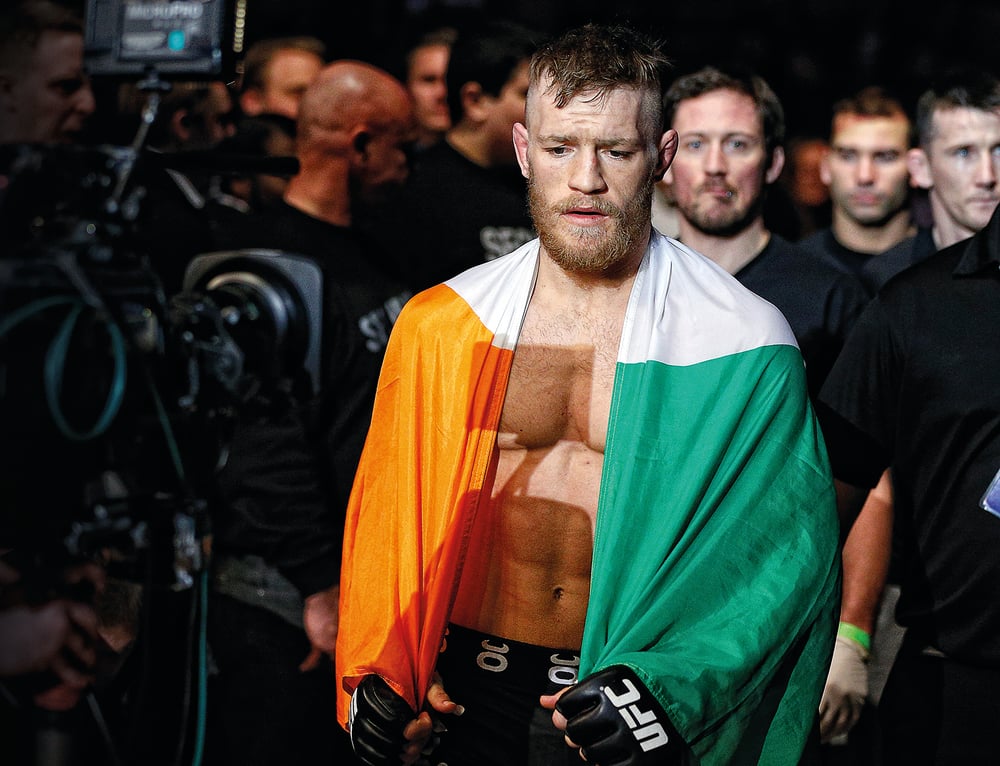
Thirteen years after Conor McGregor outpointed a young Max Holloway, the unfinished draft he defeated returns as a Hall of Fame machine, who has created a legendary, full-circle collision to prove whether McGregor can capture lightning in a bottle twice.
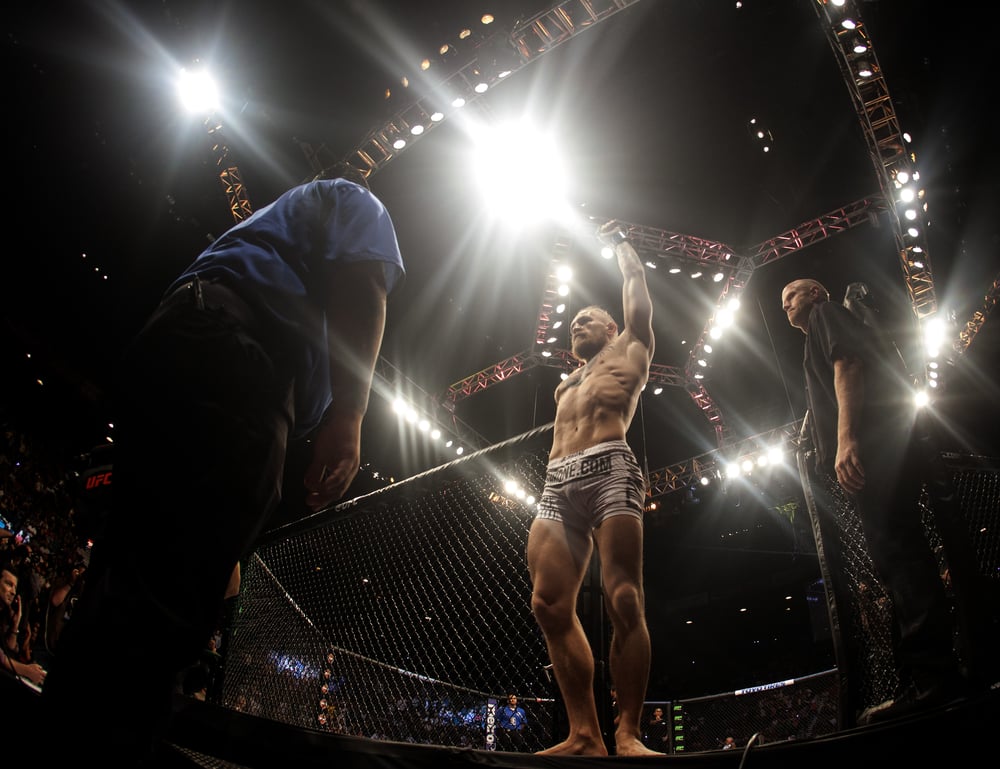
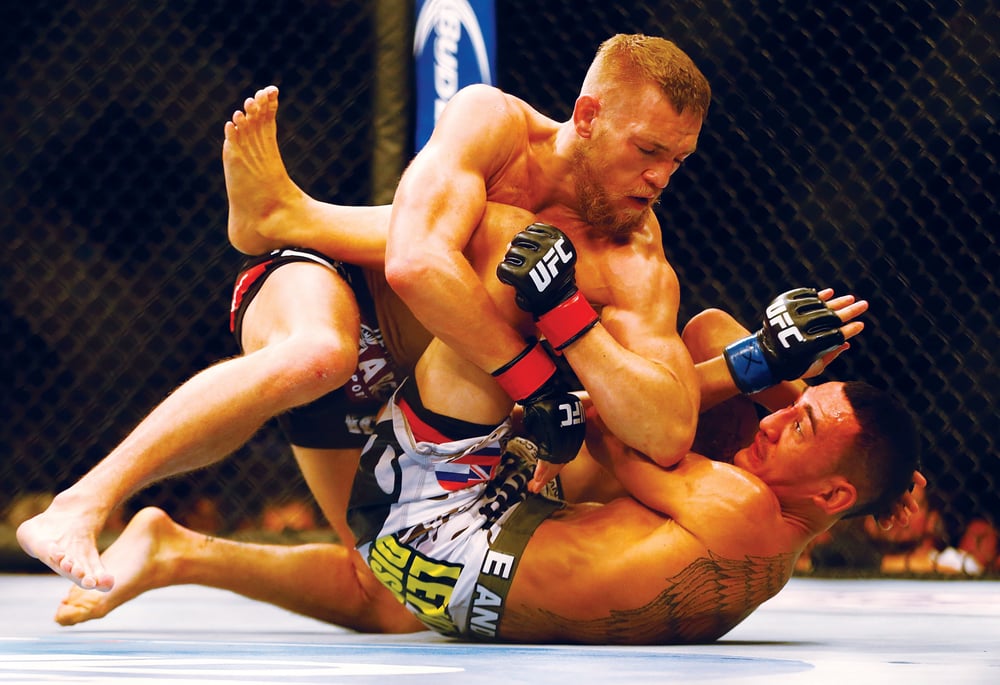
Your mum, and at least one of her friends, knows who Conor McGregor is. So does your neighbor. So does that odd bloke from accounts who couldn't tell you the difference between an armbar and a wheelbarrow. Very few fighters escape the confines of MMA. But McGregor has achieved household name status. Simply say “Conor,” and millions of people immediately picture the beard, the swagger, and the left hand. His fame makes it easy to forget that before the F**k-You-pin-striped suits, Hollywood cameos, and Proper empire, there was a 24-year-old Irishman who stood across from a skinny 21-year-old Max Holloway. That night may have been the beginning of a story neither man realized they were writing. For three rounds inside Boston's TD Garden, McGregor looked every bit the superior fighter. Even after tearing his ACL midway through the contest, he adapted, landing four takedowns from five attempts and controlling long stretches on the ground. On the feet, the gap was even wider. McGregor landed 53 significant strikes to Holloway's 23 while connecting at a higher percentage. It was comfortable, convincing, and, at the time, almost entirely forgettable. Or so we all thought. The defeated Max Holloway, who walked out of Boston that night, no longer exists. Over the next 13 years, he transformed himself into perhaps the greatest pressure fighter the sport has ever seen. Today, he owns the UFC record for significant strikes landed with a staggering 3,681, nearly 1,000 more than any of his counterparts. Adding to that, he has spent 8 hours, 52 minutes, and 43 seconds inside the Octagon, more than any fighter ever. They read like typographical errors rather than official statistics, but therein lies the cruel irony. McGregor didn't just beat a future champion. He may have helped create the perfect fighter to answer the one question nobody has been able to answer for almost a decade. Is Conor McGregor still Conor McGregor?
THE MCGREGOR AUDIT
True to form, McGregor has already told the world exactly how all of this pre-fight conjecture ends.
“It's going to be a demolition," he told CBS Sports. “It's going to be an absolute demolition. I know the damage he's taken. I will just have to touch him, and after that, it will be clinical. To win alone is not enough. It must be spectacular.”
Mystic Mac has spoken once more, but the bookmakers aren't buying it. At the time of writing, McGregor sits as a marked underdog against Holloway, and not because anyone has forgotten who he once was. It's because the betting algorithms remember exactly what made him so terrifying. His left hand is lavished with hero worship, but it deserves only about half the credit. McGregor's greatness was built on arriving first. Before the punch came the trap. He'd steal half an inch of distance. Lean just outside your range. Show you a target that wasn't really there. Then, the moment you reached for it, he'd disappear, and the left hand would arrive before his opponent’s brain had finished telling your body there was a problem. Sports science suggests those reflexes are among the first athletic qualities to fade because age, long layoffs, and serious injuries all chip away at the ability to process visual information, recognize patterns, make decisions, and fire muscles in a precise sequence, all within fractions of a second. McGregor has always done more than hit people. He made them late, and that may be a problem because sports science says making other people late is exactly what the birthday candles chip away at. A five-year study of 2,229 professional MMA fights found that age was a stronger predictor of victory than height or reach. Worse still for McGregor, the penalty was greatest in the lightweight and featherweight divisions, where fights are decided by reactions, speed, and split-second decisions rather than brute force. Sadly, time doesn't treat every fighter equally. It hunts the lighter weight classes first.
STANDING OUT
Then there's the scaffolding because we can't forget the snapped tibia. McGregor's game has always been built from the floor up. Every counter started with his feet. Every trap relied on balance, weight transfer, and the ability to explode off the canvas without thinking. The left hand was simply the receipt after all the hard work had already been done. A repaired leg has to do more than just heal; it has to remember. A 2024 study of professional athletes returning from traumatic tibial fractures found performance dropped by an average of 14.7% after they returned to competition. This wasn't because they couldn't compete anymore, but because reproducing explosive movement under pressure proved incredibly difficult, even after months of rehabilitation. Chris Weidman recalled how difficult it became to trust his previously broken leg again during his comeback fight against Brad Tavares.
“And I came back and my first fight back, I'm going against Tavares, and this dude starts leg kicking me right away,” Weidman said when asked how tough this injury was to come back from. “In training, I was leg kicking with the shin pads on and stuff, and I thought I was fine. He could leg kick me, always my instinct was ‘I'm kicking back even harder.’ He kicked me, and I just couldn't throw my damn kick, and I'm like, ‘F**k…oh, my God.’”
If anyone was going to rise to the challenge, it would always be McGregor. Almost six years ago, he admitted he'd completely changed the way he approached recovery after reading about NBA superstar LeBron James' investment in his body.
“I read something about LeBron James a while back,” McGregor said. “That he spent $1.5 million annually on his health... his nutritionists, trainers, everything. And I spent nothing. Only in camp. I'd drop money on a bleeding car or a watch. So, I'm like, spend on myself. My health, my fitness, and that's helped me.”
It marked a philosophical shift. The man who once collected watches started collecting recovery specialists. And we’re all hoping that nutritionists, physiotherapists, and performance experts have become part of the investment portfolio. Whether that's enough is the million-dollar question. Or perhaps, in McGregor's case, the $1.5 million question, but he’s got the bank to spend. That said, can the money buy back milliseconds? Since he’s dropped in and out of the UFC’s drug testing pool for some years, there’s a chance that sports science’s dark arts might be able to buy back the reaction time Father Time may have stolen.
POWER MIND
When it comes to mindset and endurance, he very publicly went 10 rounds with Floyd Mayweather, arguably the best defensive boxer of all time, and fought a 5-round war with Nate Diaz, so his endurance is proven, probably courtesy of that indomitable will of his. This is a man who convinced himself he could become the biggest name in combat sports long before he had enough money to fill his car with petrol. After reading The Secret, he became obsessed with visualization. He and Dee Devlin would drive around Dublin pretending they already owned the expensive cars parked outside luxury hotels. Before almost every major fight, he slipped his grandfather Albert's battered flat cap into his gear bag, not because it made him punch harder, but because it reminded him who he was before the world started calling him Mystic Mac. After his first fight with Holloway, Fighter’s Only spoke with McGregor in LA, and he was equally confident in his manifesting powers.
“I’ve seen my visions happen before my eyes,” he told us. “I can predict the future. Not all of it’s happened yet, but I know it’s going to, because a lot of it has. Daydreaming, visualizing, whatever you want to call it. I’ve been a dreamer all my life.”
That day, he went on to make another prediction, which at the time may have seemed rather far-fetched but rather eerily came true.
“People who have been right about me all along,” he smiled. “Me, I’ve been right about myself all along. John Kavanagh, he has been right about me all along. He always used to say, ‘We are going to change the face of this game.’ I always used to get told that. In the middle of the training sessions, I used to shout, ‘We are world champions!’ – before you knew it, I had two Cage Warriors belts at different weights. Cathal Pendred has one, Chris Fields had one – because we all believed in ourselves. I have really proved to myself what a strong mind can do: it can do anything. And that’s why I am going to be a UFC champion.”
WINNING MINDSET
You'd imagine that same highly focused mind has spent the past few months binge-watching Max Holloway fights, of which there is plenty of footage. There’s every jab. Every shoulder feint. Every habit. If preparation alone won championships, McGregor would already have his hand raised. But watching old tape, is just that: old. Just ask Dustin Poirier. Back in 2014, McGregor needed just 1 minute and 46 seconds to flatten him. The rematches, almost seven years later, told a completely different story. Poirier had evolved and weathered the early storm, dragged McGregor into deeper water, and stopped him. Then he did it again. The danger with watching too much tape is that you’re studying yesterday, and Holloway has spent the last thirteen years becoming tomorrow. Where the delicious irony lies is that McGregor probably knows Holloway better than Holloway knows himself. Dustin Poirier offered a unique perspective on the matchup during an appearance on Josh Thomson's Weighing In podcast when he was asked whether he expects McGregor to show signs of decline similar to Nate Diaz.
“Yeah, I don't think Conor's going to look as bad as Nate, bro. That was really bad,” Poirier said. “The thing is that I think the punching power is going to be there, regardless. Conor's going to come back from the injury and still have that natural punching power. The question for me is the timing, the athleticism, the movement. All those questions need to be answered. I don't know. We haven't seen him, so I don't know.”
Poirier went on to point out that Holloway has touched the canvas in his last three fights, but failed to mention that after being dropped twice by ‘The Diamond,’ he got up and won the fight. Therein lies the tenacity of Holloway, who will almost always shatter expectations around him. The only place we'll find out whether McGregor is ready is when the Octagon door closes. And waiting on the other side is perhaps the worst possible examiner: a man who owns the UFC records for significant strikes landed and total fight time, and who has built an entire career exposing the tiniest cracks in another fighter's armor.
THE 1,000-PUNCH PROBLEM
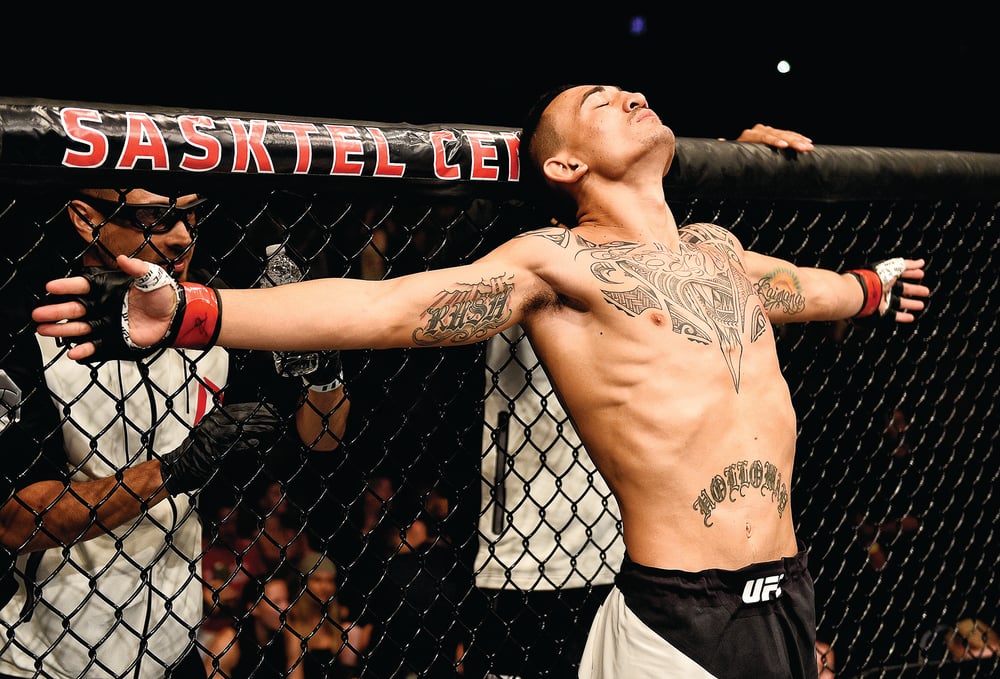
Let's assume McGregor passes the audit, and the left hand is still throbbing with its nuclear power because all those recovery specialists have somehow mugged Father Time in a dark alley. A Max Holloway-shaped problem still remains. Against Calvin Kattar, Holloway landed 445 significant strikes over 25 minutes. That's almost 18 clean scoring blows every minute. Most fighters frame a performance like that, but Holloway probably forgot about it by breakfast, because he’s always about the bigger picture. Speaking with Fighters Only some years ago, he made his intentions clear.
“Everything else washes away, but legacy doesn’t,” he told us. “All this money, all the things I’ve got will all disappear, but legacy will be there all the time. When you look in the history books, I want my name in there. When I’m long gone from this world, and no one even knows who I was, they can look in the books on their fancy iPhone 4010 and see I was in the UFC, and I had a legacy worth remembering. It’s all about legacy. I’m trying to inspire the next kid up, whoever it is. Let them know that if I can do it, why can’t they? Work hard, get your head down, don’t listen to no one and go after it. If you really want it, it’ll be a beautiful ride. Sometimes it won’t be the most fun ride, but when it’s all said and done, you’ll enjoy it.”
Despite the recent loss of his BMF title and failing to win the featherweight title from Ilia Topuria, he’s forever a student of the game.
“We make sure to cover our bases everywhere,” Holloway told Fighters Only. “If you think you can move on to one thing because you’re good there, you’re screwing up. You need to get great at everything. The sport is always evolving. Someone will always bring a new trick, a new way to set something up. You can never feel you’re great anywhere. Things will start going downhill from there. We watch back my fights and see what I did or did not do and try to get better. You’re striving for perfection, and it may be far away, but if you’re not striving for it, you’re in the wrong sport. This game is about adapting. You’ve got to be a chameleon, able to adapt to every situation. Sometimes my coach will tell me something, and I’ll tell him he’s crazy as shit, but we’ve got to do whatever it takes to get the win.”
He’s a man who is humble in both defeat and victory, so you can bet you’ll see something fresh from him when he takes on yet another championship belt wearer.
THE FINAL EXAM
If this story has taught us anything, it's that statistics and research studies don't throw punches. Fighters do. So, while the numbers might favor Holloway, the sports science raises all sorts of legitimate questions because time remains undefeated. Yet anyone who has followed Conor McGregor's career knows that logic has rarely been his favorite training partner. This is the man who collected a welfare cheque before collecting world titles. The man who talked his way into opportunities, then punched his way into history. He has spent his entire career making sensible people look foolish. If he’s shown us anything over the past decade, it's that belief has always been his greatest performance enhancer. Long before sports psychologists spoke about visualization, he was already living inside tomorrow before anyone else could see it. Meanwhile, Max Holloway deserves every bit of the praise he's earned. The skinny prospect McGregor outpointed in Boston has evolved into one of the most complete Hall of Fame fighters the UFC has ever produced. But greatness doesn't disappear just because a spreadsheet says it should; it has to be taken by force, which is why rematches like these will get opinions from everyone. It's a collision between the fighter who changed MMA and one of the finest examples of what that change inspired. Maybe Holloway completes the journey that began back in Boston. Or maybe the greatest trick Mystic Mac ever pulls is convincing us, one more time, that the impossible was only improbable. Either way, if we get to see that famous ‘Point Down’ challenge, we'll all be watching.
...