

issue 230
June 2026
We ask a veteran cage-side doctor why some fighters seem impossible to knock out, and whether an iron chin is born, built, or simply borrowed from biology.
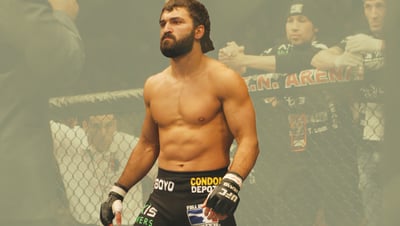
Strikers have made careers out of proving that people’s faces are much more durable than the anatomy charts might suggest. For a recent example, look no further than Justin Gaethje’s performance at UFC Freedom 250, where he spent four rounds tenderizing Ilia Topuria's head like it was a Saturday night schnitzel. Sure, it was labeled as a TKO because Topuria finished on the stool, but he kept walking forward and didn’t hit the canvas, despite looking through a set of scratched-up googly eyes. We've all seen fighters like this. They wear a barrage of shots from terrifying punchers that keep plodding along. Fans call it a granite chin, fighters call it toughness, and there’s a long line of alumni who carry this quality. Marvin Vettori. Paddy Pimblett. And even Max Holloway before his encounter with Topuria. Marlon Vera is probably best known for this ability, despite suffering a series of recent losses.
“You can hit me with your best shot,” he famously said. “You can kick me in the face. My chin is made of different material. When guys hit me flush, and they see me just walk forward, I can see the look in their eyes. I see them realize, 'Oh, this guy isn't human.' That's when I win the fight.”
STRAIGHT TALKING
Okay, so that last part may not always be true, considering he’s lost his past four fights by decision, but neither is the part about the chin because a good chin isn't hiding in your jaw. It's hiding inside your skull, and the greatest trick an iron chin ever pulled was convincing everyone it lives in the face. It doesn't. It lives upstairs. Every knockout is really your brain throwing the emergency breaker switch. One such man who has seen it all is Doctor Asoka Wijayawickrama. He's a cage-side doctor, a general practitioner and a Brazilian jiu-jitsu black belt who has spent years patching fighters back together through Safe MMA.
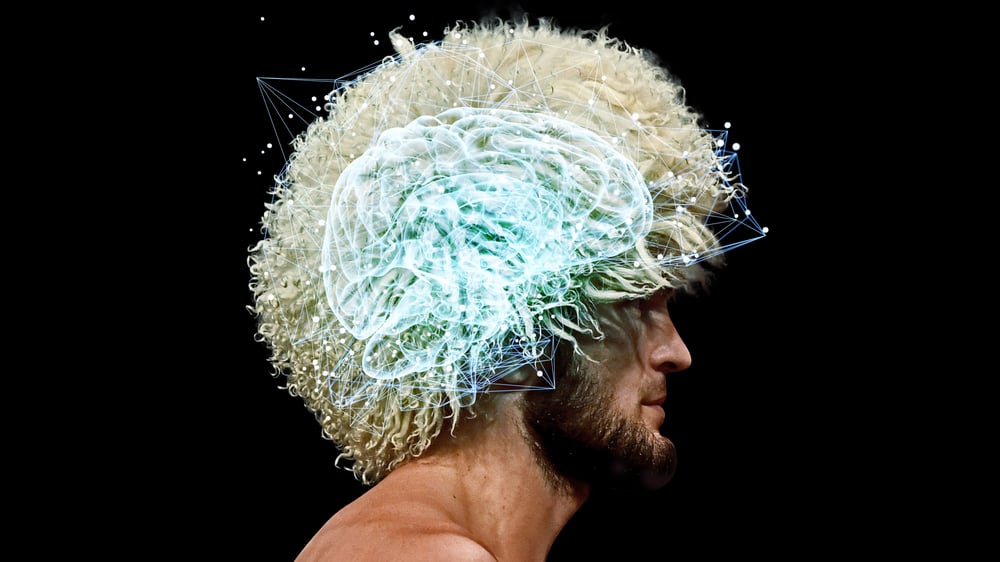
“The brain is surrounded by fluid inside the skull,” he explains. “When an impact is made with the skull, the brain moves within that fluid and strikes the inside wall of the skull. This basically causes a biological short circuit of the brain's electrical activity, causing it to shut down to protect itself.”
In other words, your brain would rather reboot itself than let itself get rattled any further, which is a clever little adaptation for combat sports. However, perhaps less so if you were headbutted by a wild boar and needed to get to safety, but who are we to argue with evolutionary responses? Fact is, the punch isn’t the only thing fighters need to worry about.
THE BIOLOGICAL SHORT CIRCUIT
Take Leon Edwards's legendary, world-rocking head kick knockout of Kamaru Usman at UFC 278. Usman had spent almost 24 minutes soaking up punches, walking Edwards down, and looking every bit the champion. Then came one disguised left high kick that wrapped around the champ’s jaw. The rotational force flipped the off switch, sending the pound-for-pound king unconscious before he even hit the canvas. One perfectly placed strike achieved what almost 24 minutes of punishment couldn’t. The reason lies in physics rather than power because not all strikes are created equal when it comes to triggering this biological shutdown. While a straight punch to the nose might leave blood splashed across the canvas and create a gruesome slow-motion replay, its mechanical effect on the brain is often surprisingly limited.
“Although being hit by a straight jab in the face can cause more cosmetic damage,” explains Dr Asoka Wijayawickrama, “the straight jab causes less head movement and less movement of the brain inside the skull to hit the inside of the skull.”
Instead, it's the strikes that violently rotate the head that cause the greatest trouble.
“Hitting areas such as the jaw and the chin, especially with uppercuts and hooks, will cause much more movement of the brain than being hit directly on the face.”
This boils down to how well you can take a punch, and some fighters might be better at it.
BORN WITH A BETTER CHIN
There is plenty of evidence that suggests skull thickness does vary from person to person, and thicker skulls deform less under impact, meaning they absorb and distribute the force differently. However, there isn't good evidence that simply having a thicker skull means you have a better chin in MMA, because a concussive brain injury depends on many factors. And this is why old-school combat wisdom prioritizes protecting the lower half of the skull.
“Classic boxing training tells you to keep your hands up and your chin tucked to protect both the chin and jaw from being hit,” explains Dr. Wijayawickrama. “Bracing your neck will limit the movement of your skull, hence a lot of trainers encourage fighters to have a strong neck and shoulders.”
Some fighters have gone to extreme lengths to build this protective armor.
“Mike Tyson’s famous calisthenic workout involving shoulder shrug is a prime example of training to minimize that skull movement,” he says.
Yet, while physical preparation plays a massive role, science suggests some people are just born with an unfair advantage and are almost naturally hardheaded.
“Whilst helping a lot of the research has shown that advantageous anatomy of the body in protecting against a knockout is mainly genetic,” Dr. Wijayawickrama notes.
This explains why some fighters seem inherently bulletproof, while others can train for years and still have a chin with the structural integrity of wet cardboard, even if they have a jawline so sharp it would make Stephen ‘Wonderboy’ Thompson jealous. It is a fact that also illuminates the oldest cliché in fight sports: it's the punch you don't see coming that hurts you the most.
“The saying a lot of the time, 'you get knocked out by punches you do not see,' Is that you have not been able to brace your neck muscles to absorb impact and stop your skull from moving around and hide the chin,” Dr. Wijayawickrama explains.
Furthermore, a knockout isn’t always a single, cinematic strike.
“While knockouts can happen with one clean strike, causing the brain to move with enough impact to shut off. A lot of the time, it is the accumulation of shots throughout the rounds, each one causing the brain to move around in the skull until eventually the brain shuts off as a protective mechanism to not absorb further damage.”
This vulnerability is dramatically compounded long before a fighter even steps under the stadium lights, as they hide behind the severe dehydration of a medical weight cut.
“It’s also worth noting that the weight cut, if fighters have been weight cutting and have had a bad weight cut, there is less fluid around the brain to protect it from impact.”
In other words, the weight cut may influence far more than the number on the scales. It could also influence how well your brain survives the first clean shot.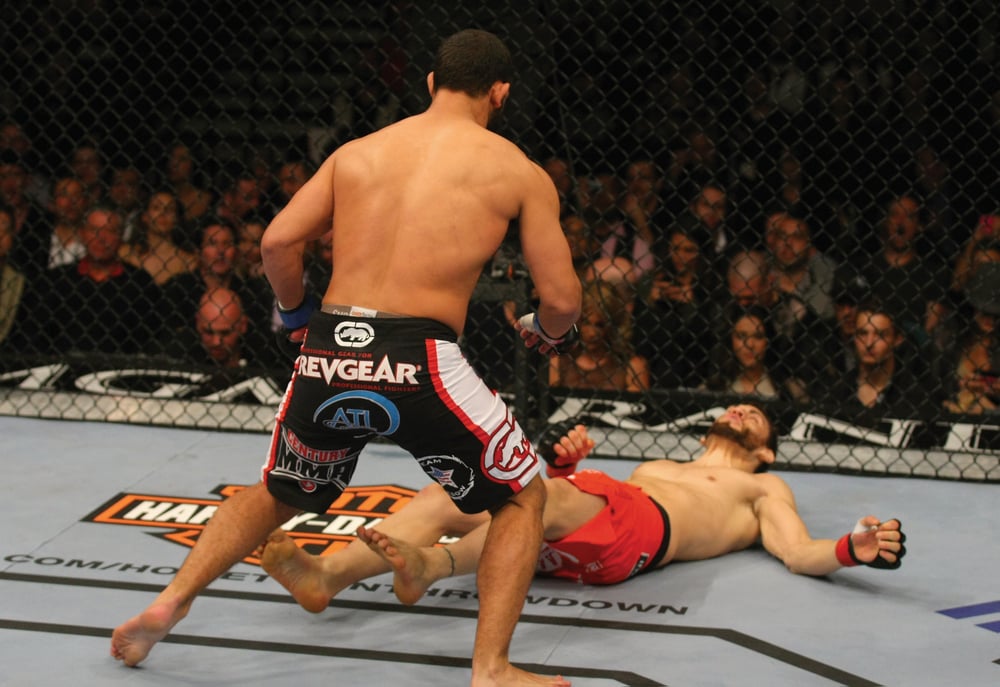
WHEN THE IRON RUSTS
A tragic phenomenon in MMA is the seemingly sudden, irreversible deterioration of a legendary chin. We have watched iconic, once-unbreakable fighters suddenly start falling to shots they used to laugh off in their prime. Chuck Liddell. Tony Ferguson. Diego Sanchez. Every fan can name one. However, this isn't a failure of heart or a sudden lack of courage. Rather, it is a structural collapse.
“What about those fighters with an iron chin suddenly deteriorating?” poses Dr. Wijayawickrama. “As explained, when the brain is twisted in the skull by a blow, nerve pathways are twisted and torn, which the brain has to attempt to rewire. Over years of sparring and competitive fighting, the brain loses its capacity to rewire the damage, and the threshold to trigger a knockout becomes lower.”
Time eventually strips away a fighter’s physical armor as well, leaving the brain entirely exposed to the laws of physics.
“As we age, our muscles generally get weaker. The neck muscles helping to brace the brain for impact are no exception, contributing to the iron chin disintegrating.”
Beneath the microscopic level, the repeated trauma leaves a permanent, devastating footprint that impacts a fighter long after they hang up the gloves.
“There is a protein called Tau, which is like scaffolding for the brain’s structure. With repeated blows to the brain, this scaffolding falls off and forms clumps. These clumps are responsible for chronic traumatic encephalopathy (CTE), causing problems such as memory and mood disturbances.”
The lesson isn't that an iron chin is a permanent superpower. It's a finite resource. The face might absorb the punishment, and the fighter might survive the round, but underneath the skull, their biology is the only scorekeeper who never loses on the judges’ cards. So while you might be born with a genetic disposition to having an iron chin, it won’t always last. Just like everything in life.
...