

Issue 233
September 2026
Ray Klerck looks at whether fighters can train their eyes and reactions to see the punches that age, fatigue and punishment make harder to spot
Ilia Topuria spent part of his White House prep against Justin Gaethje training the two body parts his opponent would eventually beat the pulp out of. His eyes. Pre-fight footage showed Topuria wearing specialized glasses while picking numbers on a screen to train how efficiently his eyes focused and worked together. It looked about as threatening as an eye test, but an August 2026 review of MMA injury research believes that the science behind those glasses was anything but shortsighted. The researchers believe that visual processing and reaction time are among the functions that can be impaired by head trauma, which makes training the machinery responsible for seeing trouble coming rather important when your next appointment is the current lightweight champ.
“With these glasses we can see how the left eye works, how the right eye works, and above all how both eyes work together,” explained one of Topuria’s offscreen trainers in a video released before the fight. “What we’re doing now is a cognitive exercise where he has to select the numbers from 1 to 50, while at the same time, we’re working on accommodation and binocular vision. It’s a very complete exercise because we’re combining the cognitive part with the visual part.”
Perhaps Gaethje saw it and decided to conduct his own eye test, because Topuria later said he lost sight in his right eye during the opening round and his left by the end of the second. Medical reports subsequently revealed non-displaced fractures to both orbital bones, and there’s no clear-cut schedule for his return. There is some weapons-grade irony in sharpening your vision only for Justin Gaethje to spend the evening turning the lights off one eye at a time. But Topuria’s preparation points toward an overlooked part of fighting. Fighters train almost everything that can legally be trained. Altitude tents, reaction boards, and enough performance data to make NASA feel like it needs to step up. Yet every slip and counterpunch begins with the same basic requirement: see the bugger coming. So can fighters train their vision to stay one punch ahead?
WHEN THE EYES START LOSING TOO
Getting punched in the peepers, somewhat inconveniently, does not appear to make the eyes better at their job. A white paper that involved 45 male professional MMA fighters competing at Bellator and Cage Fury events put that perfectly obvious statement to the test. The fighters, with an average age of 34, completed visual-tracking assessments before and after fighting. Researchers measured how accurately the fighters’ eyes could follow a moving target. The before-and-after numbers were tough to blink away. Across the group, visual-tracking scores worsened by around 116% after a bout. And this wasn’t a handful of fighters having a particularly bad night and dragging down the average. Of the 40 tested on both sides of the fight, 21, or just over half, showed a particularly large decline. The fight results were almost split down the middle too, with 21 winners and 19 losers completing post-fight testing. Win or lose, apparently your eyes can still have a rough night. Nobody suddenly forgot how to use their eyeballs. The problem is that seeing something coming is a team sport. The eyes have to find it, follow it, and feed that information upstairs, where the brain figures out what the hell it is and what the muscles should do about it. All this needs to happen while the object in question is getting closer. There are a few rather large asterisks here. The researchers couldn’t blame the decline entirely on punches. Fatigue, elevated heart rate, and the small matter of having just been in a professional fight could have influenced the results. They also couldn't establish that fighters with better visual tracking were more likely to win, as Topuria knows. Still, plenty of fighters walked in with one level of visual tracking and walked out with considerably less. That's mildly annoying if you're playing tennis. It's a bigger administrative headache when the object you're required to track is attached to Alex Pereira.
THE PUNCH YOU NEVER SEE COMING
The punch you don’t see coming that gets you. This cliché refuses to get KO’d for a reason. The August 2026 MMA review explains some of the ugly physics behind it. A punch doesn’t simply knock your head backward. It can send it rotating in different directions, and that movement matters. One analysis included in the review found axial rotation of the head was strongly associated with briefly losing consciousness. The jaw is also particularly good at ruining the proceedings because more than half of the knockouts reviewed started with a direct hit to the jaw. Unfortunately, being finished doesn’t immediately activate some invisible force field. The review found an average delay of around 3.5 seconds between the knockout-producing blow and the fight actually being stopped. In that tiny window, losing fighters ate another 2.6 head strikes on average. TKOs were even messier. During the final 30 seconds before stoppage, losing fighters absorbed an average of 18.5 strikes, with 92.3% heading upstairs. This is where the eyes become more than the two things swelling shut in the post-fight photo. Head trauma can impair reaction time, visual processing, and attention. The review even argues that visual tracking, purposeful defense, motor coordination, and delayed reactions should factor into whether a fighter can still intelligently defend themself. This creates one of MMA’s design flaws because taking damage can interfere with the very processes you need to stop yourself from getting hurt again. And while an opponent gets three or five rounds to slow those processes down, there’s someone else who gets decades to work on them. Father Time.
CLOCKS THROW QUICK HANDS
Thirty-five isn’t particularly old unless you’re an athlete. The August 2026 review found professional fighters aged 35 and older had roughly twice the odds of suffering a KO or TKO compared with younger fighters. Okay, so there’s no trapdoor that suddenly opens beneath your chin when the birthday candles hit 35. However, the researchers offer a mixed bag of possible explanations, including accumulated fight exposure, slower reaction time, reduced recovery capacity, and changes in defensive performance. Previous knockout history was also associated with greater odds of being knocked out again. Reaction time is where this hit the eyes. The paper found that head trauma can affect visual processing and reaction speed, while slower reaction time is also one of the possible explanations the researchers offer for the greater KO/TKO risk among older fighters. It raises an intriguing possibility. A veteran might still know exactly how to slip the right hand, but the message saying ‘right hand incoming’ may not be arriving upstairs quite as quickly as it once did. The research doesn’t prove that’s what’s happening, but it gives us a very good reason to ask. In normal life, a few lost milliseconds might mean being slightly worse at catching the TV remote when it slides off the couch. In MMA, the remote is someone else’s left hook. None of this proves aging eyes are why older fighters get knocked out more often. Fifteen years of accumulated punishment, previous knockouts, recovery, and changes in defense are all rattling around in the same bag. But it does make the question behind Topuria’s strange-looking glasses considerably more interesting. If reaction time and visual processing are among the things fighters can lose, can they be trained?
TRAIN YOUR EYES TO FIGHT BACK
If all this leaves you desperate to start lifting dumbbells with your eyeballs, there's good news. You don't necessarily need a lab or glasses that look like they came free with the first Avatar movie. Dr Sherylle Calder has spent years working on visual performance with athletes ranging from international rugby teams like the All Blacks to Olympians. When I interviewed her previously, she argued that eyesight and sporting vision are two very different beasts.
“Most people are born with the potential for good eyesight, but vision, the ability to identify, interpret and understand what is seen, can be trained and improved,” Calder explained.
Her program targets four areas: depth perception, reaction time, eye-hand coordination and peripheral vision. More importantly, it wasn't just a collection of increasingly elaborate ways to throw tennis balls at your mates. Calder's approach involved identifying weaknesses, training them and then testing again to see whether anything had actually changed.
TEST YOURSELF FIRST
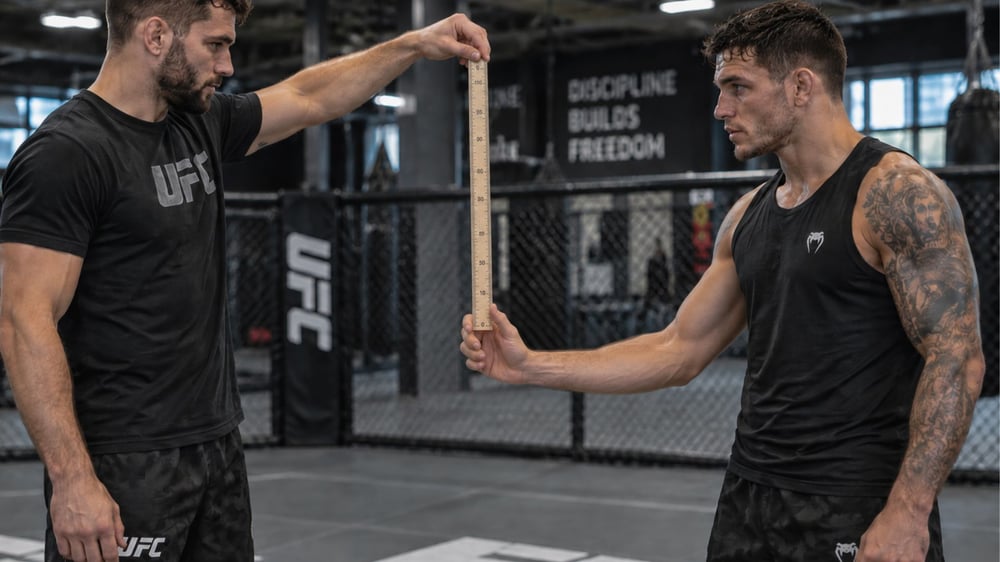
Before you start training your reactions, find out whether they're worth bragging about. All you need is a training partner and a ruler. Have your partner hold the ruler vertically at around shoulder height. Place your thumb and index finger on either side, with your thumb level with the zero-centimeter mark, but don't touch the ruler. Without warning, your partner lets go. Your job is to catch it. The further the ruler travels before your fingers clamp shut, the slower your response. Repeat four or five times, calculate your average, and compare it with the benchmarks used in the original program: less than 7.5 cm is excellent, 7.5–15.9 cm above average, 15.9–20.4 cm average, 20.4–28 cm below average, and anything beyond 28 cm poor. The scoring guide was taken from Physical Education and the Study of Sport. It's magnificently low-tech. Somewhere in sports science there is probably a six-figure machine capable of telling you the same thing, but a ruler from the stationery cupboard will at least give you a baseline. Then train.
TRAIN YOUR PERIPHERAL VISION
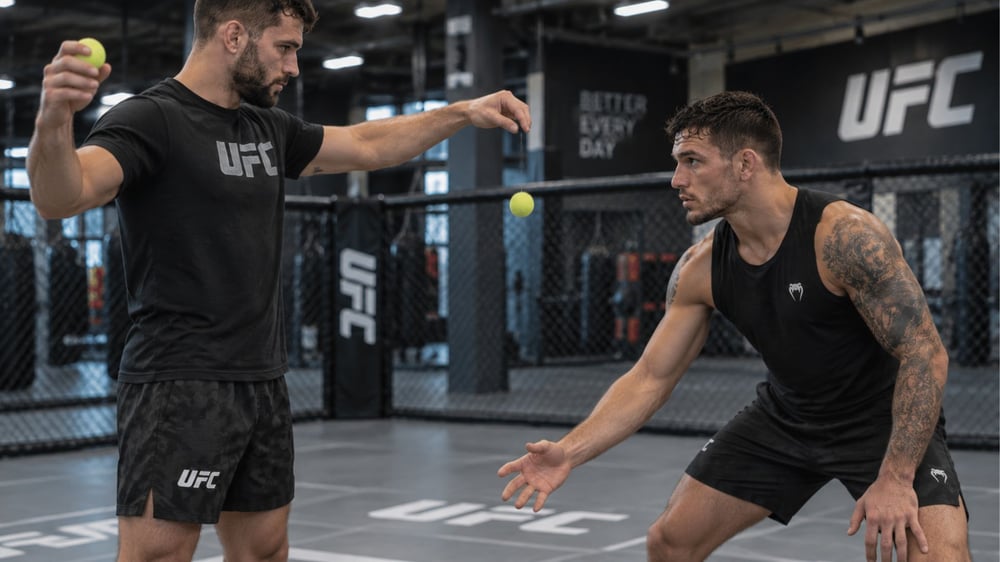
This one is designed to work peripheral vision. Face a training partner holding a ball in each hand at shoulder height. Stand with your hands resting on your thighs and maintain eye contact with your partner. That’s the important bit. Without warning, your partner drops one of the balls. Your job is to catch while continuing to look at your partner rather than snapping your eyes towards the falling ball. Do three sets of four catches, switching roles after each set. The natural reaction is to look directly at the thing you’re trying to catch, but be sure to resist it. You're forcing your peripheral vision to detect the movement while your central gaze remains occupied elsewhere. The attraction for fighters isn’t difficult to see. An opponent comes with two hands, two feet, two knees, and an irritating habit of using all of them. Staring directly at each weapon as it starts moving isn’t going to get you very far.
THE PUNCHBAG AMBUSH
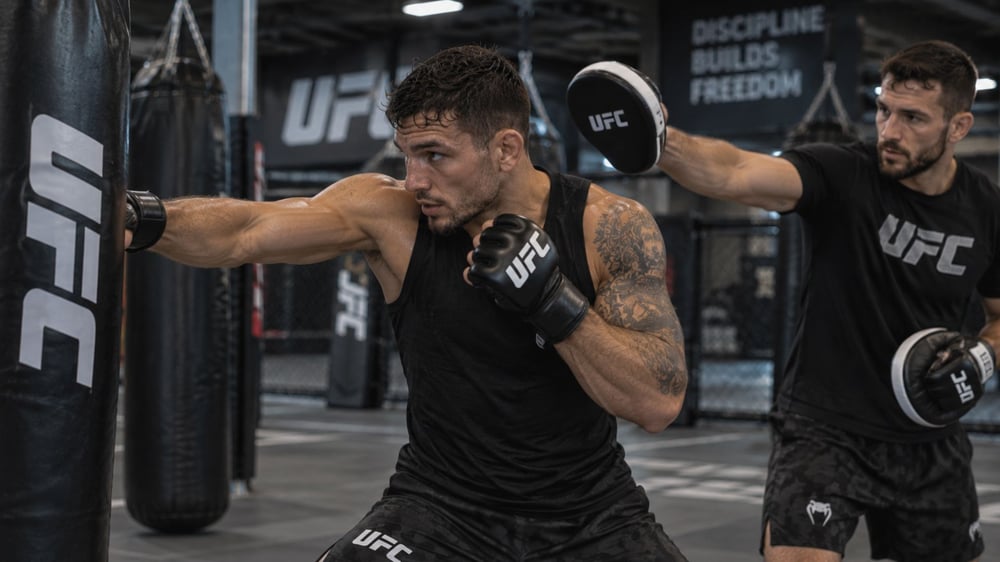
Of all the original exercises that Calder gave me, this one feels suspiciously like it was designed with fighting in mind. Stand in front of a heavy bag and lightly tap away with alternating left and right punches. Your training partner stands behind you holding focus mitts. While you focus on the bag, your partner slowly brings a mitt into your peripheral vision. The moment you detect it, attack the pad. Calder's original instructions are to punch, elbow, or kick depending on the height at which the target appears. Then immediately return to the bag and wait for another mitt to sneak into view. Complete three sets of 30 seconds, swapping with your partner after each interval. Your eyes already have something to deal with. Your hands are already working. Then new information appears at the edge of your vision, and you have to detect it and respond appropriately. Basically, your training partner gets permission to annoy you from behind for 90 seconds. At last, a scientifically respectable reason for it.
GIVE YOUR BRAIN TWO JOBS
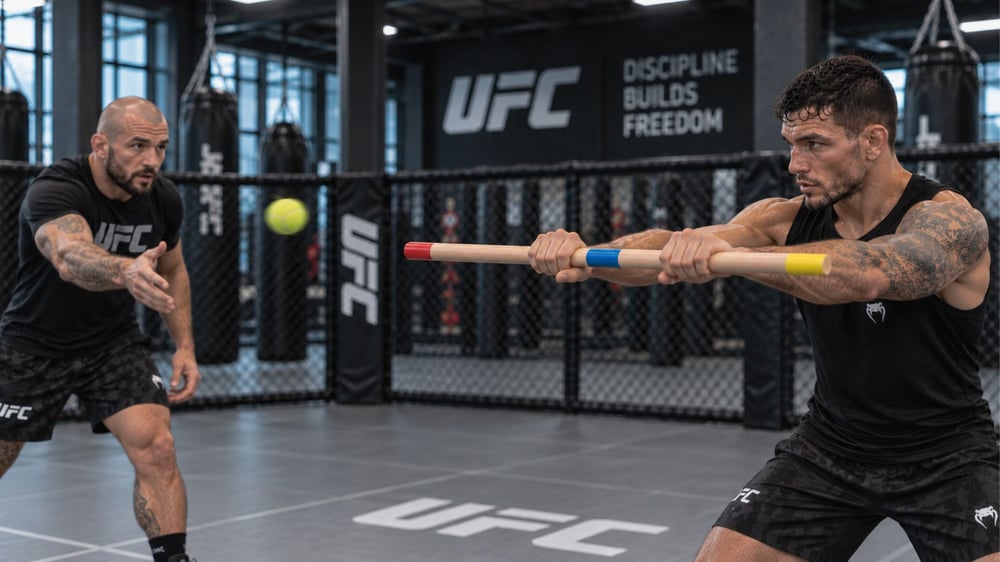
Now it is time to add a decision. Take a meter-long stick or dowel and wrap three different colors of tape around it, one at either end and another in the middle, evenly spaced. Stand around two meters from your training partner and hold the stick with two hands. Your partner bounces or throws a tennis ball towards you at approximately chest height. At the same time, they call out one of the three colors. You have to track the incoming ball, process the color being called, locate that section of the stick, and use it to knock the ball away. Stay relatively fixed rather than chasing the ball around the gym. As you improve, increase the speed or alter the distance. Calder's original program prescribed four sets of 30 seconds. That's considerably more interesting than simply reacting to something that’s just moving. The brain receives two pieces of information, chooses the appropriate response, and then convinces the body to execute it before the tennis ball arrives. Fighting is essentially that problem with considerably worse consequences for getting the answer wrong.
NOW TEST THE HAND-EYE CONNECTION
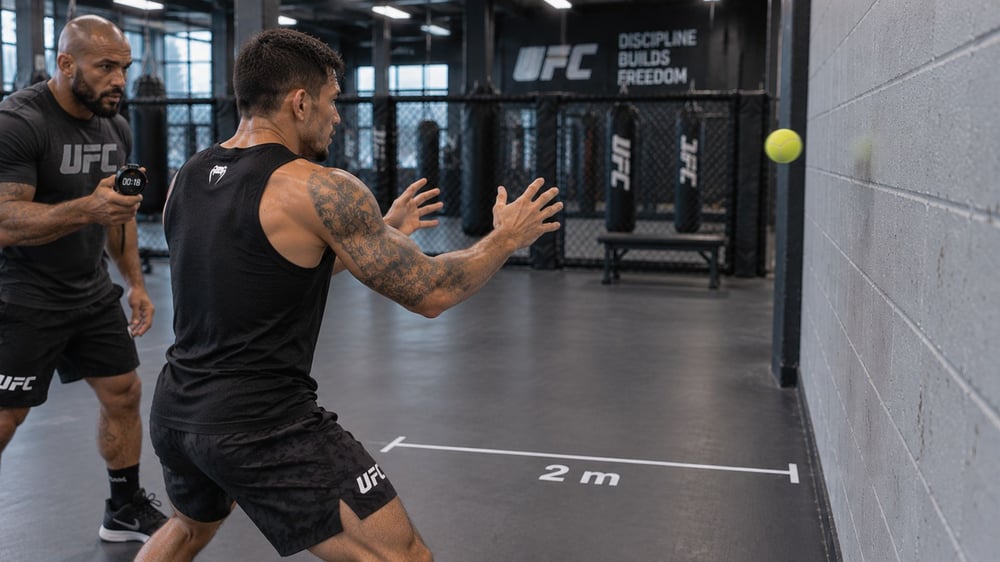
Calder's program also offers another simple way to track your progress. Warm up and stand two meters from a wall holding a tennis ball. When your training partner shouts ‘GO,’ they start a stopwatch. Throw the ball against the wall with your right hand and catch it with your left. Immediately throw it with the left and catch with the right. Continue alternating hands for 30 seconds while your partner counts only successful catches. More than 35 was rated high, 30–35 above average, 25–29 average, 20–24 below average, and fewer than 20 poor. Those benchmarks came from Weight Lifting and Fitness for Health and Performance. Then comes the bit that matters. Repeat the same tests every 1-2 weeks of training. Same ruler. Same distance. Same 30 seconds. Ideally, even the same irritating training partner. If the ruler isn't traveling as far before you grab it and the tennis ball is hitting your hands more often, you've at least got evidence that you've improved at the things being measured. What we can’t say from Calder's old program alone is that shaving centimeters from a ruler-drop test means you've suddenly become harder to hit in an MMA fight. That's the far bigger question hanging over sports vision training: does getting better at the drill make you better at seeing the punch? Because catching tennis balls is nice but Justin Gaethje doesn't throw tennis balls.
SEE YOU LATER
That is where the science leaves us, somewhere between promise and a tennis ball bouncing off a gym wall. Fighters have good reason to care about visual processing, reaction time, and peripheral awareness, and there are ways to train and measure parts of that machinery. What we don’t yet have is proof that getting better at these drills buys a fighter another millisecond against a left hook or another year before younger opponents begin arriving faster than expected. Maybe Topuria and the growing army of sports scientists putting fighters through visual training are onto something. Maybe the eyes can be trained to surrender a little less ground to punishment and age. For a sport that has spent decades strengthening necks and trying to squeeze another percentage point from almost every part of the human body, they're certainly worth caring about. After all, you can have the fastest hands in the division. They're not much use if your eyes deliver the news late.
...