

Issue 233
September 2026
The unsung fighters ranked between seven and 12 spend their careers separating genuine contenders from prospects who merely look the part.
The UFC rankings have a penthouse, a lobby, and a rather unpleasant stretch of stairs between numbers 7 and 12. This is where some of the best fighters on the planet spend their careers, treated as a proving ground where a contender can either punch their ticket to the top or get pushed to the back of the line. These men and women are far too dangerous to be given an easy fight and are often just far enough from the belt to watch somebody younger and shinier jump the queue. For every prospect charging towards the top five with an unbeaten record, there are the likes of Marlon Vera, Stephen Thompson or Mateusz Gamrot waiting to ask the only question that matters: are you genuinely world-class, or have you simply been matchmaking well? It is a thankless job performed under savage pressure. These fighters must keep training as if they’re future champions, even though the promotion may view them as supporting actors in someone else’s main-character narrative. Yet the rankings would be meaningless without them. These gatekeepers do not block the path to greatness. They make sure greatness has earned the right to pass.
THE FIGHTERS WHO CHECK YOUR HOMEWORK
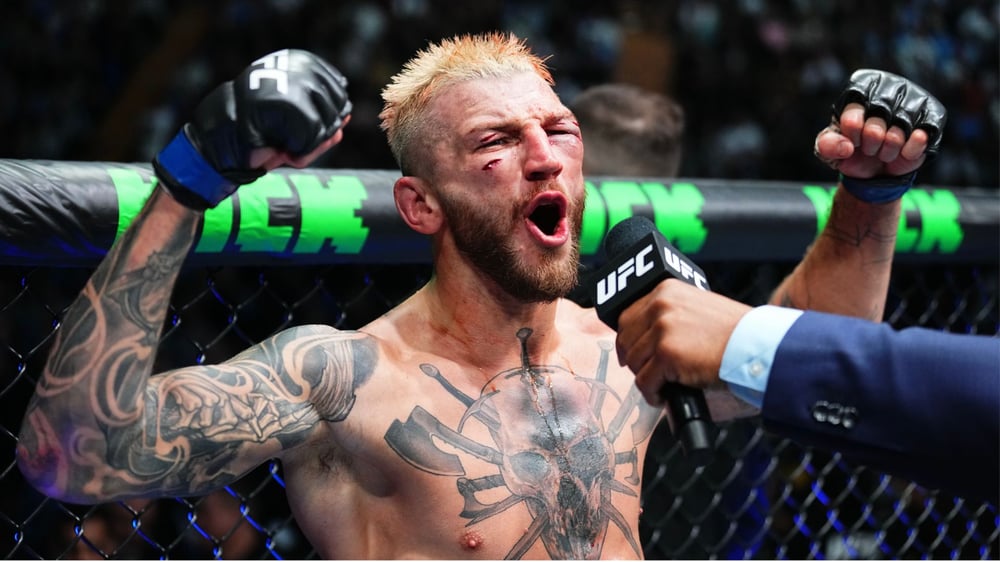
Dan Hooker represents one of the most active versions of the role because his fights always deliver a very stern performance review to his opponents. Across more than 23 UFC appearances and five Fight of the Night bonuses, ‘The Hangman’ has become a soul test for rising lightweights, forcing them to prove they can remain dangerous after the tactics have frayed and everything starts hurting. Beat him convincingly as Arman Tsarukyan and Islam Makhachev did, and you’re only one to two fights away from a title shot. But accepting this title has meant Hooker’s form has left a bad taste in the mouths of people like Daniel Cormier, especially after his loss to UFC newcomer, Saldine Parnasse.
“When people hear they're a gatekeeper, they're mad and fight that with all they can,” said Cormier. “Dan Hooker seemed to be embracing that. I think there's too much acceptance, too much comfort in that. You do that before the fight, and then the fight goes the way it did. That's really, really not good for Dan Hooker.”
This loss cost Hooker his spot in the top 10 lightweight rankings and dropped him to 13th after his more recent defeat, just outside the gatekeeper threshold. Maybe he’ll stop being the guy everyone wants to beat. This was never a problem for a fighter like Donald ‘Cowboy’ Cerrone who always made that examination available on extremely short notice. His 38 UFC fights produced 23 wins, 16 finishes, and 18 post-fight bonuses, making him the promotion’s favorite measuring stick and the fans’ favorite reason to avoid making Saturday night plans. Fighters like Hooker and Cerrone matter because rankings need more than numbers beside names. They need recognizable standards, men whose toughness and skill give supporters an immediate understanding of how good the newcomer really is. Michael Bisping spent 29 UFC bouts doing exactly that, earning 20 wins while repeatedly policing the middleweight border. Then, after years of being used to measure other people’s championship credentials, ‘The Count’ stepped in on short notice at UFC 199 and won the belt himself. It was the perfect reminder that a gatekeeper is not necessarily somebody who cannot reach the throne. Sometimes he is simply the contender everyone stopped looking at.

THE SCIENCE OF STAYING RELEVANT
In this world, a loss typically sends a fighter down the rankings, but it does not always remove him from the machinery. A 2025 study mapped UFC results from March 1994 to March 2021 as a series of networks, treating fighters as points connected through bouts and the sequence of winners and losers. It was not designed to study gatekeepers, but it does help explain why certain veterans remain important long after a clean route to the title has disappeared. The researchers found that fighters could remain important to their division even after several losses. In fact, well-connected losing fighters were more closely associated with the UFC’s top 15 than with its champions or pound-for-pound stars. Sure, losing may end a title run, but it does not always end a fighter’s relevance. The researchers specifically mentioned Donald Cerrone and Nate Diaz as examples of well-known fighters who kept getting prominent opportunities despite somewhat inconsistent results. That is familiar territory for the gatekeeper. He may lose to champs or title challengers, but it’s the quality and variety of those assignments that keep him relevant. His record becomes less impressive while his usefulness becomes more obvious. The study also found that a fighter’s life became considerably less predictable after a defeat. Losing fighters moved through a far more erratic matchmaking network than winners. Victorious fighters generally stayed among other successful contenders as they moved up the ladder. A vet coming off a loss could instead be sent towards a ranked contender, an unfamiliar newcomer, or somebody the UFC would like to know more about. So, while one career might follow the rankings, the other gets used to check whether those rankings are working. Look, the paper does not statistically prove the value of the ranked 7-12 gatekeepers. What it does show is that winning is not the only way a fighter can remain structurally important. Some careers are built around reaching the belt. Others hold the division together while everybody else tries.

EVERYTHING TO LOSE
Gatekeepers are often mistaken for journeymen, but their roles in the sport differ. A journeyman is an experienced professional who is used to determine whether a developing fighter belongs in the UFC. The gatekeeper is the ranked brute waiting to find out whether they belong near the expensive end of it. A review in Sports Medicine did not examine either label, but it helps explain why the second test is considerably more unpleasant. They found that expert combatants were better at spotting patterns, judging their opponents’ attack ranges, and adapting when they did something unexpected. They called the ability to operate near the limits of what is possible ‘brinkmanship.’ A gatekeeper has spent years living in that uncomfortable space, where openings are small, and the smallest mistakes get immediate feedback. Beat a journeyman and the UFC may give you somebody better. Beat a gatekeeper, and you may take his ranking, his opportunities, and the least comfortable chair at the top table. The cruelest part of being a gatekeeper is that the stakes are very rarely equal. A hot prospect arrives with momentum, attention, and almost everything to gain. Beat the veteran, and they inherit the ranking and perhaps a main-event booking. The established fighter receives no such reward. Victory merely protects what they already had, while defeat turns them into the name attached to somebody else’s breakthrough. It creates a peculiar pressure where every fight feels less like another step towards the belt and more like defending the patch of ground beneath their feet. The training remains just as brutal, but motivation becomes harder to manufacture when the prize for winning is another dangerous prospect six months later.
...