

Issue 233
September 2026
New research suggests the best way to find MMA’s hardest hitters might be to get them off the bench and let their whole body do the talking.
Alex Pereira needs nothing other than a line of fallen opponents to tell the world he punches hard. Still, when ‘Poatan’ planted himself in front of a punch measuring device and threw a right, he produced a score of 191,796, which dwarfed Francis Ngannou’s previous mark of 129,161. One of MMA’s fan-favorite qualities suddenly had a number attached to it. It was a moment that somehow captured where modern MMA training is going. Almost everything a fighter does can now be measured, and finding out what comes out the other end of these figures makes plenty of sense. However, the trickier question is what went into it. The weight room has traditionally offered some fairly muscular answers. Get stronger. Bench more. Become explosive. Do all of this and hope some of that enthusiasm follows you into the fight. None of this is wasted work because general strength matters. The awkward bit is that punching power has never behaved particularly well around muscles or gym numbers. Some fighters, like Paulo Costa, look capable of carrying the team bus home and hit exactly as hard as advertised. Others, like Sean O’Malley, look like they could still be asked for ID buying an energy drink, but can comfortably switch off an opponent’s lights. The bench press is the famous measuring tool, but it has plenty of flaws because you’re lying down with your back supported and there is no meaningful rotation. It’s left a gap in the measuring toolbox between knowing how strong a fighter is and knowing how well they can turn that strength into something another human being definitely notices. Punching is a full-body conspiracy, starting at the floor before the fist swoops in at the end and takes all the credit. Joel Jameson a world-renowned strength and conditioning coach to fighters like Demetrious Johnson and author of Ultimate MMA Conditioning.
“What this tells us about punching power is something that we already know – that punching power comes from high-speed, coordinated rotational movement across the body.”
The question, then, is how the hell do you measure that in a gym? If you want to know what makes someone genuinely dangerous, perhaps the test needs to look a little more like the thing you’re actually testing. And that’s what researchers may have found.
GET OFF THE BENCH
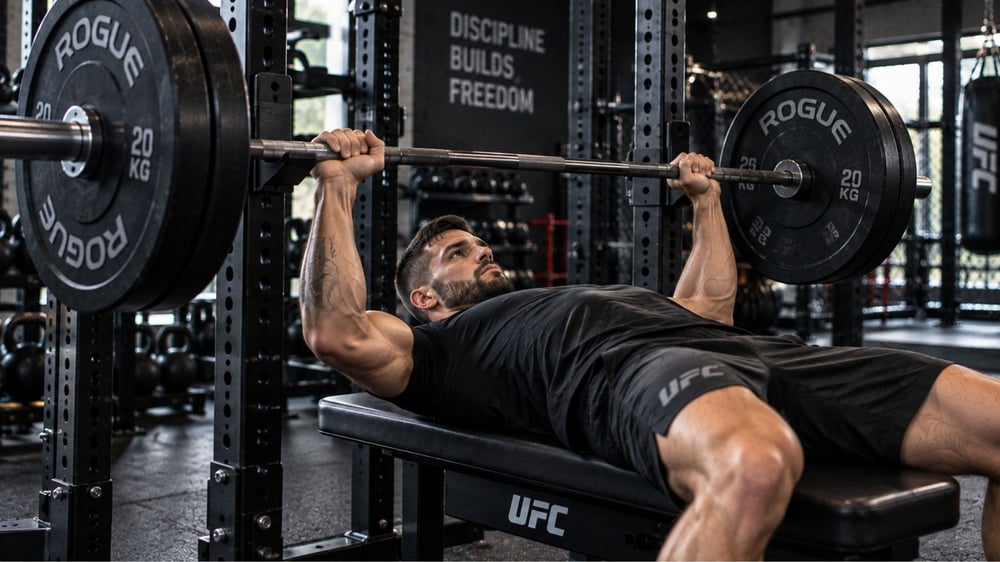
Box-fresh research published in September 2026 decided to find out whether the weight room had been asking MMA fighters the wrong question. To find out, they recruited 36 elite male MMA athletes and first established the number everyone actually cares about: how hard they hit. This was called relative striking force, and it was the metric used to separate them into higher, middle, and lower-impact groups. This must have made for an interesting morning when a dozen elite fighters discovered science told them they could barely knock the fluff off a cupcake. Then came the gym tests. Fighters performed clap push-ups, an isometric bench press and a bench press throw, covering the familiar ways coaches measure upper-body strength and explosiveness. The researchers then added something far more punch-shaped: a standing landmine punch throw. Instead of lying on a bench and firing weight towards the ceiling, the fighters stood up and drove the end of a barbell forward, allowing rotation to become part of the movement. It wasn't quite throwing a right hand, but at least the hips had been invited back into the building.
THE PRESSING RESULTS
The researchers tested the throwing movements with different loads, allowing them to see how each fighter balanced force and speed rather than simply finding out who could shift the most weight. Then they compared those results with how hard each man actually struck. The bench didn't get completely flattened. Several traditional measurements were linked with harder striking, and the bench press throw performed reasonably well. But the strongest relationship with striking force came from the landmine punch throw. On the researchers' correlation measure, its leading score was roughly 45% higher than the equivalent result from the bench press throw. More importantly, when the 36 fighters were split into thirds by striking impact, the landmine measure was the only one that clearly distinguished the higher, middle, and lower-impact groups. For Joel Jamieson, there is a fairly obvious reason why.
“It’s not surprising that a landmine movement would be better at separating harder punchers from softer powers because it’s the only one that involves rotation and velocities that are more in line with actual striking,” he says. “Movements like the bench press are not rotational in nature. They do not take place in the same standing body position, and they use loads and speeds that have little resemblance to the movements of striking. That is why they generally don't transfer in a meaningful way. They are incredibly non-specific exercises for striking.”
A HIDDEN SECRET
There was another intriguing number. The researchers even found an early benchmark. Fighters scoring 2.12 watts per kilogram or less on the landmine test tended to fall into the lower-impact striking group. So if you drop below that number, there was a good chance you were among the softer hitters in this group of elite fighters. With only 36 athletes, that isn't MMA's new official line between pillow fists and dynamite, and the researchers themselves called this part of the analysis exploratory. But it suggests coaches may eventually have something more useful than simply watching the heavy bag swing and nodding thoughtfully. The bench press therefore survives. MMA gyms do not need to drag it onto Facebook Marketplace just yet. General strength and explosiveness still mattered, but the biggest factor in striking performance was the test that stopped treating the fighter like a piece of furniture and let him stand up and rotate.
“Traditional strength work can help build muscle and provide a level of general baseline strength, but once that’s been achieved, more is not better,” suggests Jamieson. “It’s important to consider that lifting heavy weights is generally very slow, while the speeds during striking are very high by comparison. So, as a basic rule, the heavier your weights get, the less specific the movements become to the sport of striking. This is because the brain solves high-speed and high-load challenges through different motor activation patterns.”
PUT YOUR PUNCH TO THE TEST
The landmine punch throw is refreshingly simple to understand, but is training it putting the cart before the horse?
“Chasing a bigger landmine number is a mistake because hitting hard is fundamentally a skill, not just a byproduct of being able to generate power by itself,” says Jamieson. “Some of the hardest hitters I’ve ever worked with, fighters like Chris Leben, were not particularly explosive, but they still hit very hard because they developed the right technique for it. Someone who wants to hit harder needs to invest in learning this skill, and the landmine can help with some aspects of this, but it’s safe to say that many of the hardest-hitting strikers in history never used one.”
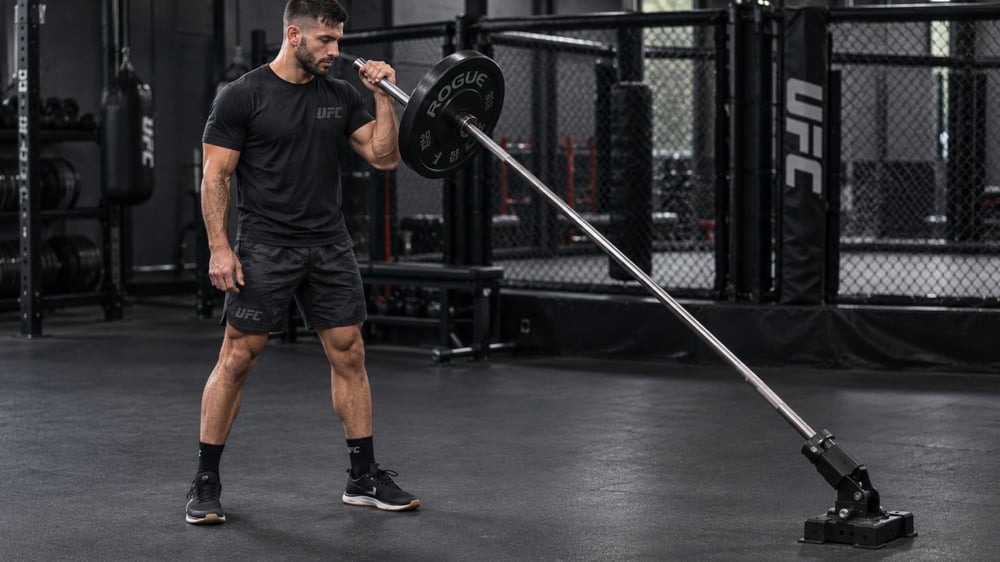
That said, it can be useful to include in your training every now and then. One end of a barbell is anchored to the floor, and the other becomes something you're trying to send away from you as quickly as possible. The important difference is that you're finally allowed to use the rest of your body. Here’s how to do it right.
1. Set the bar
Anchor one end of a barbell securely in a landmine attachment and hold the free end in one hand around shoulder height.
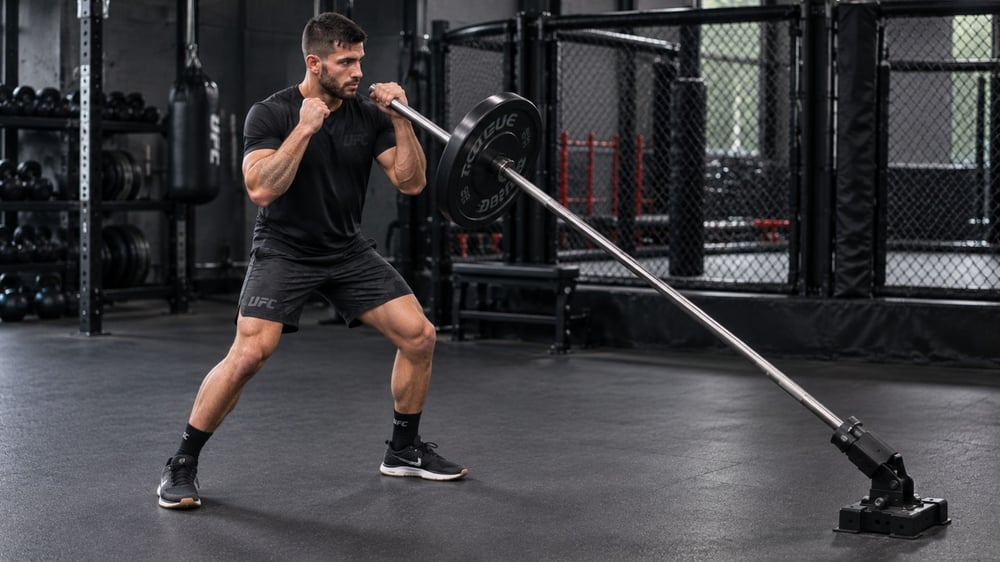
2. Find your fight stance
Stand in a strong athletic position rather than square underneath the weight. Keep your feet planted and your body balanced. The whole point is to produce force from a standing position rather than borrowing stability from a bench.
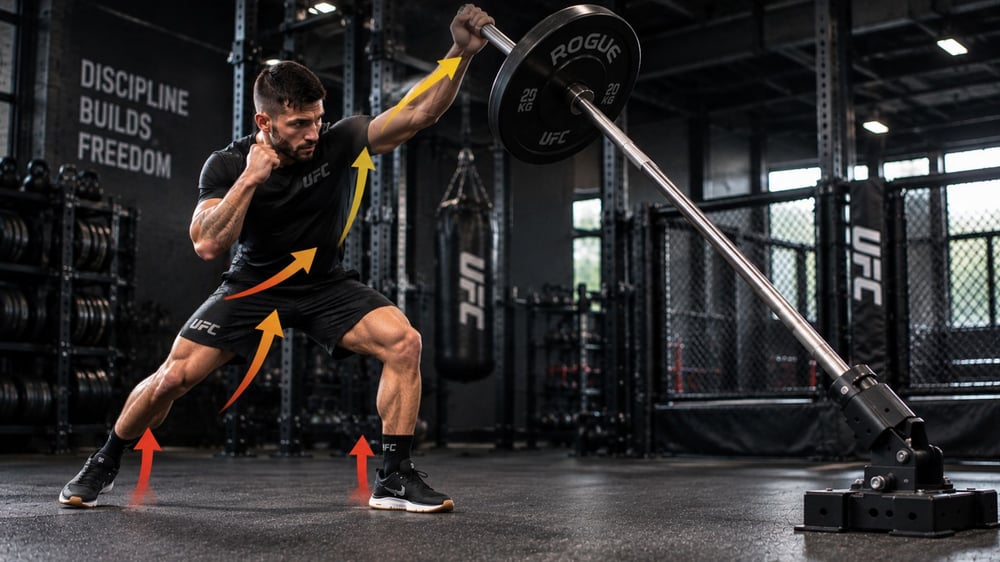
3. Start from the floor
Don't turn it into an expensive triceps extension. Drive through the ground, allowing the legs and hips to begin the movement before rotation carries that force upwards through the trunk.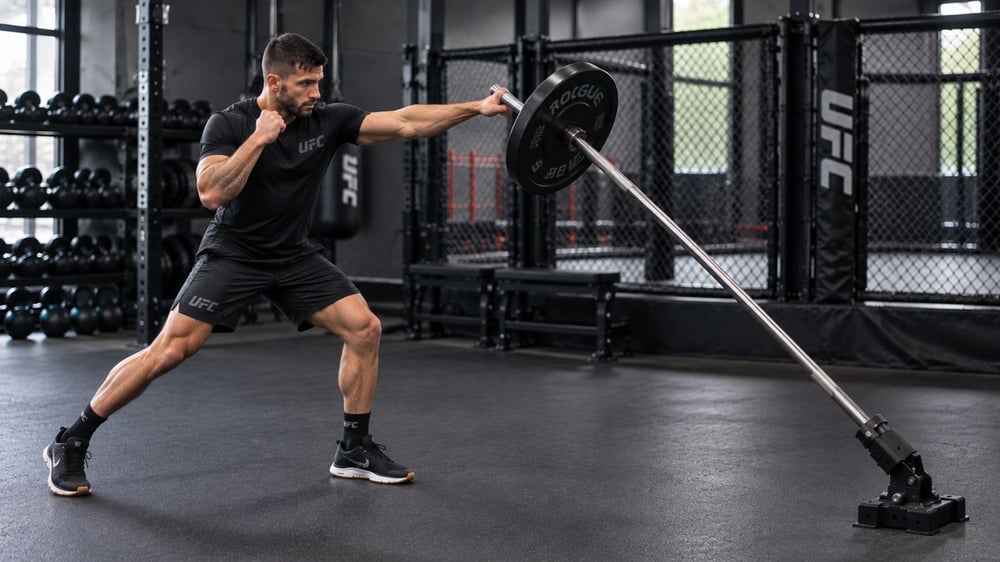
4. Punch the bar away
Drive the free end forward explosively, extending the arm as the hips and trunk rotate. Think about sending force through the bar rather than simply pushing it. The anchored end guides the bar through an arc while you concentrate on moving it as quickly and explosively as possible.
How can you pull this all together into a long-term training plan? Very carefully, suggest the experts.
“The best way to program the use of a landmine depends on the athlete’s goal and skill level, but a basic guideline for an athlete that wants to improve punching power is to start with 4-6 sets of around 6 reps at relatively low loads,” suggests Jamieson. “The goal should be to execute the movement with the highest speeds possible, which means relatively long rest periods between sets. It’s important to keep in mind that this type of training should always be thought of as supporting movement, not a replacement for developing greater skill as a striker.”
THE SKILL SET
This is where the study went beyond a normal gym exercise. The researchers tested the fighters across different loads and measured how quickly the bar moved. Lighter loads reveal more about speed, while heavier loads demand greater force. Combining those performances created the load-velocity profile that proved so good at separating the harder hitters from the rest. But only an expert in the trenches can give the insights into what this kind of research is missing.
“Most fighters that are strong in the gym but don’t hit particularly hard are often both stiff and have poor rotational mechanics and sequencing at the same time,” says Jamieson. “There are two big components of being a hard puncher. The first is having the right timing of sequential rotation from the ground up at high speeds. This is what good technique is all about, and a big part of that is being relaxed and fluid, not stiff, as the body is rotating. The second main component is the ability to become very stiff at the last instant, just as contact is made, to transfer as much force as possible into the opponent. This stiffness is what people think of when they say someone has ‘heavy hands,’ and it’s a crucial part of being a hard hitter. If someone doesn’t hit very hard, it’s generally because their mechanics are bad, and stiffness throughout the rotation, rather than at the very end, is often a contributor to that as well. This comes back to the fact that hitting hard is a skill, and strength and fitness can support that skill, but no amount of strength is a replacement for it."
This is the all-important catch before everyone starts hunting for that 2.12 watts-per-kilogram score. You can't simply throw a landmine bar across the gym and compare the result with the study. That benchmark came from the researchers' specific testing and calculations. Replicating it properly requires the same measurement method. As an exercise, however, the appeal is obvious. The fighter is standing, the legs are involved, the hips can rotate, and force has to travel through the body before reaching the hand. Finally, the weight room is asking a question that looks a little more like striking.
...