

Issue 233
September 2026
6,146 UFC fights reveal why some fighters need one perfect moment while others make every moment progressively worse.
Ciryl Gane’s frame is built to solve problems with single punches, whether his fingers are open or not. Even the great Alex Pereira claims he was the victim of what he calls a ‘lucky punch’ from Gane. Hovering around 250lb and quick enough to make all that mass arrive without much warning, Gane has every physical excuse to end fights early. Ironically, he prefers to pick his moment. It has made him the heavyweight division’s most brilliantly frustrating character and heir to the now-vacant throne. This is the division where subtlety has never been compulsory, and fans generally expect the big boys to honor the job description. Instead, Gane would rather move, make you miss, and slowly turn every small mistake into another tiny invoice which is something Daniel Cormier backed up.
"I feel, honestly, Gane is the evolution of MMA at the HW Division,” DC said. “I know Francis is big and powerful. We've seen guys like that before. We have not seen a Ciryl Gane though, a guy that moves the way he moves, that can pick you apart and do the things he's done.”
Shifting 250lb around for 25 minutes while staying accurate and technically useful is a very different physical assignment from producing one enormous punch at exactly the right moment. Those are essentially the two ways to win on the feet. One fighter needs to manufacture a devastating moment. Another needs to manufacture useful ones over and over again. It’s the hammer or the sandpaper. Both are considerably more sophisticated than their hardware-store descriptions suggest. More importantly, the bodies producing them may be doing very different jobs. So, if one fighter is built to produce devastating moments while another is built to keep producing useful ones, why are we training them as though they are trying to do the same thing?
PICK YOUR WEAPON
Calling fighters hammers and sandpaper sounds like something invented after three beers while watching the fights. Turns out, 6,146 UFC fights have given the idea a respectable alibi, says an August 2026 research paper published in theStrength & Conditioning Journal. They found that striking success tends to fall into two broad strategies, which were labelled critical or cumulative. Critical striking is the hammer. It relies on high-impact shots that can immediately change the direction of a fight, with the researchers pointing to rapid force development and neuromuscular power as key physical ingredients. Cumulative striking is the longer game. It uses volume, accuracy, and repeated successful attacks to build damage gradually. It does this by prioritizing aerobic capacity and the ability to maintain motor control as fatigue creeps in. The divide becomes particularly interesting as the fighters get bigger. The analysis found heavier divisions increasingly leaned towards critical outcomes, while lighter fighters were more likely to operate in the cumulative world.This is what makes Gane such an interesting heavyweight. He owns the hardware for one game but often chooses to play another. At the other end sits Merab Dvalishvili. If Gane is sandpaper that somehow wandered into the heavyweight aisle, Merab is the industrial sander. His game is built around his bountiful energy reserves. His wrestling means he isn't a pure example of cumulative striking, but physically he offers an exaggerated glimpse of its central requirement: keep producing useful work while the other man becomes progressively less capable of returning the favor. The authors are careful not to pretend these are two boxes every fighter can be neatly stuffed into. The physiological explanations are still speculative, and MMA has a habit of making tidy categories messy. Nobody confiscates the hammer because you've been issued sandpaper. But their findings raise a much more useful possibility for coaches. Perhaps the question isn't simply how to make a fighter more powerful or fitter, but which physical qualities make their particular way of fighting horrible for everyone else.
THE ENGINE BEHIND THE SANDPAPER
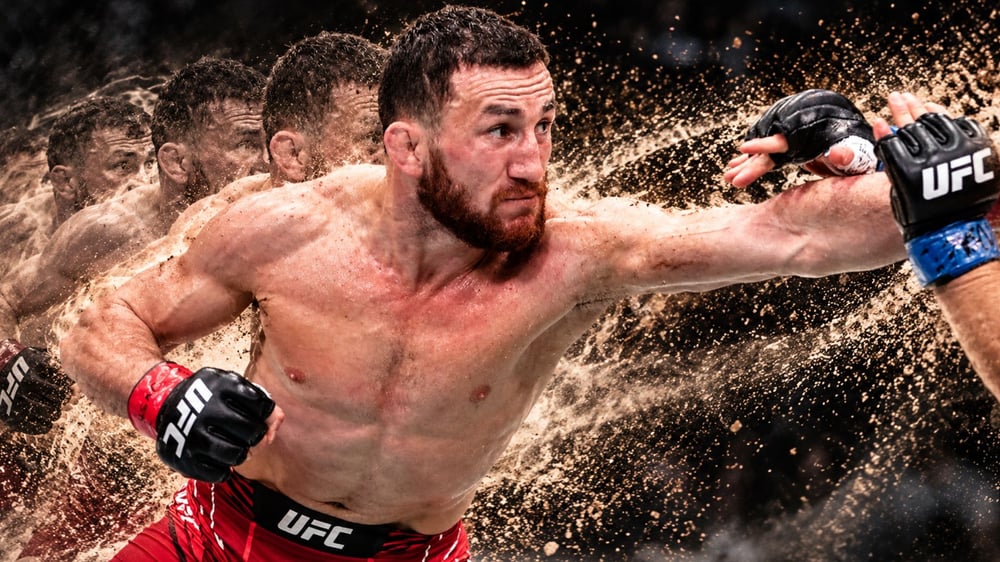
Merab Dvalishvili is famous for turning his cardio into harassment. The impressive part isn't simply that he can work hard. It's that after working hard, he appears irritatingly ready to do it all again. That ability to recover, reload and immediately become someone else's problem is where the sandpaper fighter gets interesting. Nobody has watched that engine more closely than his coach John Wood, who says the secret isn't that Merab somehow escaped the human requirement to get tired.
“The thing is that he gets tired, assuming like everyone else, but I think you know he obviously has some kind of genetic craziness going on inside,” Wood said in an interview with the Kairouz Bros. “But what I think more so than anything else is his mental fortitude. His mental cardio. His mental capacity. His will is unmatched to anything I’ve ever seen.”
Genetic craziness is hard to put on a treadmill. The cardio isn't. A new 2026 study from Peru tested 17 professional MMA fighters using an incremental treadmill test to estimate their aerobic capacity. Admittedly, this was the lower end of the MMA weight-class spectrum. Six were flyweights, five bantamweights, three featherweights, and two lightweights, with one atomweight completing the group. Their average estimated VO2max was 51.56 ml/kg/min. Eleven were classified as having excellent aerobic capacity and another four as superior. That put 15 of the 17 fighters in the top two categories most sports scientists use to judge elite athletes. Is this trait only for the lighter weight classes? Well, another study of 20 world-class UFC and Bellator fighters found the lighter athletes had better aerobic capacity than those weighing 185lb and above. Body size probably explains some of that difference, but the researchers also point out that lighter fighters tend to throw more strikes. That creates an interesting chicken-and-egg problem. Do lighter fighters throw more because they have bigger aerobic engines, or do the demands of fighting that way help build those engines? Either way, the two make very good roommates.
MAKING IT WORK
The interesting bit isn't that professional fighters are very fit. We'd probably have survived without a university paper confirming that. MMA isn't an endurance event with the violence sprinkled evenly on top. It's a series of energy-expensive little explosions followed by enough recovery to pay for the next one. The researchers point out that aerobic capacity helps support these repeated high-intensity efforts while improving recovery between demanding exchanges and rounds. Cumulative doesn't necessarily mean less explosive. A fighter may still be throwing hard combinations at full speed, but the difference is that instead of betting the fight on one enormous withdrawal, they keep finding enough in the account to go back to the ATM. At the end of the maximal treadmill test, the fighters averaged 172.35 heart beats per minute. After one minute of recovery, that had fallen to 140.52, a drop of roughly 32 beats. The researchers don't establish that as some magic MMA benchmark but measuring recovery does matter because the faster the body can start paying back the cost of one hard effort, the sooner it can afford another. That makes Merab an exaggerated example rather than proof of the theory. His great trick isn't that he never gets tired. It's that he seems able to make fatigue far more expensive for the other bloke.

BUILT FOR THE MOMENT
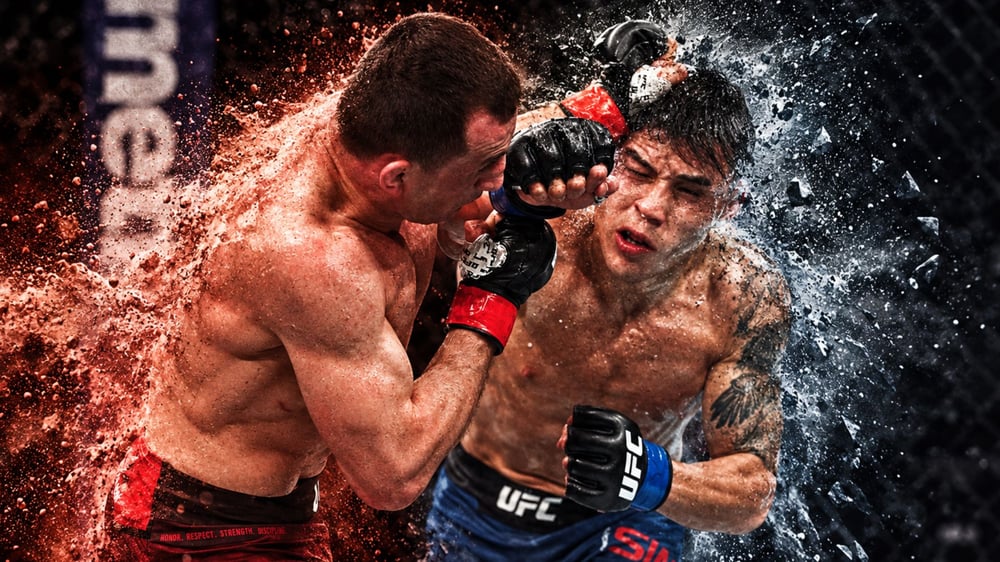
The hammer has a different problem, and there may be only milliseconds to solve it. The original UFC analysis mentioned above suggests critical striking may lean heavily on neuromuscular power and rapid force development. Strip away the sports-science wrapping, and it makes perfect sense. Being ridiculously strong is lovely. Being ridiculously strong but arriving slightly too late to your target is considerably less useful. To help understand this, another study involving 29 MMA fighters whacked a stopwatch onto the problem. They noted that explosive movements such as strikes can unfold within 50 to 200 milliseconds. That's not much of a window. Your muscles don't get the luxury of checking the calendar before deciding how much force to produce. To figure out how that upper-body explosiveness might be primed, researchers split the fighters by experience. Fourteen had trained for less than five years, while 15 professionals had more than five years behind them. The researchers had the fighters lift progressively heavier weights before testing their explosiveness with ballistic push-ups. The veterans generally produced their best rapid-force numbers after the heaviest activation, while the less experienced fighters did better with lighter loads. In simple terms, experienced fighters appeared to respond better when their nervous systems received a heavier knock on the door first. There is some fine print before everyone starts benching heavy in the changing room. The changes within the groups weren't statistically significant, and the researchers weren't measuring punches. Nobody walked into the laboratory as Alan and left as Alex Pereira. What the experiment does expose is the difference between owning strength and being able to spend it. A fighter can have a warehouse full of force, but the fight only cares how much can travel through the right movement before the target disappears. That's the hammer's real specialty. It’s not merely owning power but making an enormous amount of it available inside a very small piece of time.
KNOW YOUR WEAPON
Perhaps the lesson isn't that every fighter is either a hammer or sandpaper. MMA has never been considerate enough to make anything that tidy. Most fighters carry both. The interesting question is which one pays the bills. If you're a fighter, that means looking past the gym numbers that make for neat little Instagram captions. A monster bench isn't much use if your power turns up after the punch, and a heroic VO2max means very little if you're incredibly fit while achieving absolutely nothing. Look instead at what your game repeatedly asks your body to do. If your best work happens in sudden, violent windows, train to exploit them. If your advantage comes from making an opponent solve problem number 70 after already surviving the previous 69, your ability to recover and repeat becomes part of the weapon. Then build enough of everything else to stop somebody finding the warranty loophole. For fans, it gives you something new to watch. The knockout artist patiently waiting and recovering isn't necessarily doing nothing, while the fighter landing his 80th useful strike may be quietly ruining someone's evening, one small inconvenience at a time. And heavyweight might soon give us the perfect test case. Josh Hokit has called for Gane next, which could put two unusually cardio-friendly big men across from each other. Gane has spent years showing that a heavyweight can choose sandpaper despite owning a perfectly good hammer. Hokit brings wrestling, pace, and an engine that seems equally offended by the heavyweight tradition of having a nice sit-down. If they do meet, the interesting question may not be which man hits harder. It'll be which 250lb body can keep doing useful things for longer. Because hammer or sandpaper isn't really about choosing one weapon and throwing the other away. It's about knowing which one makes you dangerous, and having enough of the other tucked in the toolbox for when the fight refuses to cooperate.
...