

Issue 233
September 2026
Fighter’s Only catches up with Johnny Walker before his move to heavyweight, only to discover that the new research suggests getting bigger could mean giving up less.
Sometimes the fabric of this sport runs on fuzzy logic. Fight to be as big and strong as possible, then spend the weeks in the lead-up to a bout desperately starving and dehydrating yourself, then try to put Humpty Dumpty back together again. Johnny Walker is one of the UFC elites bucking this trend. Squeezing his hulking 6’6 frame into a 205 lb limit is a big ask, so the heavyweight division is next. The most immediate benefit to him is wonderfully uncomplicated. He gets to eat.
“It feels good,” he told Fighters Only about the move. “I'm training well. I don't need to cut. I don't need to lose muscle mass to do my weight division. I can eat well. I've always been eating well, healthy. But at 205, I had to cut the calories so I could drop the weight. Now I just keep eating, so I don't have the drastic cutting. The drastic lower calories so I can cut my weight, so it's just great to be able to train strong and eat enough to recover.”
That sounds like common sense, but in weight-division combat sports it is practically revolutionary. Perhaps it is driven by the lack of perceived heavyweight star power in a division that’s been put on a go-slow since Jon Jones was at the helm and holding the weight class to ransom. Walker is hardly the first fighter to move north, but his reasoning lands at an interesting time. Some rather comprehensive research published this year has questioned one of the key assumptions that has kept fighters boiling themselves down for decades: that being considerably heavier after the weigh-in necessarily provides enough competitive advantage to justify what it took to get there. Maybe bigger really is better. Maybe it’s just not in quite the way MMA thought, and Walker is a perfect case study.
THE GREAT SHRINKING CONTEST
Weight divisions exist to stop enormous people fighting considerably smaller people. Size and strength can overwhelm skill, so weight divisions level the playing field, but fighters have always responded by finding a loophole: temporarily becoming smaller. And MMA has become particularly good at it. A February 2026 study notes previous research reporting rapid weight loss in more than 90% of MMA athletes, with 57% dehydrated at official weigh-ins and 43% severely dehydrated. Previous UFC research cited by the authors found fighters losing roughly 6–8% of their body mass during the 72 hours before weighing in, while extreme cuts can reach 10–15%. A separate August 2026 scoping review highlighted MMA because the roughly 24-hour recovery window creates a particularly powerful incentive to cut. Small MMA studies have reported average losses approaching 8% below walk-around weight, with some mad dogs attempting considerably more. The logic holds up. If everybody else is turning up temporarily shrink-wrapped, refusing to do it can feel like volunteering to be the disadvantaged little bloke.
WHAT WE LOSE IN THE FIRE
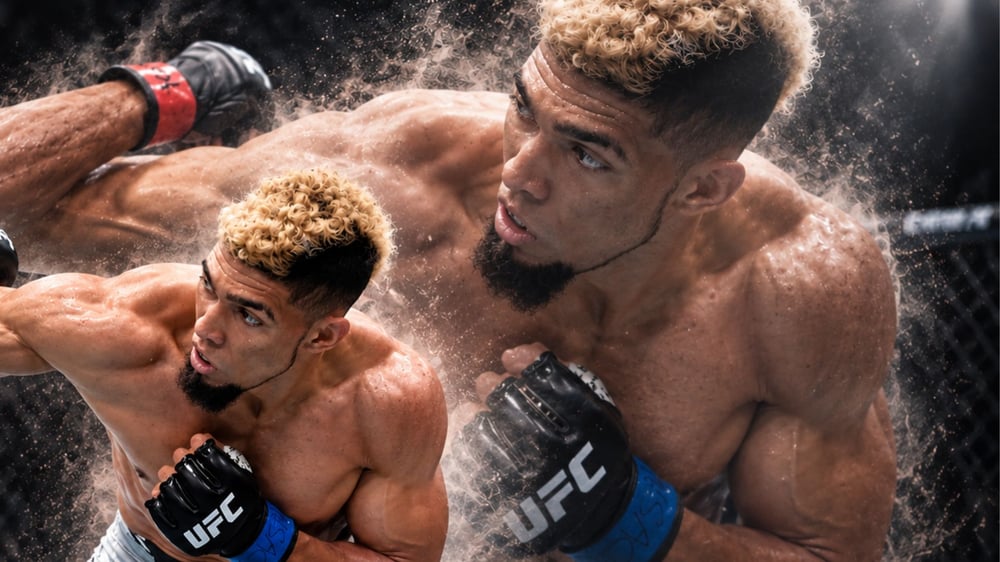
The problem is that disappearing kilograms aren't simply body fat politely leaving the premises. Fight-week losses can involve water, glycogen and its associated water, gastrointestinal contents and potentially lean muscle. The review links aggressive cutting with dehydration, electrolyte imbalance, renal stress, impaired thermoregulation, endocrine disturbance, low energy availability, sleep disruption, fatigue and mood changes. Rapid weight loss is often defined as losing 5% or more of your body mass within seven days, and a previous systematic review cited in the 2026 paper found that losses of up to 5% didn't significantly damage certain physical-performance measures after recovery. But the researchers warn against treating 5% as a magical safety line. Preserving a strength or power test doesn't mean the kidneys, hormones, hydration, or nervous system have necessarily enjoyed the experience. Producing one respectable number in a laboratory isn't the same as repeatedly wrestling, scrambling, thinking, and getting punched for 15 minutes. This makes Walker's comment about being able to “train strong and eat enough to recover” considerably more important than simply enjoying a larger breakfast. The cost of making weight isn't confined to the final miserable hours in a sauna. Severe energy restriction and glycogen depletion can interfere with training quality, recovery, mood, and sleep during the very period when a fighter should be sharpening rather than slowly turning into beef jerky. Move up in weight and that equation changes.
THE 10% QUESTION
Of course, fighters haven't been doing this for fun. The goal is to win. The February 2026 study examined California State Athletic Commission records from UFC and Bellator events held between 2018 and 2024. Researchers had official weigh-in and fight-night measurements and analyzed 154 winning professional fighters. On average, they regained 10.17% of their body mass. Among those 154 winners, weight regain didn't differ significantly by how they won. KO/TKO winners regained 10.55%, decision winners 10.18%, and submission winners 9.30%. The difference wasn't statistically significant. There is an important caveat to apply here. They only examined winners, so it cannot tell us that regaining weight doesn't help you win. Nor does any of this mean size has suddenly stopped mattering. Having a large heavyweight sit on you remains an impressively effective peer-review process. There's another wrinkle. Getting the number back on the scales doesn't necessarily mean everything inside the fighter has returned with it. A fighter can make weight, put a frightening amount of it back on and look physically restored while some of the physiological bill is still sitting on the table. Suddenly the success of the old ways becomes less obvious.
BIGGER BUT FASTER
That's the bet Walker is making.
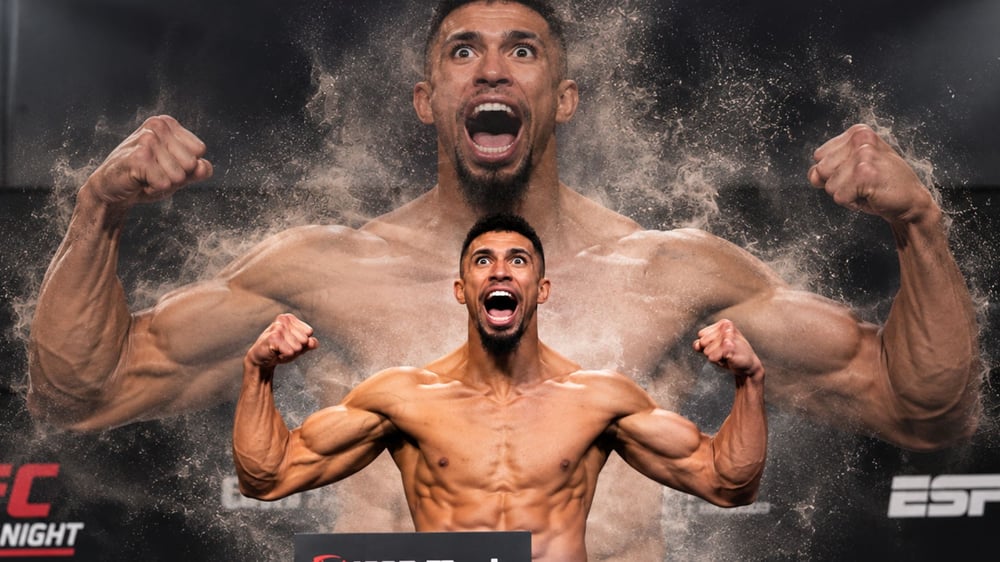
“I don't know,” said Walker, pondering the question about why he’s moving up. “I think for me it's going to fit better, because I'm more agile. I'm quicker, and I'm long enough to fight them. And I also have jiu-jitsu and wrestling, so I think the light heavyweight division, jiu-jitsu and wrestling. There's a lot of striking, so it's going to be a good move for me. I'm going to start slowly. They've got Mick Parkin number 15, so I'm going to start with him and see what's next, but big jumps, step by step, and see the division, how I fit in it, and then I'll go from there.”
That's the other side of moving up that bathroom scales don't measure. A fighter may concede mass but hang onto the fight skills that made them successful in the lower divisions. Speed, movement, reaction, reach, and cardiovascular conditioning don't appear as another five kilograms beside your name. Walker is betting he can carry enough size while bringing something larger men aren't accustomed to dealing with. And he’s found himself a fairly useful laboratory to do it.
“I'm actually with a new team,” he told us. “I'm training in the Porrada Training Center now. My main training partner is the number two heavyweight in the world, Alex Volkov. My striking coach now is Ray Sefo, and I'm training with Ronnie at the Porrada Training Centre. So, Ronnie, Marcelo, two really good grapplers. Guys that have experience with heavyweight, because Alex Volkov has been training there for a few years, so I think it's amazing.”
He doesn't exactly undersell his new surroundings.
“It's the best ever for heavyweight,” he said. “For heavyweight in Vegas, it's that gym. Number two in the world training there. There's nothing better than that.”
If you want to see whether your body can handle elite heavyweights, repeatedly putting it next to Alexander Volkov is one way.
“It's very beneficial,” Walker said. “I know the level of the division. I'm training for number two. I know what to expect of the other guys. He's a very experienced fighter. We help each other. We both help each other. It's very high-level training. If I'm training for number two, I need nothing else.”
Moving up, therefore, isn't simply removing the calorie restriction, buying bigger shorts, and discovering the dessert menu. Walker has to find out whether his existing weapons still work when his bodies he’s fighting get considerably larger.
A DIFFERENT REBUILD
Another trap is assuming a new weight class automatically produces a new fighter. Walker wasn't particularly satisfied with the old fighter who lost in his most recent outing against Dominick Reyes.
“I'm a little bit disappointed,” he said, reflecting on that bout. “Even if I win that fight. I know it was a split decision. I would not be happy because I know I could do better. I fixed those mistakes. I started training with Reyes. He helped me to engage more safely. And find my range better as well. So, I fixed the mistakes. So, I'm going to bring a different level for the next fight.”
That's important because a different number on the scales doesn't repair a fighter. Heavyweight Walker gets more food, potentially better recovery, and no need to sacrifice muscle mass just to reach 205lb. But he still needs to become a better version of Johnny Walker. Otherwise, he's simply Johnny Walker with a larger dinner. Perhaps that's why he isn't talking like a man expecting to eat his way directly into a title shot.
“I'm not in a rush,” he says. “I'm not going to move that fast. I'm going to do it step by step. Like I said, I'm going to take every fight as serious as the last important fight. And I'm going to go from there. I don't want to rush, because this is my best shot now, no? So, I'm going to take my time and move every fight. Pay attention to every fight, and focus on every fight, like I'm focused now. I don't even think about my next opponent, if I win or what happens next. When it happens, I'll be ready to answer that question, but right now, my main focus is on Mick Parkin, nothing more, nothing less.”
Parkin therefore becomes more than Walker's first heavyweight opponent. He's the first proper test of the theory.
“I believe it's a very good match-up for me,” says Walker. “He's a good guy. A good fighter that's going to welcome me to the heavyweight. He's going to show me, if I pass him, I'm ready. If I don't pass him, I'm not ready. It's just a test, and I see him as a test. I'm going to, with everything that I have, do my best every day, to pass my first test. And I'm going to start slow after that. Pass the first test. That's what I'm aiming for. Just think about the first test. He's my first test on the heavyweight.”
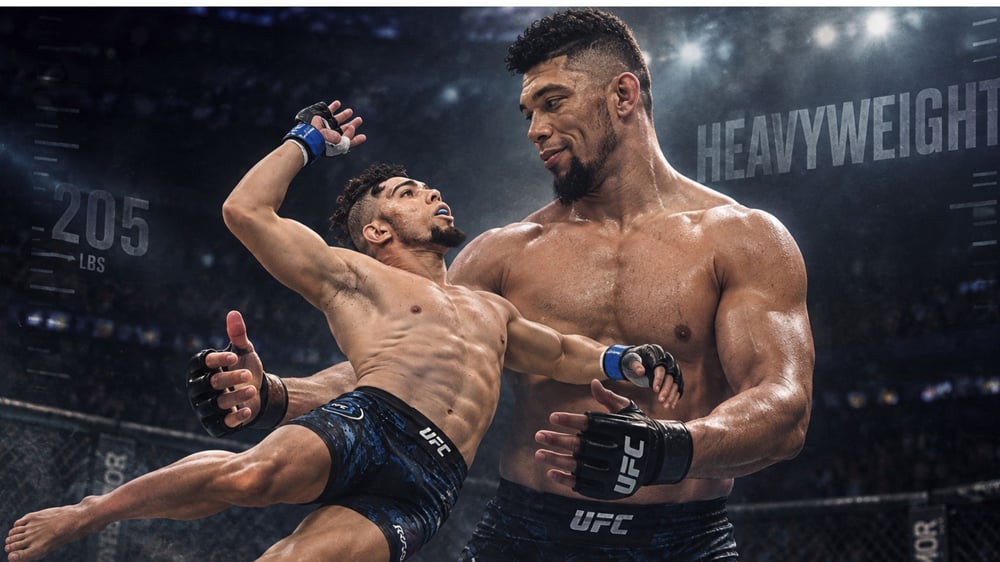
HOW QUICKLY HEAVYWEIGHT MOVES
There is a temptation here to declare weight cutting pointless. The science doesn't support that conclusion. Size matters in MMA. So do strength and leverage. Some observational research has associated greater post-weigh-in regain with winning, including an MMA dataset covering around 1,400 weigh-ins, while other studies haven't found the same relationship. But the 2026 scoping review still says that the evidence linking rapid regain with competitive success just isn’t there. The better question is whether that additional size is worth what an individual fighter has to sacrifice to obtain it. That's a different calculation for a natural 180-pounder making welterweight than for a towering light heavyweight who says he's restricting calories and losing muscle to reach 205lb. Walker knows heavyweight can move quickly, too. During the interview, he was asked about undefeated prospect Josh Hokit before the title bout was announced and sounded in absolutely no hurry to get involved.
“Hokit?” he said, smiling. “Yeah, I think it’s a good fight for me. Even for my brother. My brother wants to fight him too, so there's me and my brother in this division, and I think this probably can be the next fight for him. For me, maybe after two wins, if he's still up there, I'll face him too. Yeah, he's okay, he's funny. He starts to do his character, you know? Everybody has... This is the thing we do in this sport, you know? Every fighter has their own character, their own personality, and that's what's making them who they are, you know? I love it. Well, it varies. Everyone kind of brings their own unique vibe to things.”
That quote aged quickly. Hokit has since been booked to challenge Ciryl Gane for the UFC heavyweight championship at UFC 334 at Madison Square Garden on November 14. Hokit reached the shot after just four UFC victories. For Walker, it is a fairly spectacular demonstration of what “if he's still up there” can mean at heavyweight. By the time you've finished settling into the division, the bloke you were discussing as a possible future opponent can be fighting for the belt.
WHAT ARE YOU REALLY GIVING UP?
The lightest division you can physically reach isn't automatically the best division for you. In fact, the 2026 scoping review goes far beyond simply warning fighters about dangerous cuts. Its authors argue that if an athlete can’t stay within a manageable distance of a division without repeated distress, severe restriction, dehydration, poor training quality, or persistent fatigue, then moving to a higher weight category should be considered. That's where Walker's experiment becomes bigger than Johnny Walker. He doesn't want the move to heavyweight to take away what made people care about him in the first place.
“I want people to see me as the highlight guy, you know?” he told us. “The one that you see on Instagram, YouTube, and you want to see a flesh knockout or something spectacular, they're going to type my name to fight.”
For years, fighters have treated successful weight cutting almost as another martial art. The latest science doesn't say they were fools. Nor does it say everybody should immediately order dessert and move up a division. It says something considerably more useful: there’s a lot of physiological mucking around for an advantage that isn't nearly as straightforward as MMA culture once made it sound. For some fighters, being the bigger man on fight night may still be worth paying for. For others, the greater advantage might be turning up as the biggest, strongest, and best-recovered version of themselves instead. Walker will find out which one he is on October 4 at UFC 332. After decades spent asking how much weight fighters can lose and still perform, perhaps it's worth asking a different question. How much fighter are they losing in the process?
]
...