

Issue 233
September 2026
Fighters are trained to ignore pain. New research asks whether the real skill is knowing when to listen.
Justin Gaethje has a pain pedigree that could make a medieval torturer feel underqualified. There’s the pain he inflicts on other people. The pain of fighting. The post-fight walkaround pain. And finally, the pain of getting everything working again so he can do it again. While Arman Tsarukyan and Ilia Topuria are pushing for a crack at the title, he isn't wondering who he should fight. He's still deciding whether he should embrace all that agony again.
“I have injuries I have to take care of,” he said on the Flagrant podcast. “I haven't made a decision. But I am 37 years old. My first fight was 2008. I've had 40 fights, including my amateur fights. So, I don't know.”
Gaethje made clear what was driving the decision, which few fighters talk about.
“This has never been about money for me. It's about health.”
There has certainly been plenty of niggle to manage. Gaethje has broken his nose multiple times, had it surgically repaired and then had Max Holloway rearrange it again. More recently, the damage has followed him from fight to fight.
“Right now, I have a deep bruise in my knee. Still can't punch with my hand. We're three months removed from my last fight. I gave a lot of myself for this fight in January. In June, luckily I came out on top, but it cost me a lot, so I need to recover. I need to rest my brain because a lot of training went into those fights,” Gaethje said.
For most of us, pain is the body's unsubtle way of suggesting we stop doing something, but fighters spend their careers learning that the message is negotiable. That ability can become a competitive advantage. It can also become a problem. Because a growing body of research is beginning to show just how complicated the relationship between combat athletes, pain, and recovery really is. A systematic review published in September 2026 has pulled that evidence together, and it raises a question every fighter eventually has to answer: when pain is part of the job, how do you know which pain you should actually listen to?
PAIN IS PART OF THE JOB
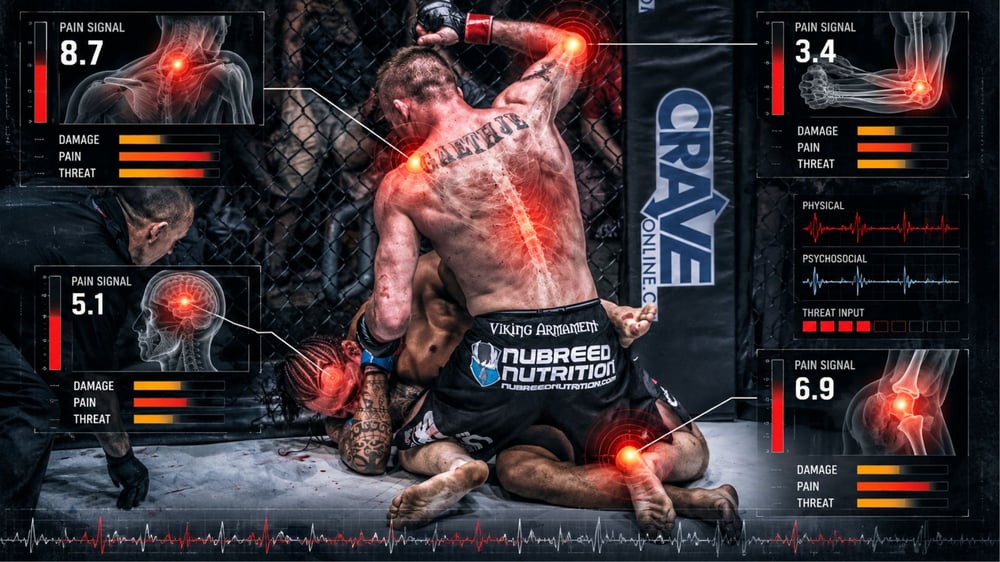
All athletes spend so much time in pain, but science has spent surprisingly little time figuring out what to do about it. A new 2026 systematic review was one of the first to examine the collective body of work on pain in mixed martial arts. It started with 1,444 records spanning more than two decades. What they tested will sound familiar to anyone who has spent time around a serious fight gym: dry needling and manual therapy, cooling and compression, topical gels and neurodynamic mobilization. Broadly, these treatments seemed able to turn down the pain volume. Researchers recorded improvements, including higher pressure-pain thresholds, better blood flow, and reduced soreness, although these were mostly short-term plugins. One MMA study dished up probably the most useful example. Twenty fighters received either dry needling or a sham treatment. The real treatment improved blood flow, reduced muscle tone and stiffness, improved elasticity, and raised pressure-pain thresholds. It even improved power, with some effects still measurable 24 hours later. That sounds like a win until you consider what is actually being measured. Making something hurt less isn't necessarily the same thing as making it healed. That distinction matters because Dr Beau Hightower, who has worked with elite fighters at Jackson Wink, told Fighters Only one of the hardest parts of his job isn't finding another treatment. It's convincing fighters to stop.
“One of the most challenging things to do is to get fighters to rest when they need to.”
That single sentence gets surprisingly close to the problem the review exposes. Pain management can help an athlete feel better and potentially perform better. But when your profession already rewards the ability to ignore discomfort, turning down the warning light is only useful if you still know what the warning light was trying to tell you.
WHEN HURT DOESN’T ALWAYS MEAN HARM
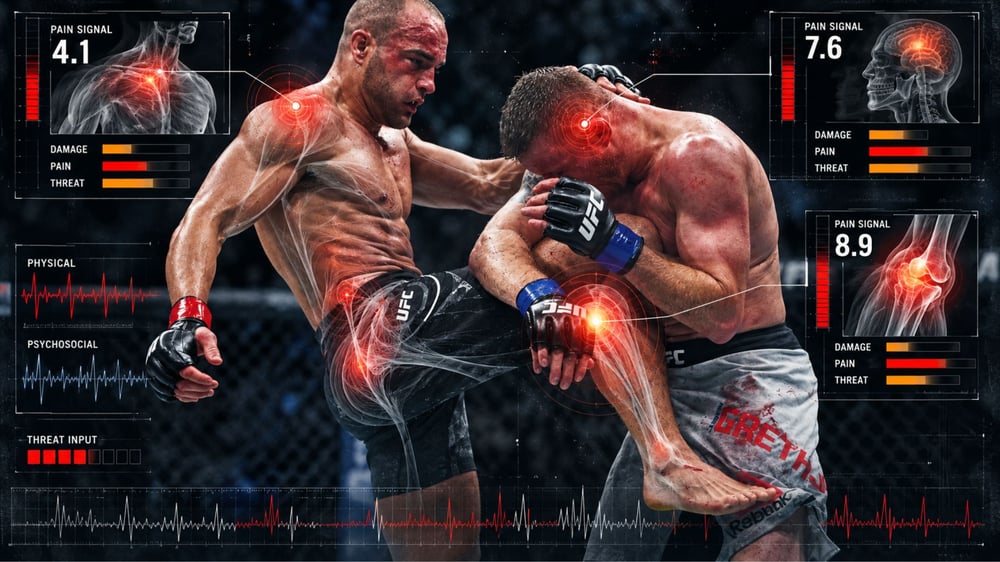
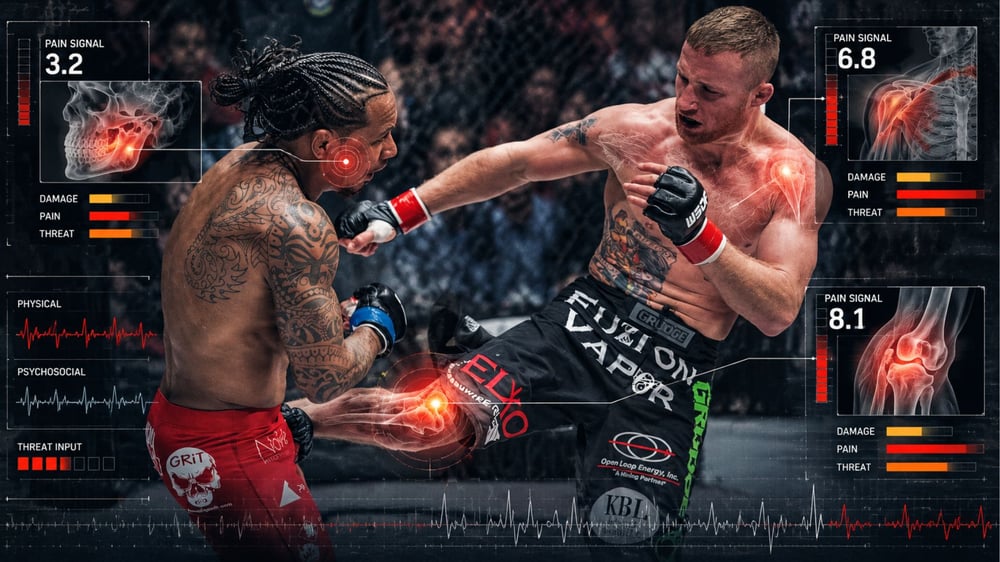
Here’s where pain gets weird. We tend to treat it like the body’s damage meter. Simple, but unfortunately not at all how your system works. Australian pain researchers David Butler and Professor Lorimer Moseley have spent decades pulling apart that assumption. Their influential book Explain Pain argues that pain is better understood as a protective response than a damage report. Pain is real, but its intensity does not necessarily tell you how much tissue damage has occurred. The nervous system weighs information about potential threat, including what is happening in the tissues, but also the context, which includes your previous experiences, beliefs, and other cues, before producing protective responses that can include pain. This means it is best not to think of it like a damage meter in a Grand Theft Auto PlayStation game, but more like an overprotective security system. Its job isn't to provide an itemized account for every damaged muscle fiber. Its job is protection. Sometimes that alarm can be deafening when tissue damage is pretty minor. At other times, significant damage can happen without pain matching it. That produces one of the strangest facts about pain: you don't actually need tissue damage to experience pain. You can also damage tissue without immediately feeling pain. In other words, hurt doesn't always equal harm, and harm doesn't always immediately hurt.
FIGHTING THE PAIN
Butler and Moseley’s work is especially interesting in fighters because getting punched isn't unexpected when you're a UFC champ. It's just a regular Wednesday afternoon. Fighters repeatedly encounter sensations that most people would immediately associate with threat, yet MMA requires them to distinguish between discomfort they can continue through and something that means they genuinely need to stop. The 2026 combat-sports review suggests that distinction isn't purely physical either. It notes that coping style, athletic identity, and emotional state can influence the experience of pain, while physiological recovery and how recovered an athlete actually feels don't always move together. That creates a particularly nasty problem in MMA. Being able to tolerate pain is useful when somebody is trying to kick your leg off. It becomes less useful when the person you're fighting is your own body. Dr Beau Hightower has seen that problem repeatedly while treating elite MMA athletes at Jackson Wink.
“One of the most challenging things to do is to get fighters to rest when they need to,” he told us. “Minor injuries often precede the early warning signs of more serious injuries. Typically, small amounts of tissue damage can lead to more significant tissue damage in the future.”
Pain, then, presents fighters with a bastard of a contradiction. It can scream when relatively little is wrong and whisper while damage mounts. Their livelihood depends on becoming very good at ignoring the first without accidentally ignoring the second.
PAIN GETS PERSONAL
The problem is that knowing pain is complicated doesn't make it any easier to work out what somebody's pain actually means. Ask two fighters to rate their battered knuckles out of ten, and you're still relying on two brains, two histories and two very different definitions of what constitutes a seven. Researchers have recently tried to get underneath that problem by collecting physiological, clinical, psychological and social data from 118 people with chronic pain and healthy controls across 4,697 experimental pain trials. The participants were given small but painful heat pulses while researchers measured brain activity and changes in skin conductivity, alongside detailed information about things such as anxiety, depression, fatigue, and how they responded psychologically to the pain. From all of this, they developed two separate measures: one representing the physiological component of pain and another capturing the mismatch between someone's reported pain and their measured physiological response, helping quantify its-all-in-the-mind contribution to the experience. The eventual goal is personalized treatment rather than treating every painful back, knee, or shoulder as though the alarm is being triggered for exactly the same reason. For MMA, that's a fascinating wrinkle. A fighter saying something hurts tells you something important, but potentially not everything you need to know about what is happening underneath. And a fighter saying something doesn't hurt much isn't necessarily a clean bill of health either. Which brings us back to the dangerous superpower fighters spend years developing: being extremely good at carrying on.
KNOW WHAT YOU’RE FIGHTING
So, after 1,444 papers, what can fighters actually take from all this? First, feeling better and being better are not necessarily the same thing. Research says dry needling, manual therapy, cooling, compression, and other treatments can reduce soreness, raise pain thresholds, and improve some short-term recovery measures. Great. Use them when you need to. Second, stop treating every ache with the same recovery lucky dip. Try all sorts of approaches and match them to what is actually causing the problem. That might mean treatment. It might mean more rest days. Third, don't let toughness become diagnostic equipment. Being able to train through something tells you that you can train through it. It doesn't tell you whether you should. Hightower has seen how that story can end.
“Minor injuries often precede the early warning signs of more serious injuries. Typically, small amounts of tissue damage can lead to more significant tissue damage in the future.” The niggle that keeps coming back deserves more respect than simply giving it another round with the massage gun. Fourth, listen to the person attached to the sore knee. Coping style, athletic identity, and emotional state can influence the experience, while physiological recovery and feeling recovered don't necessarily arrive at the finish line together. That doesn't mean pain is imaginary. It means there's a whole human being attached to that dodgy shoulder. And finally, don't train yourself to feel less pain. MMA has already done that. Train yourself to become better at reading it. Discomfort comes with getting fitter. There are aching muscles that come with learning to fight. Then there is pain that keeps returning, changes how you move, robs you of power, or comes attached to an injury that hasn't had a chance to heal. The real skill isn't becoming tougher than all of it. It's knowing the difference. Which brings us back to Justin Gaethje. For nearly 20 years, his job has rewarded him for answering pain with another leg kick. Now, at 37, with a body he says he still can't punch with, he faces a pain-management decision no ice bath can make for him. The question isn't whether he can keep fighting through pain. Of course he can. After all these years, the tougher question might be whether he finally knows when not to.
...