

Issue 233
September 2026
What happens when the fighter you spent years wanting to beat becomes the bloke helping you get better?
Alex Pereira beat Sean Strickland. And beat probably undersells it. This wasn’t a TKO. He was out cold. Somehow, they became friends and training partners. Israel Adesanya KO’d Robert Whittaker, stole his UFC title, beat him again just to make sure everyone got the message, then eventually welcomed him into City Kickboxing as if the previous five years had meant nothing. And it’s not just middleweight weirdness. Training with your ex is surprisingly common. GSP and Dan Hardy did it. Stephen Thompson and Tyron Woodley buddied up. More recently, Johnny Walker told us he’d been working with Dominick Reyes after they fought. MMA does strange things to relationships, and perhaps locking horns has a way of putting the real and manufactured beef in the rear-view mirror. Suddenly, the bastard who found the hole in your defense might even be the best person to explain why it was there. For most of us, getting punched is a perfectly reasonable reason to stop speaking to someone. In MMA, it may mark the beginning of a beautiful friendship. The interesting bit is what has to happen between the ears to make this possible.
BEEF ON THE BRAIN
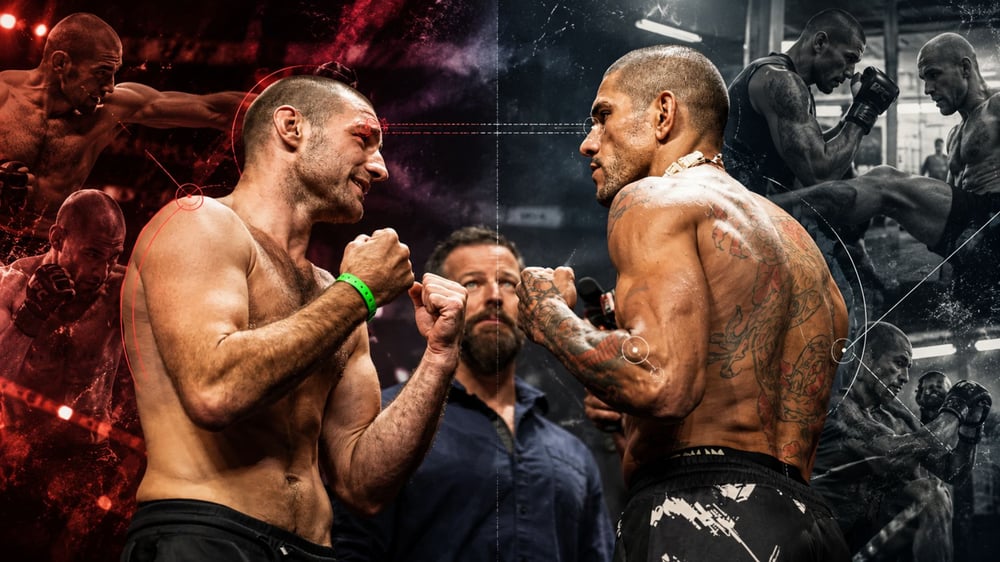
Maybe some fight beef has an expiry date. And it’s not just the MMA elite divisions. In a study of 219 martial arts and combat-sport athletes, researchers found combat-sport athletes had higher levels of hostility than traditional martial artists. But the juicier bit was buried in the discussion. Previous research suggests simply expecting to compete with someone can reduce trust and make us see more negative traits and generally assume the other dude is a bit of a dick. All of this sounds remarkably like a UFC fight announcement. Before fighting Alex Pereira, Sean Strickland mocked his elite kickboxing credentials, said his technique “f***ing sucks” and suggested Pereira only succeeded because he was a physical freak. Pereira, meanwhile, later admitted Strickland’s lunatic public persona actually made him a little nervous. Then Pereira flattened him with a left hook. And strangely, that seemed to help. The story goes that backstage, a humbled Strickland went directly to Pereira and his corner to congratulate them, praising his timing and power. Pereira got a different version of Strickland and was impressed by his respect. Glover Teixeira, Pereira’s coach, opened the door and invited Strickland to travel to Connecticut later to train with Pereira. Strickland provided relentless, high-level wrestling defense to sharpen Pereira against well-rounded contenders, while Pereira refined Strickland’s distance control and striking posture. Because Pereira moved up to light heavyweight while Strickland stayed at middleweight, their lack of divisional overlap allowed them to freely share secrets and become frequent, high-level training partners. Both went on to become champions, so the skill trade-off definitely worked, but all of that started with respect, suggests Dr. Paul McCarthy, a sports psychologist with 25 years of experience who specializes in MMA.
“Very few relationships involve experiencing another person's decision-making under maximum pressure,” he says. “In a fight, you witness things that training partners, coaches, and spectators never see. You see (and you can see it in their eyes) how someone responds when hurt, exhausted, frustrated, behind on the scorecards, or facing uncertainty. You also learn what they are afraid of and what they are willing to endure, which, in and of themselves, need to be interpreted sensibly. That creates a form of respect that is difficult to develop elsewhere. It is not necessarily friendship, but it is often a deeper understanding than outsiders appreciate.”
KEEP YOUR ENEMIES CLOSER
There’s actually a name for this odd-couple arrangement: coopetition. It sounds like something dreamed up at a corporate retreat where everyone gets a lanyard, but the idea is solid. A British Journal of Sports Medicine editorial describes how competitors can cooperate because they possess knowledge and resources that can make both sides better, even while remaining rivals. Pereira and Strickland found the perfect loophole. Pereira moved to light heavyweight while Strickland remained at middleweight, lowering the chances that all those shared tricks would one day come back to haunt them. More recently, Johnny Walker and Dominick Reyes now have something similar. They fought at light heavyweight, Reyes won, and Walker recently told us they’ve since trained together as he makes his move to heavyweight. Yesterday’s opponent becomes today’s extremely well-qualified consultant. Robert Whittaker and Israel Adesanya make it even more interesting because they don’t have quite the same insurance policy. After two UFC title fights and years as middleweight rivals, Whittaker eventually walked into City Kickboxing and trained alongside Adesanya. That requires a different level of trust.
“This can be one of the healthiest responses to defeat,” suggests McCarthy. “Initially, defeat threatens identity. A fighter may think: ‘If I learn from them, am I admitting they are better than me?’ That is an ego (a sense of self – who am I?) question. Over time, psychologically mature athletes often arrive at a different question: ‘What can this person teach me?’ At that point, the opponent stops being evidence of failure and becomes a source of information. And that is what we encourage all fighters to search for in their experiences. This shift can help process defeat because the loss gains meaning. Instead of replaying the outcome repeatedly, the fighter extracts lessons and retains a sense of agency (I believe/feel I can address this issue) and direction (I know what to do to address it, working with my coach). In many ways, learning from a former opponent is an act of psychological flexibility. It prioritizes development over ego protection.”
PUNCHING MAKES IT PERSONAL
MMA might be unusually well designed for turning hate into friendship. A March 2026 paper on the neurobiology of martial arts proposes that the unusual physical interaction involved in fighting may help develop something called embodied empathy. When fighters grapple, clinch, and exchange techniques, they’re constantly reading each other through touch. The paper even describes prolonged grappling contact as an ‘embodied conversation.’ There may even be some chemistry involved because high-intensity jiu-jitsu sparring increased oxytocin immediately afterward, with grappling producing a bigger increase than striking. Oxytocin is a neurochemical produced by the brain that’s involved in social bonding and trust. Adding to this, fighters may have another useful psychological quirk. A 2025 study comparing combat and team-sport athletes found the combat athletes had a much stronger internal locus of control. In plain English, they were more likely to believe what happened was down to their own decisions, actions, and effort, rather than coaches, teammates, luck, or outside circumstances. Okay, so they weren’t exactly studying defeated MMA fighters becoming training partners, but the finding offers an interesting possibility. If you’re wired to look inward after something goes wrong, losing to another fighter presents you with a walking, talking source of information about exactly what went wrong. Who better to help identify the hole than the opponent who just climbed through it?
“Before a fight, an opponent often exists partly in the imagination,” says McCarthy. “A fighter creates a mental representation (called a schema) based on highlight reels, media narratives, gym rumors, and promotional content. The person can become larger than life, more threatening, more confident, or more hostile than they are. The fight punctures that image. Once you've shared a cage or ring, uncertainty is replaced by experience (which can be an advantage or disadvantage depending on how the fighter interprets what happened). You no longer wonder what they are like. You know. You've felt their timing, pace, pressure, and reactions. That concrete experience often reduces fear and hostility. The opponent becomes a human being rather than a symbol. And this is often what you see, at least in my experience watching boxing, when the fight ends. There is a mutual understanding and respect for one’s opponent.”
GSP and Dan Hardy make the theory rather fun. Hardy spent 25 minutes being wrestled and very nearly submitted by St-Pierre at UFC 111. Years later, he went to Montreal to train with the same man. By then, GSP wasn’t merely somebody Hardy knew. He was somebody Hardy had felt working from inches away for five rounds. That might be one of MMA’s peculiar advantages. Fighters don’t experience rivals from the opposite end of a pitch. They feel them breathe, tire, adjust, struggle, and keep going. Sometimes getting to know someone the hard way means you actually get to know them.
THE OLD GYM CODE IS CRACKING
There was a time when inviting a former opponent into your gym would have gone down roughly as well as inviting him into your bedroom to critique your technique.
“Perhaps the most interesting question is not whether enemies can become training partners,” explains McCarthy. “It is whether a fighter can transform a person who once represented threat into a person who now represents growth. Safety and growth represent alternatives for everyone in the world. And while we encourage growth, we need to acknowledge the where, when, and how of growth for the person. The fighters who manage that transition often demonstrate a hallmark of psychological maturity: they no longer need the opponent to remain the villain. They are secure enough in their sense of self to acknowledge both the defeat and the value of the person who caused it (on that occasion. In that sense, the former opponent becomes more than a rival. They become part of the fighter's development story.”
Gyms used to be tribes where techniques were guarded. That made more sense when information was genuinely hard to get. Early fighters couldn’t pull a phone from their pocket and watch every fight an opponent had ever had. Today, almost everybody’s game leaves digital fingerprints. Fight libraries and breakdown channels have made keeping the secret sauce secret considerably harder. Half the recipe is already online, and some bloke with 37 subscribers has probably made a 24-minute video explaining it. There’s enough footage to show Alex Pereira that Sean Strickland walks forward. What Pereira can’t download is what that pressure actually feels like. The same applies when Robert Whittaker walks into City Kickboxing or Johnny Walker trains with Dominick Reyes. That may be where MMA’s old gym code is changing. The secret used to be what you knew. Increasingly, the advantage is how well you can use it. It also makes the former enemy strangely valuable. He may know your game better than some of your team do, largely because they haven’t spent eight weeks plotting your professional destruction. None of this means MMA gyms are suddenly communes where everybody shares protein powder, teddy bears, and feelings. However, the information economy around fighting has changed. Perhaps that makes yesterday’s enemy slightly less dangerous as tomorrow’s training partner. He already knows plenty about you. The clever bit might be finding out what he knows.
...