


issue 219
July 2025
Ray Klerck exposes why your CNS could be the silent factor your punches feel like pillows by round three.
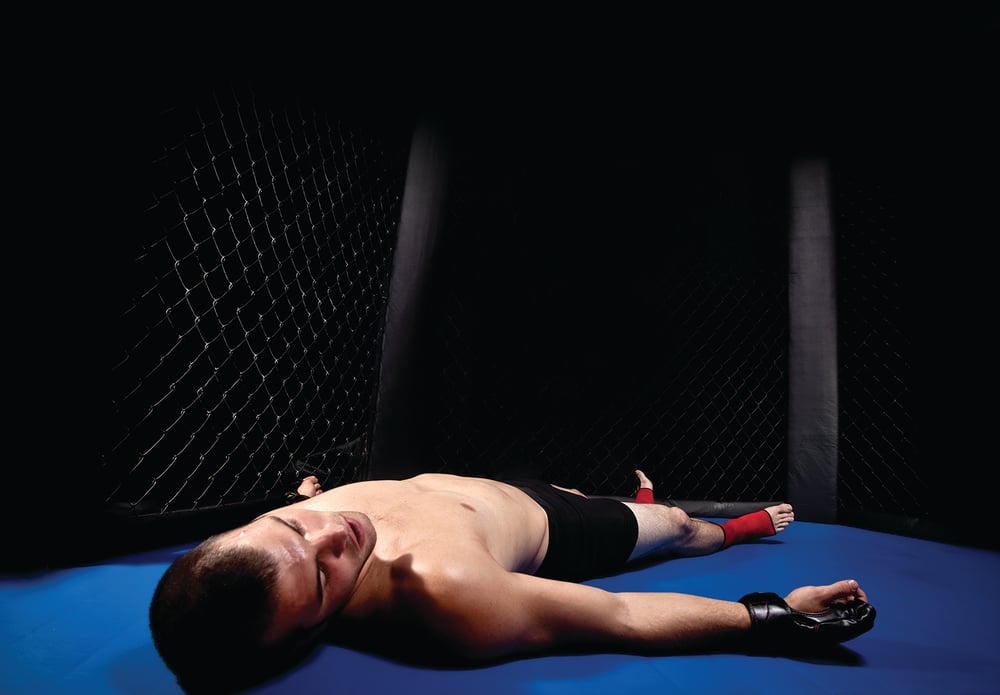
Maybe you’re not gassing out because you’re weak-minded and undertrained. You’re probably fatigued because your brain’s had enough and pulled the plug. Research has dealt a body blow to the idea that soreness causes fatigue. A study in the Journal of Strength and Conditioning Research revealed that MMA training is as tough on your muscles as it is on your nervous system. If not tougher. It creates a state called central fatigue, where your brain slowly stops trusting the demands placed on your body and creates a neurological stop order, even if you feel fresh. This central fatigue is the point where your brain stops trusting your body and quietly dials down your output. For you, this means you think you’re at full power, but you're swinging at 70% and wondering why nothing lands. This isn’t guesswork. It’s neurology. Fortunately, learning how to tap into it will help you train longer and recover faster, allowing you to fight better or lose a little extra fat.
THE STUDY THAT CHANGED THE GAME
The study design wasn’t perfect in design, but it offered some intriguing insights. The lab coats had nine active MMA fighters, with at least one amateur or professional fight experience, go through a 3-round simulation that mimicked a real fight. This structure involved pad work, heavy bag smashes, groundwork, and active rest. After each round, muscle power (MVF), neural drive (VA), and muscle twitch response (Ptw) were measured. The results? All three of these performance markers took a massive hit, but the biggest finding was that even when the muscles started to recover, the nervous system couldn’t. Peak fatigue hit five minutes after the last round, which was odd considering that was long after the final bell. This means that the brain may continue to reduce the ability to throw hands long after the fight ends, validating the five-round championship structure. Most strikingly, these fighters’ muscle power was linked to voluntary activation, a measure of how well the brain communicates with the muscles, rather than their actual strength. That’s the central fatigue concept in full effect. Weirdly, it’s probably invisible to anyone not measuring it. Including you.
CENTRAL FATIGUE IS A PERFORMANCE KILLER
Let’s peel back the mechanics of exhaustion. Peripheral fatigue is a condition that affects your muscles. It’s the kind of tired you feel when you’ve lost the pop to your sprawl. It’s usually because your energy is low or you have a buildup of byproducts, such as lactate. It’s the type of stuff David Goggins tells you to ignore and “stay hard.” Conversely, central fatigue establishes itself in your nervous system, creating a top-down output cap. So, while your muscles are physically able to do another rep, your mind dials down intensity because it’s worried that you’ll fry the circuit. Your prefrontal cortex, spinal cord, and motor neuron pathways begin to malfunction due to stress, effort, and the cumulative strain of combat. Your central nervous system begs you to stop. It’s not doing this to make you look like a mat filler. Instead, the study suggests that this mental override prevents catastrophic damage. However, it also means you might be underperforming when it matters most. And unlike muscle fatigue, which is something you can feel, central fatigue creeps up on you like a silent fart in a car. You’ll scarcely notice it until your speed drops, your jab loses sting, or your coach asks why you’re hesitating. It’s all because your nervous system is whispering, “Not today, champ.”
TRAIN YOUR BRAIN SMARTER
Here’s the good news: you can train your nervous system to resist this internal sabotage in ways that doesn’t involve brain electrodes. It starts by understanding that explosive intent and precision always beat volume. Try using the following strategies in your weekly routine.
Try post-training neural reboots. Add 2 - 3 sets of low-load, high-velocity movements, like jump squats, med ball throws, or explosive push-ups, at the end of your training sessions. Research suggests that this may help jumpstart your brain-muscle connection without adding load, allowing you to exercise for longer even when tired.
Do contrast therapy after training. Hot-cold immersion isn’t just recovery voodoo that floods your social media feed with people bragging about how hard they are. It can help you improve your muscle function and reduce soreness, allowing you to recover more effectively. It may also enhance your parasympathetic activity, which can help reset your nervous system after intense training, such as sparring. Just don’t dive into frozen lakes headfirst like Merab.
Prioritize Olympic lifts. Cleans, snatches, and jerks are the boss-hogs of weight lifting because they demand max intent, timing, and total-body coordination. Research shows that this is what makes them so good at training your central nervous system because they’re so challenging to master, and this stops you from feeling that central fatigue when you’re in the final minutes of the third round.
Use more isometric exercises. You already use a lot of this when you’re in a clinch or grappling. However, researchsuggests that if you do it with weights, you’re conditioning your nervous system to be tougher. When you hold a lift (like a squat or deadlift) at a tough sticking point for time, your brain learns to fire more muscle fibers and keep them switched on longer. It’s like teaching your body to remain powerful under pressure, even when everything is burning.

MONITOR THE SIGNALS THAT MATTER
Most fighters who want to improve will track their weight. However, very few track their readiness. To do this, you may want to use tools like Heart Rate Variability (HRV) and Rate of Perceived Exertion (RPE). HRV monitors the balance between your sympathetic (fight-or-flight) and parasympathetic (rest-and-digest) nervous systems. A lower HRV can mean fried CNS. A higher HRV can mean you’re ready to roll. It’s not perfect, but it beats winging it. Use a wearable device like an Apple Watch, Whoop, or Oura, or take your pulse when you wake for roughly a week to find your baseline, which you can then contrast against your highest heart rate. RPE is even easier. Ask yourself: How cooked am I? If the answer is “Very” but the weight feels light, your nervous system is still trashed. Adjust. That might mean fewer rounds, more recovery, or shifting to skill work. Overreaching helps no one if the lights are on but the neurons are not firing.
POWER ISN’T ALWAYS STRENGTH
There’s a reason the biggest guy in a Planet Fitness gym doesn’t have lightning-fast hands. Strength is just raw muscle. Power, on the other hand, is speed with force, and that comes from your nervous system. Muscle size without sharp neural firing won't win exchanges. To stay powerful late in a fight, you need drills that keep your brain switched on and reactive. To train for this, you can also try contrast sets, such as a heavy squat followed by a jump squat, or pad work at low intensity followed by an all-out sprint. These sharpen your CNS and reinforce the brain-muscle connection. Power is usually the first thing to fade. It's the early warning sign that you're heading into the red. Train for it or lose it when the crowd is watching.
RETHINKING RECOVERY
MMA is about timing your output, so it lands hardest in round three. That means understanding how neuromuscular fatigue works and how to fight back. Peripheral fatigue? You can feel it. Central fatigue? You have to anticipate it. This study shows that it doesn’t always appear when you expect it. Sometimes, your biggest performance dip hits after the work is done. Smart training is a balancing act where you know when to push and when to pull back. Master it in training using the advice above, and you’ll be a master of your brain when you’re in a fight.