


Issue 227
March 2026
Former fighter and psychologist Jakob Sverre Lovstad explains why the brutal honesty of an MMA gym might be the leadership course every modern CEO actually needs.
Modern corporate life is loaded with plenty of fake saccharine enthusiasm, where you have to censor yourself to comfort other people’s ignorance, then talk in bumper stickers to be PC. It’s the kind of environment that could learn a lot from MMA. No surprises that CEO’s the world over have turned to the dojo to gain these secrets, but what about an MMA fighter who punches up into the corporate world? Enter Jakob Sverre Lovstad, the ‘Striking Viking,’ who is a former pro MMA fighter turned software engineer with a master’s in clinical psychology. He argues that while society has drifted into a weird, polarized world that’s become removed from physical reality, the MMA gym remains a rare bastion of honest meritocracy. In the boardroom, you can treat someone with no respect and face zero consequences, but on the mat, it’s a different story.
“If you don’t behave well and don’t understand the unwritten rules of the gym, you’ll end up with a broken nose or a torn knee," says Lovstad.
He suggests that what works automatically in gyms, especially when they are integrating Russians, Chechens, police officers, and criminals into one cohesive session, is a massive hassle for private businesses. Perhaps it’s time for CEOs to momentarily trade the necktie for a mouthguard once a week, and everyone will benefit, including the company’s bottom line.
THE SHARED ADVERSITY ADVANTAGE
In a modern office, team building may involve a stale margarita pizza that’s scoffed in front of a PowerPoint so boring it makes you want to unzip your human suit and run your skeleton into the woods. MMA takes a different approach to team building, creating a group identity through a shared sense of suffering. A paper in the journal Science, aptly titled "The Social Glue of Pain," found that sharing painful or high-stress experiences increases trust and cooperation more effectively than many other team-building activities. Researchers found that groups subjected to physical discomfort exhibited significantly higher levels of bonding and prosocial behavior than those in vanilla office-style environments. Okay, so it sounds sadistic, but that’s the kind of accelerated bonds MMA brings to the table very quickly.
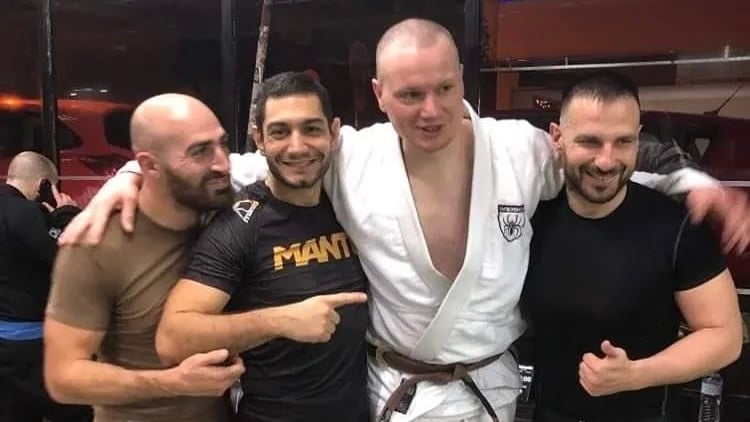
"Respect in MMA has nothing to do with your political standpoint, your religion, your ADHD, your ethnicity, or any of the other stuff that is often thrown around on social media," says Lovstad. “The old school rules humans were meant for still apply, forcing a bond because your skill level is your currency. You quickly learn that if you can sink a good armbar, hit a sharp double, or throw a good combination, then you’ll get that approving smile and fist bump from your sparring partner. In a world where people can get famous and wealthy without any real skill, the mat offers a necessary return to a physical reality where you must cooperate and talk to people with respect, so you do not bitch about every single thing."
WARMTH AND THE NO ASS** RULE
The corporate world is often run by Boss-Level Karens who thrive on politics rather than performance, and their bad behavior is seldom called out, especially if it’s married to rising profits. Conversely, MMA acts like a steel fist in a velvet glove, where you must be skilled to be accepted, but even if you’re the best in your gym, you cannot be a chump to your teammates. Research suggests that humans judge others primarily on warmth (intentions) and competence (capability). These are the things that create a team that succeeds, and in a dojo, they are both celebrated and audited in real-time.
"Immediate and clear consequences to antisocial behavior are generally the norm at most gyms," Lovstad notes. “What works pretty much automatically in MMA gyms is a struggle for corporate organizations because crappy behavior doesn’t get chin checked. At times, I feel inclined to just hand out gloves and shin guards at board meetings to see if we can just solve the issues that way.”
Since the HR manual and the penal code generally frown upon a double-leg takedown on colleagues, the practical move is to stop rewarding the politics and start valuing visible competence. The goal isn't to turn the office into a fight but to create an environment where people are respected for what they can actually do, rather than who they can successfully gaslight into a corner.
SKIN IN THE GAME FEEDBACK LOOP
Upper management can inhabit the David Brent cringe economy where their mistakes are felt by shareholders and underlings, not themselves. There is, however, a better way because Nassim Taleb’s research, titled Skin in the Game, suggests that systems only function when the decision-maker shares the risk everyone in the organization faces. Cooperation flourishes when members are willing to punish free-riders, even at potentially great personal cost. In MMA, that crucial feedback loop is instantaneous because there is no corporate whitewashing when someone is trying to punch your lights out. Lovstad argues that society has something to learn from fighters in this respect.
“This makes sense psychologically according to the so-called ‘Stereotype Content Model’ where MMA is a sport with two important factors at play if a fighter hopes to be taken in by the team,” he says. “First on the list is that you can’t be an a**hole to your teammates. You have to either be skilled or be willing to work hard to become skilled (preferably both). If you don’t behave well and don’t understand the unwritten rules of the gym, you’ll end up with a broken nose or a torn knee.”
While HR departments use a Venn diagram to force integration, the MMA gym uses a sweating-like-a-dog-in-a-Vietnamese-restaurant training intensity to ensure everyone follows the unwritten rules. As the Viking says, "You quickly learn to cooperate, talk to people with respect regardless of who they are, work hard, and learn not to complain about every single thing."
THE HONEST MERITOCRACY
Comparing MMA training to the corporate environment is about reclaiming a sense of physical reality about who we’d prefer to work with. When people's own success or financial reward depended on a teammate's performance, 77%–83% of participants chose the competent jerk (high competence, low warmth) over the lovable fool (high warmth, low competence). If you’re building a soccer team, you don’t care if the striker is nice. You just want him to kick goals. The same goes for the surgeon doing your back surgery or the CEO in charge of the company you work for.
"What I find interesting is that what works pretty much automatically in MMA gyms seems to be so much of a hassle when working with both private businesses and public organizations," Lovstad observes. “By valuing visible competence over fake enthusiasm, leaders can ensure their quality of outcomes is predicated on the quality of their thoughts. And it’s a pretty good deal as far as becoming a decent person goes.”
LEADERSHIP THE MMA WAY
It’s not that CEOs should start throwing elbows in quarterly reviews, but that the MMA gym exposes something the modern workplace so often hides: reality. In a gym, respect is earned through effort, humility, and competence, not group emails. When people share hardship, test their limits, and face immediate consequences for poor behavior, cooperation becomes natural rather than forced. If more leaders experienced that kind of honest feedback loop even once a week, they might return to the office with rare leadership skills. It grants perspective, a little humility, and a clearer understanding that teams work best when respect is earned the old-fashioned way.