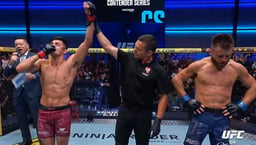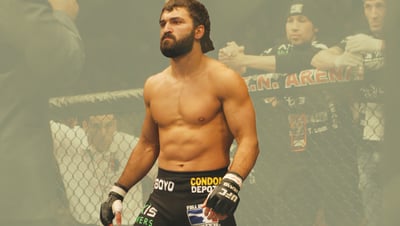

Roman Gabriel Puga is still bruised, battered and healing from one of the wildest fights of the 2026 season, but the newly signed UFC featherweight already has his sights set on his Octagon debut.
Puga (6-1) earned his UFC contract Tuesday night on Dana White’s Contender Series after going three furious rounds with Taner Trembley (7-1). The bout was an all-action affair from the opening bell, with both men absorbing heavy punishment before Puga ultimately had his hand raised.
Even days later, Puga has already watched the fight three times.
“The first time I watched it as a fan,” Puga told Fighters Only. “The second time I criticized myself, and the third time I was aware of what needs to be polished up.”
His conclusion was clear: he believes he won all three rounds, while readily acknowledging that his opponent had his moments and that there are areas of his own performance that need improvement.
Most importantly, Puga was thrilled with the spectacle they produced.
“I’m so happy I was able to put on that kind of performance for Dana White’s Contender Series and everyone in attendance and everyone, all the fans at home who watched it as well.”
The fight was so memorable that comparisons to the legendary Forrest Griffin-Stephan Bonnar war from The Ultimate Fighter have already begun to circulate. For Puga, being mentioned alongside one of MMA’s most iconic fights is an honor, particularly because Trembley is now a fellow UFC fighter.
The two men were taken to the hospital after the bout, meaning they did not immediately get to experience the news that both had earned contracts. Puga was lying on a hospital gurney when his coach, Chad, streamed the Contender Series broadcast on his phone.
That was when the news came through.
“I knew immediately after the fight when I got my hand raised, like, ‘Okay, I got the contract,’” Puga said. “And I had a feeling, too, that Dana was also going to give Taner his contract. So, yeah, it was perfect.”
The two fighters were treated in the same hospital, and Puga’s cornermen eventually heard Trembley’s team celebrating from elsewhere in the building.
Puga then went to find his opponent.
“I walked over there to congratulate Taner as well and thank him for sharing the Octagon with me,” he said. “A piece of Dana White Contender Series history that we’re both going to take with us on our journey and in our life.”
Puga believes their fight could ultimately be remembered as one of the defining contests of the year.
“We’re always going to be talked upon as one of the best fights, fight of the year potentially, 2026,” he said. “So we’re even being compared to Forrest Griffin and Stephan Bonnar when they had their war. That’s an absolute honor as well. We made history together.”
A fighter built around his hands
Puga’s performance showcased exactly why his boxing has become such a major part of his MMA game.
He constantly pressed forward, worked behind an excellent jab and repeatedly found a home for his punches. But the 145-pound prospect also demonstrated something equally important: an ability to absorb serious punishment and keep coming.
Trembley landed several clean uppercuts, and Puga admitted that some of them caught him by surprise.
“They landed pretty flush,” he said. “They kind of surprised me. I was like, ‘Man, did this guy just hit me with a little uppercut right now?’”
Rather than backing away, however, Puga used the shots as motivation.
“I just kept going forward. It made me more like, ‘All right, I got to get him back. I can’t back down.’”
The boxing foundation behind that mentality stretches back more than a decade.
Puga began boxing around the age of 10 or 11, although he admits he did not immediately fall in love with it. He moved into Brazilian jiu-jitsu and grappling around 13 or 14 before returning to boxing more seriously at 18 or 19.
Since then, he has competed extensively as an amateur and amassed five professional boxing bouts, going 4-0 with one draw.
Boxing, he says, is simply part of who he is.
“My last name, Puga, is the root word for pugilist, which is professional boxer,” he said. “So I found boxing in my life. It was cool. It just happened like that, man.”
He has not closed the door on boxing now that he is under contract with the UFC, either.
With the UFC now involved in boxing, Puga sees possibilities for the future.
“Anything is possible in the fight game,” he said. “If the opportunity presents itself, I will be ready for that.”
Carrying Joe Camacho’s legacy
Behind Puga’s journey to the UFC is a more personal story.
During the Contender Series broadcast, Puga spoke about Joe Camacho, his first Brazilian jiu-jitsu and MMA coach. Camacho was one of the early pioneers of the Southern California MMA scene, fought for King of the Cage and became a champion with the promotion.
Puga began training with him in 2010 at just 13 years old.
Camacho became more than a coach. Coming from what Puga described as a difficult upbringing and neighborhood, he provided mentorship both inside and outside the gym.
“He directed me not just in the sport but also giving me life advice,” Puga said. “I was fortunate to have had a mentor like that in my life, both in martial arts and in life.”
Camacho ultimately passed away after suffering a heart attack.
By that point, Puga had already told his coach that he wanted to become a professional fighter after graduating high school. But Camacho would not be there to see that dream become reality.
For a period, Puga stepped away from training and fell out of shape. Eventually, however, he returned.
“I was like, ‘Man, I can’t give up,’” Puga recalled. “If I give up, then the dream dies with him.”
That motivation has remained with him throughout his career.
Now, Camacho’s name has been carried onto one of MMA’s biggest development platforms, with Puga publicly honoring the man who helped establish his path in the sport.
And after his Contender Series performance, Puga has finally reached the destination he envisioned as a teenager.
“It’s finally becoming a reality”
The UFC contract has not yet fully sunk in.
Puga knows he needs some time to recover from the punishment he absorbed against Trembley. He was advised to take roughly a month and a half to two months away from competition, although he plans to assess his recovery before deciding exactly when he will return.
His ambition, however, is already clear.
“I’m still looking to get another fight, hopefully with the UFC by the end of this year,” Puga said. “Hopefully one more before this year ends. I want to be able to step inside the UFC Octagon and get a fight.”
At featherweight, Puga says he is not particularly interested in calling out names or studying potential opponents.
He has been busy balancing fighting with work and other aspects of life, and admits he has not closely followed the UFC roster.
That will not stop him from accepting whatever challenge comes next.
“I’m another hungry fighter in the 145-pound division,” he said. “I’m coming.”
For now, Puga is still processing the moment he has spent years chasing.
“It feels like it’s finally becoming a reality because I saw it in my mind, but now it’s starting to play itself in the physical form,” he said.
“It’s amazing for me to see what I saw in my mind, my vision, to become a reality.”
After one of the most memorable fights in recent Contender Series history, the next chapter is waiting.
Roman Gabriel Puga is officially a UFC fighter — and if his Octagon debut looks anything like his Contender Series arrival, the featherweight division has just acquired a very entertaining new problem